




The central role of CRBN ligands in targeted protein degradation and their ligand screening technologies
Author: Senior Product Manager of UA Views:41 


Human CRBN Ligand Screening Assay Kit
- Recent Advances
- Product Information
Recent Advances
The Central Role of CRBN Ligands in Targeted Protein Degradation and Ligand Screening Technologies
Overview
This article focuses on the central role of CRBN as an E3 ubiquitin ligase ligand in the field of targeted protein degradation, systematically elucidating the mechanistic differences between PROTACs and molecular glues, and analyzing the advantages of CRBN-based degraders in clinical development as well as the limitations of existing ligands.
This article focuses on the central role of CRBN as an E3 ubiquitin ligase ligand in the field of targeted protein degradation, systematically elucidating the mechanistic differences between PROTACs and molecular glues, and analyzing the advantages of CRBN-based degraders in clinical development as well as the limitations of existing ligands.
I. The Central Role of CRBN Ligands in Targeted Protein Degradation
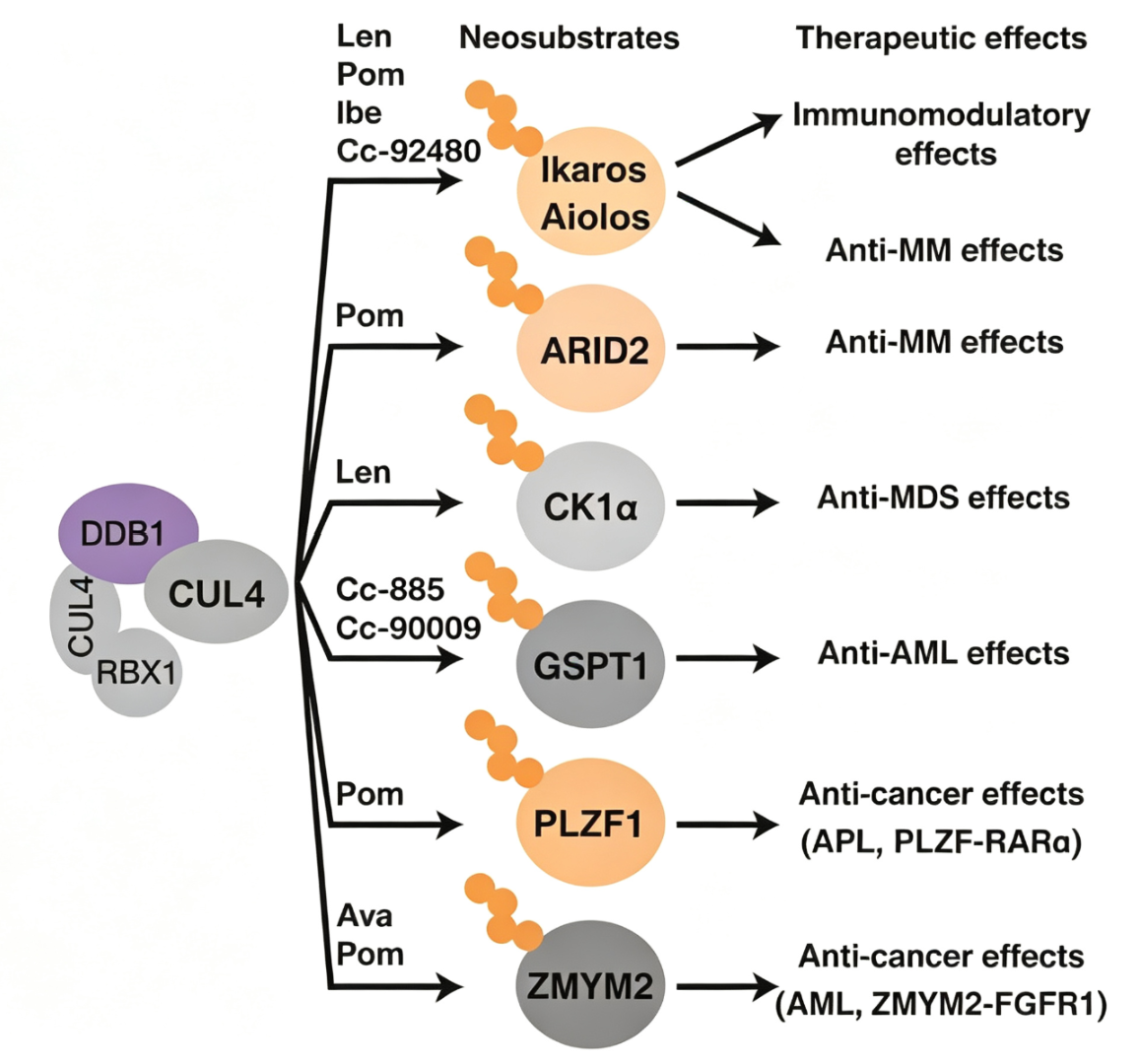
Targeted protein degradation (TPD) is a rapidly developing drug discovery strategy that utilizes the intracellular ubiquitin-proteasome system to degrade disease-related proteins, providing new intervention approaches for traditionally "undruggable" targets. In 2010, Ito et al. first identified CRBN as the direct target of immunomodulatory drugs (IMiDs). As the substrate recognition subunit of the CRL4CRBN E3 ubiquitin ligase complex, CRBN plays an irreplaceable role in the design of PROTACs and molecular glues.
Although PROTACs and molecular glues both belong to degraders, their mechanisms of action differ. PROTACs are heterobifunctional molecules consisting of a target protein ligand, an E3 ligase ligand, and a linker, which simultaneously bind the target protein and E3 ligase to induce ternary complex formation. Molecular glues are monovalent and enhance interactions between two proteins to induce degradation. Currently, CRBN-based designs account for over half of reported PROTACs and more than 90% of disclosed clinical-stage degraders.
II. Clinical Advantages of CRBN-Based PROTACs
The most commonly used E3 ligases for PROTACs are VHL and CRBN. Compared to VHL-based PROTACs, CRBN-based PROTACs occupy a more favorable chemical space for oral absorption, with molecular weights potentially reduced below 700, improved drug-like lipophilicity, and reduced hydrogen bond donors. This advantage has enabled several CRBN-based PROTACs to enter clinical studies, including the most notable compounds ARV-110 and ARV-471 (Vepdegestrant), with ARV-471 receiving FDA approval as the first globally approved PROTAC drug.
III. Limitations of Existing CRBN Ligands
Current CRBN ligands used in PROTACs and molecular glues remain primarily immunomodulatory inhibitors such as thalidomide, lenalidomide, and pomalidomide. However, these compounds exhibit significant drawbacks: some ligands carry teratogenic risks due to off-target degradation of neo-substrates like SALL4; IMiD scaffolds (including phthalimide and isoindolinone) often display hydrolysis sensitivity, leading to suboptimal pharmacokinetic properties. Therefore, developing novel chemical classes of CRBN ligands is critical for advancing PROTACs.
IV. CRBN Ligand Screening and Evaluation Technologies
In the discovery and optimization of novel CRBN ligands, efficient screening tools are key to accelerating research progress. For evaluating and screening CRBN ligand binding activity, TR-FRET (Time-Resolved Fluorescence Resonance Energy Transfer) technology has been widely adopted to detect compound-CRBN binding affinity. This technique utilizes lanthanide chelates as energy donors, where ligand-CRBN binding generates specific fluorescence signals through energy transfer, with signal intensity proportional to binding activity, enabling high-throughput screening and quantitative activity assessment of CRBN ligands.
To address these research needs, UniOne provides the UniOne® TR-FRET Human CRBN Ligand Screening Assay Kit, suitable for applications including novel CRBN ligand binding activity screening, structure-activity relationship studies of IMiD compounds, and activity evaluation of CRBN ligand components in PROTACs molecules.
V. Conclusion
As the most widely used E3 ligase ligand target in PROTACs and molecular glue design, CRBN holds a central position in targeted protein degradation. CRBN-based degraders demonstrate significant advantages in oral absorption and clinical development, but limitations such as off-target risks and metabolic instability of existing IMiD-class ligands drive continuous development of novel CRBN ligands. Highly sensitive CRBN ligand screening technologies will provide critical tools for the discovery and optimization of new ligands.
This article is reviewed and published by the technical expert team of UA
Disclaimer: This article partially utilizes artificial intelligence assistance in its creation. If any content involves copyright or intellectual property issues, please let us know and we promise to verify and remove it as soon as possible.
Purchase recombinant protein, choose Nanjing UA-Bio
UA protein focuses on providing various protein reagents, raw materials, and services required for drug research and development, cell therapy, gene therapy, and basic scientific research, including drug target proteins, immune checkpoint proteins, cytokines, tool enzymes, customized protein expression, and full-length transmembrane protein development. Youai is committed to providing customers with high-quality products and professional services, and building a High-tech Biological Enterprise with International Competitiveness.
Target proteins | membrane proteins | cytokines | enzymes | viral antigens | protein customization
Nanjing UA Biotechnology Co., Ltd. Email:order@ua-bio.com Phone:+86-25-56221161

Product Information

Link:





©2021-2026 all rights reserved UA Biotechnology Co.,Ltd.
Privacy Policy 
网站备案号 浙ICP备2022019033号-2 浙公网安备33010202004867号
 Business license (three certificates in one)
 Tel:+86-25-56221161
E-mail:order@ua-bio.com
All products sold on this website shall not be used for clinical diagnosis or treatment of humans or animals, and shall only be used for non-medical purposes such as industrial or scientific research.
