




Classification, markers, and functional characteristics of dendritic cell subsets
Author: Senior Product Manager of UA Views:13 


This article systematically elaborates on the classification system of dendritic cells, detailing the surface markers, cytokine profiles, and core functional characteristics of conventional DCs (cDC1 and cDC2), plasmacytoid DCs, and monocyte-derived DCs in both human and murine systems.
- Recent Advances
- Product Information
Recent Advances
Classification, Markers, and Functional Characteristics of Dendritic Cell Subsets
Overview
This article systematically elaborates on the classification system of dendritic cells, detailing the surface markers, cytokine profiles, and core functional characteristics of conventional DCs (cDC1 and cDC2), plasmacytoid DCs, and monocyte-derived DCs in human and murine systems.
This article systematically elaborates on the classification system of dendritic cells, detailing the surface markers, cytokine profiles, and core functional characteristics of conventional DCs (cDC1 and cDC2), plasmacytoid DCs, and monocyte-derived DCs in human and murine systems.
I. Development and Functional Positioning of Dendritic Cells
Discovered by Steinman in 1973, dendritic cells are currently recognized as the most potent antigen-presenting cells in the body, playing an irreplaceable role in initiating and regulating innate and adaptive immunity. Based on developmental origin, phenotypic characteristics, and functional differences, DCs can be divided into several subsets, including conventional DCs, plasmacytoid DCs, and monocyte-derived DCs. Strict identification of DCs requires meeting three criteria: exhibiting typical dendritic morphology, high expression of MHC class II molecules and other co-stimulatory molecules, and the ability to migrate to lymphoid organs to stimulate naive T cell activation.
II. Characteristics and Functions of Conventional DC1
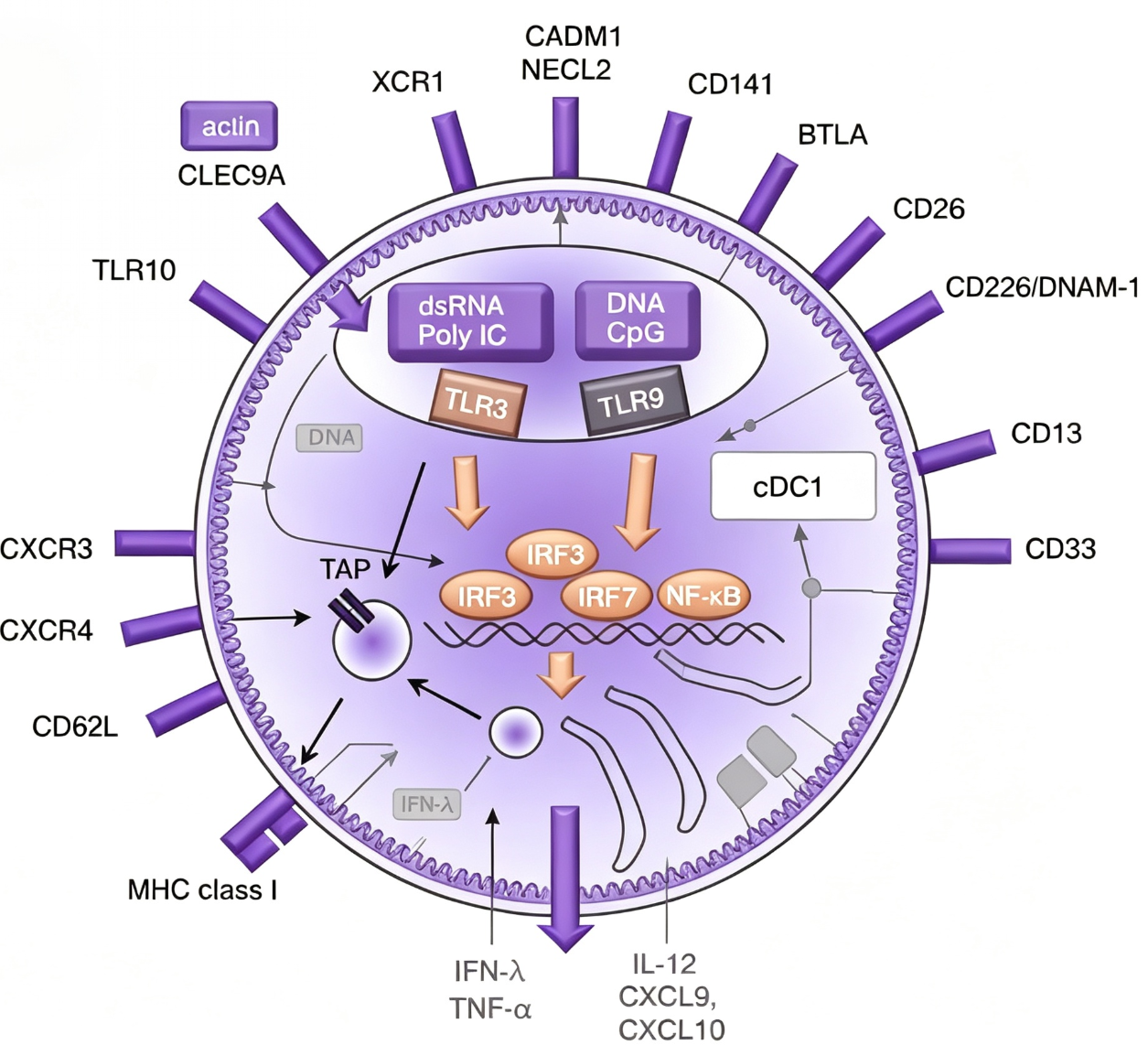
Conventional DC1 (cDC1) is characterized by its cross-presentation function in both humans and mice, responsible for activating CD8⁺ T cell and Th1 cell immune responses against tumors and intracellular pathogens. The hallmark surface molecule combination for human cDC1 is CD141⁺CD11c⁺, with major markers including HLA-DR⁺, XCR1⁺, CLEC9A⁺, DEC205⁺, and low expression of TLR1, TLR3, TLR6, TLR8, TLR10, and STING. Murine cDC1 is marked by CD11c⁺CD24⁺, with major markers including MHC-II⁺, CD8α⁺, CD103⁺, XCR1⁺, CLEC9A⁺, and DEC205⁺. In terms of cytokine secretion, human cDC1 produces IL-12, low levels of type I and III IFNs, TNF-α, CXCL9, and CXCL10; murine cDC1 secretes high levels of IL-12 and type I and III IFNs. cDC1 is associated with favorable tumor prognosis.
III. Characteristics and Functions of Conventional DC2
Conventional DC2 (cDC2) expresses numerous pattern recognition receptors and exhibits strong functional plasticity. The hallmark marker for human cDC2 is CD1c⁺CD11c⁺, with major markers including HLA-DR⁺, CD11b⁺, CD172a⁺, CD1a⁺, and subsets expressing CD14 and CD5. It expresses TLR1 to TLR9, RLR, NLR, and STING, as well as multiple CLEC family members. Murine cDC2 markers include CD11c⁺, MHC-II⁺, CD11b⁺ (high expression), CD172a⁺, and broad expression of TLR1, TLR2, TLR4 to TLR9, TLR13, RLR, NLR, STING, and various CLEC family members.
The function of cDC2 is context-dependent: it can secrete multiple pro- and anti-inflammatory cytokines such as IL-12, IL-1, IL-8, TNF-α, IL-10, and IL-23, inducing Th17 cell activation. Depending on the microenvironment and specific cDC2 subset, it can also induce Th1, Th2, Treg, and CD8⁺ T cell activation. Under steady-state conditions, cDC2 plays a crucial role in maintaining the Treg-Th17 balance in the gut and lungs.
IV. Characteristics and Functions of Plasmacytoid DC
Plasmacytoid DC (pDC) is the DC subset primarily responsible for secreting type I and III interferons in both humans and mice. The hallmark marker for human pDC is CD11c⁻HLA-DRlowCD123⁺, with major markers including CD303⁺ (CLEC4C⁺), CD304⁺, CCR2⁺, CXCR3⁺, and expression of TLR7, TLR9, RLR, STING, and CLEC12A. Murine pDC markers include CD11clow, MHC-IIlow, B220⁺, CD317⁺, SIGLEC-H⁺, CD172a⁺, CD209⁺, CCR9⁺, and CXCR3⁺, with expression of TLR7, TLR9, TLR12, RLR, STING, and CLEC12A. Functionally, pDC rapidly secretes type I and III interferons during acute or chronic viral infections, exhibits cross-presentation capability to activate CD8⁺ T cells, and is involved in the progression of autoimmune diseases, though it is associated with poor cancer prognosis.
V. Characteristics of Monocyte-Derived DC
Monocyte-derived DC (MoDC) is primarily generated during inflammatory responses. Human MoDC markers include CD11c⁺, HLA-DR⁺, CD1c⁺, CD11b⁺, CD14⁺, CD64⁺, CD206⁺, CD209⁺, CD172a⁺, CD1a⁺, and CCR2⁺. Murine MoDC markers are CD11c⁺, MHC-II⁺, CD11b⁺, Ly6C⁺, CD64⁺, CD206⁺, CD209⁺, and CD14⁺. Functionally, MoDC promotes CD4⁺ T cell differentiation into Th1, Th2, or Th17 cells.
VI. Conclusion
Dendritic cell subsets exhibit significant differences in development, phenotype, and function. cDC1 is primarily responsible for cross-presentation to activate CD8⁺ T cells, cDC2 demonstrates greater plasticity, pDC is characterized by type I interferon secretion, and MoDC is mainly generated under inflammatory conditions to promote T cell differentiation. Accurate identification and distinction of different DC subsets require integrating multidimensional information such as surface markers, cytokine profiles, and morphological features.
In the aforementioned DC differentiation studies, precise cytokine combinations are the key prerequisite for inducing bone marrow-derived DCs to differentiate into specific subsets. To meet this research need, U-Share provides the BMDC Differentiation Cytokine Set, Mouse, suitable for in vitro directional differentiation of murine bone marrow-derived hematopoietic progenitor cells into cDC1, cDC2, pDC, and other DC subsets.
This article is reviewed and published by the technical expert team of UA
Disclaimer: This article partially utilizes artificial intelligence assistance in its creation. If any content involves copyright or intellectual property issues, please let us know and we promise to verify and remove it as soon as possible.
Purchase recombinant protein, choose Nanjing UA-Bio
UA protein focuses on providing various protein reagents, raw materials, and services required for drug research and development, cell therapy, gene therapy, and basic scientific research, including drug target proteins, immune checkpoint proteins, cytokines, tool enzymes, customized protein expression, and full-length transmembrane protein development. Youai is committed to providing customers with high-quality products and professional services, and building a High-tech Biological Enterprise with International Competitiveness.
Target proteins | membrane proteins | cytokines | enzymes | viral antigens | protein customization
Nanjing UA Biotechnology Co., Ltd. Email:order@ua-bio.com Phone:+86-25-56221161

Product Information

Link:





©2021-2026 all rights reserved UA Biotechnology Co.,Ltd.
Privacy Policy 
网站备案号 浙ICP备2022019033号-2 浙公网安备33010202004867号
 Business license (three certificates in one)
 Tel:+86-25-56221161
E-mail:order@ua-bio.com
All products sold on this website shall not be used for clinical diagnosis or treatment of humans or animals, and shall only be used for non-medical purposes such as industrial or scientific research.
