




Analysis of Phenotypic and Molecular Characteristics During In Vitro Differentiation of Human Plasma Cells
Author: Senior Product Manager of UA Views:33 


This article systematically elucidates the dynamic process of human B-cell differentiation into plasma cells, detailing the stage-specific phenotypic changes, immunoglobulin class switching patterns, and nuclear transcription factor expression characteristics during the transition from memory B cells through activated B cells and plasmablasts to mature plasma cells.
- Recent Advances
- Product Information
Recent Advances
Phenotypic and Molecular Characterization of Human Plasma Cell Differentiation In Vitro
Summary
This article systematically elucidates the dynamic process of human B cell differentiation into plasma cells, detailing the stage-specific phenotypic changes, immunoglobulin class switching patterns, and nuclear transcription factor expression characteristics during the transition from memory B cells through activated B cells and plasmablasts to mature plasma cells.
This article systematically elucidates the dynamic process of human B cell differentiation into plasma cells, detailing the stage-specific phenotypic changes, immunoglobulin class switching patterns, and nuclear transcription factor expression characteristics during the transition from memory B cells through activated B cells and plasmablasts to mature plasma cells.
I. Establishment and Temporal Progression of the In Vitro Plasma Cell Differentiation Model
To systematically analyze the complete pathway of B cell differentiation into plasma cells, researchers isolated human peripheral blood memory B cells (CD27⁺CD19⁺) and cultured them with cytokine cocktails combined with stimulants such as ODN to induce directional differentiation into plasma cells in vitro. Over a 10-day culture period, four consecutive differentiation stages were clearly observed. Day 0 represented the memory B cell stage, characterized by small lymphocyte morphology in a quiescent state. By day 4, cells entered the activated B cell and early plasmablast stage—some cells enlarged in size with reduced CD20 and gradually increased CD38, entering an active proliferative state (S-phase proportion rising to 38%), while others began transitioning into plasmablasts with CD20 turning negative and CD38 further increasing. Day 7 primarily marked the plasmablast stage, with cells further enlarging, nuclear chromatin condensing, cytoplasm darkening, but proliferation capacity significantly declining. By day 10, cells entered the mature plasma cell stage, ceasing division and forming the terminal differentiation phenotype of CD20⁻CD38⁺⁺. Throughout differentiation, the S-phase proportion displayed a dynamic curve of initial increase followed by decrease.
II. Evolution of Phenotypic Markers at Each Differentiation Stage
During B cell differentiation into plasma cells, surface marker expression exhibited regular changes. CD19 and CD45 fluorescence intensity gradually decreased from the memory B cell stage to the mature plasma cell stage but remained positive. CD20 began weakening during the activated B cell stage and turned completely negative by the plasmablast stage. CD38 continuously increased after differentiation initiation, reaching its highest level at the mature plasma cell stage. CD27 maintained high expression throughout differentiation. CD43 and CD62L were progressively upregulated during differentiation. The chemokine receptor CXCR4 was upregulated in later stages, while CXCR5 showed a downward trend. The Ki67 proliferation index peaked during the activated B cell and plasmablast stages and significantly declined by the mature plasma cell stage.
III. Dynamic Characteristics of Immunoglobulin Class Switching
Regarding immunoglobulin expression, memory B cells exhibited moderate levels of sIgM, sIgA, sIgG, and cytoplasmic forms. By the activated B cell stage, sIgM and cytoplasmic IgM expression increased, while sIgG levels began to decline. Upon entering the plasmablast stage, sIgM and cytoplasmic IgM expression significantly decreased, sIgG reached its lowest point, but cytoplasmic IgG increased to approximately 56%. By the mature plasma cell stage, IgM and IgA were at low levels, with cytoplasmic IgG becoming the dominant form. This dynamic change indicates that B cell differentiation into plasma cells involves class switching from IgM to IgG, consistent with quantitative detection results of secreted IgG, IgM, and IgA in the culture medium.
IV. Temporal Regulation of Nuclear Transcription Factors
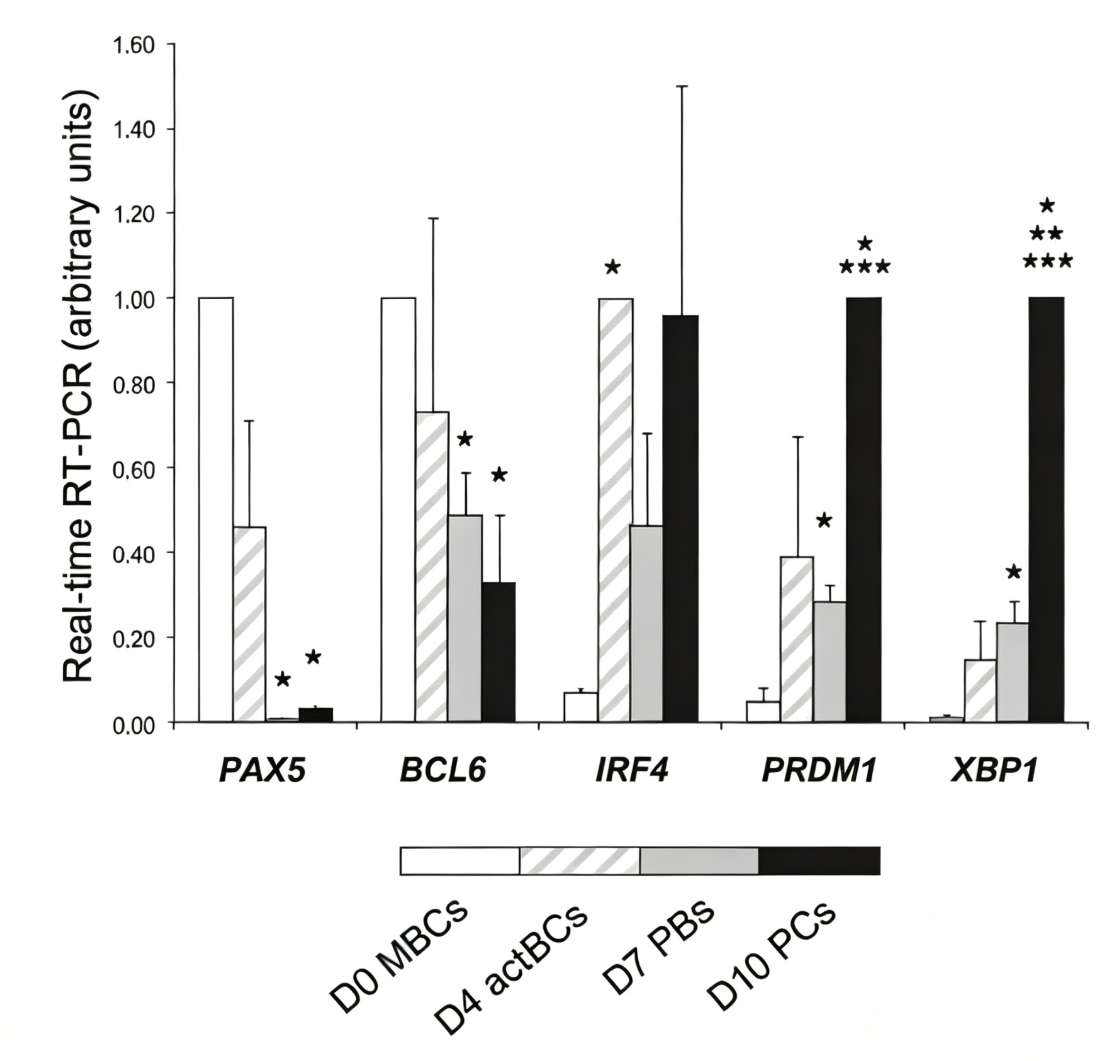
At the nuclear transcription factor level, the B cell-specific transcription factor PAX5 was significantly downregulated or even lost during differentiation, consistent with the loss of B cell identity. The germinal center transcription factor BCL6 also markedly decreased. IRF4 significantly increased during the activated B cell stage and remained at high levels through the plasmablast and mature plasma cell stages. The key transcription factors for plasma cell differentiation, PRDM1 (BLIMP-1) and XBP1, showed moderate increases during the activated B cell and plasmablast stages, further rising to peak levels at the mature plasma cell stage. This temporal expression pattern confirms the core regulatory role of PRDM1 and XBP1 in driving terminal differentiation of B cells into plasma cells.
V. Conclusion
The in vitro differentiation of human memory B cells into plasma cells is a continuous and dynamic process involving the orderly replacement of surface markers, class switching from IgM to IgG, and finely coordinated transcription factor networks. A clear understanding of this differentiation pathway provides an important phenotypic and molecular reference framework for studies in B cell developmental biology, antibody production mechanisms, and B cell-related diseases.
In the aforementioned in vitro plasma cell differentiation study, precise cytokine combinations were critical experimental conditions for inducing directional differentiation of memory B cells into plasma cells. To meet this research need, U-AI offers a human B cell polarization cytokine kit, suitable for in vitro induction of memory B cell differentiation into plasma cells, phenotypic and functional studies at different B cell differentiation stages, and exploration of regulatory mechanisms in B cell-related immune responses.
This article is reviewed and published by the technical expert team of UA
Disclaimer: This article partially utilizes artificial intelligence assistance in its creation. If any content involves copyright or intellectual property issues, please let us know and we promise to verify and remove it as soon as possible.
Purchase recombinant protein, choose Nanjing UA-Bio
UA protein focuses on providing various protein reagents, raw materials, and services required for drug research and development, cell therapy, gene therapy, and basic scientific research, including drug target proteins, immune checkpoint proteins, cytokines, tool enzymes, customized protein expression, and full-length transmembrane protein development. Youai is committed to providing customers with high-quality products and professional services, and building a High-tech Biological Enterprise with International Competitiveness.
Target proteins | membrane proteins | cytokines | enzymes | viral antigens | protein customization
Nanjing UA Biotechnology Co., Ltd. Email:order@ua-bio.com Phone:+86-25-56221161

Product Information

Link:





©2021-2026 all rights reserved UA Biotechnology Co.,Ltd.
Privacy Policy 
网站备案号 浙ICP备2022019033号-2 浙公网安备33010202004867号
 Business license (three certificates in one)
 Tel:+86-25-56221161
E-mail:order@ua-bio.com
All products sold on this website shall not be used for clinical diagnosis or treatment of humans or animals, and shall only be used for non-medical purposes such as industrial or scientific research.
