




In vitro activation, expansion, and differentiation of human B cells: Key strategies from basic research to application
Author: Senior Product Manager of UA Views:51 


This article systematically elaborates on the core technical aspects of human B cell in vitro culture, detailing the developmental origins and subset characteristics of B cells, analyzing the dual-signal activation mechanisms in vitro and the functional principles of key cytokine combinations, and introducing representative experimental protocols for the differentiation of memory B cells and plasma cells.
- Recent Advances
- Product Information
Recent Advances
In Vitro Activation, Expansion, and Differentiation of Human B Cells: Key Strategies from Basic Research to Applications
Summary
This article systematically elaborates on the core technical aspects of in vitro culture of human B cells, including their developmental origins and subset characteristics, analyzes the dual-signal mechanism of in vitro activation and the functional principles of key cytokine combinations, and introduces representative experimental protocols for the differentiation of memory B cells and plasma cells.
This article systematically elaborates on the core technical aspects of in vitro culture of human B cells, including their developmental origins and subset characteristics, analyzes the dual-signal mechanism of in vitro activation and the functional principles of key cytokine combinations, and introduces representative experimental protocols for the differentiation of memory B cells and plasma cells.
I. B Cell Development and Sources for In Vitro Culture
B cells differentiate and develop from lymphoid stem cells in the bone marrow of mammals, undergoing stages such as pro-B cells, pre-B cells, immature B cells, and mature B cells. Early pro-B cells begin immunoglobulin gene rearrangement but do not express membrane IgM. Pre-B cells express the pre-B cell receptor on their surface, subsequently developing into immature B cells that express a complete BCR. After negative selection in the bone marrow, surviving immature B cells migrate to peripheral lymphoid organs, where transitional B cells enter the spleen and differentiate into marginal zone B cells or follicular B cells. Marginal zone B cells can develop into short-lived plasma cells upon antigen exposure, while follicular B cells, activated by antigens and supported by helper T cells, develop into memory B cells or long-lived plasma cells in germinal centers. Sources of B cells for in vitro culture include solid tissues such as the spleen, tonsils, and lymph nodes, as well as peripheral blood samples, or commercially available primary B cells.
II. Dual-Signal Mechanism for B Cell Activation In Vitro
B cell activation requires the synergistic action of dual signals. The first signal is initiated by BCR binding to antigens and transmitted through the BCR-CD79a/b and CD19/CD21/CD81 coreceptor complex. The second signal, also known as the costimulatory signal, is primarily generated by the interaction between helper T cells and B cell surface costimulatory molecules (especially CD40/CD40L). Cytokines secreted by Th cells can also promote B cell activation, proliferation, and differentiation. If only the first signal is present without the second, B cells enter an anergic state.
III. Experimental Protocols for B Cell Activation and Expansion In Vitro
Taking the in vitro activation of human naive B cells as an example, the procedure is as follows: Use CD40L-expressing stromal cells as a feeder layer, and seed B cells at a density of approximately 100 cells per well in R5 medium (containing human serum, β-mercaptoethanol, L-glutamine, antibiotics, HEPES, sodium pyruvate, and MEM non-essential amino acids). The medium should be supplemented with recombinant human IL-2 (50 ng/mL), IL-4 (10 ng/mL), IL-21 (10 ng/mL), and BAFF (10 ng/mL), and cultured at 37°C with 5% CO₂ for 8 days. Half of the old medium should be replaced with fresh R5 medium containing cytokines on days 4 and 6. After 8 days, the cells should be transferred to a new feeder layer for continued culture. At the end of the culture period, cell counting, further experiments, or cryopreservation can be performed.
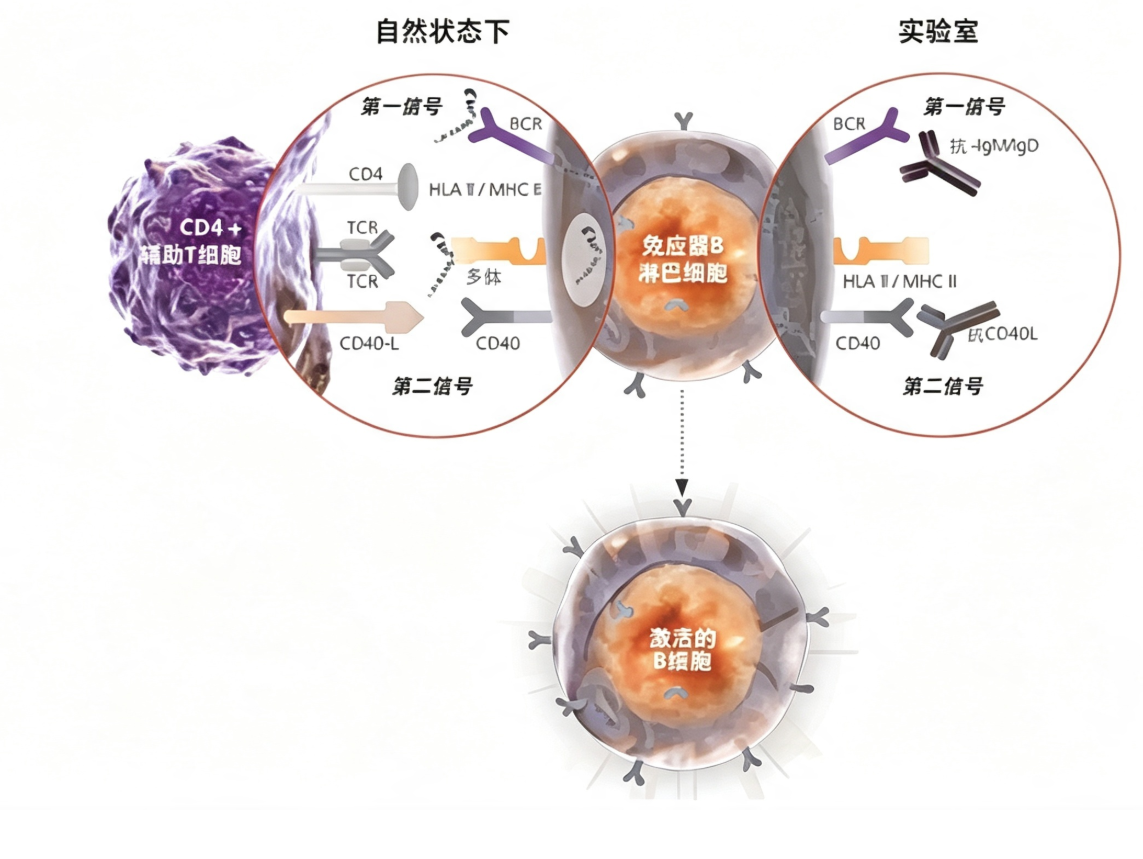
IV. Protocols for B Cell Differentiation
Under the synergistic action of CD40/CD40L and cytokines, activated B cells can further differentiate into memory B cells or plasma cells. For memory B cell differentiation, CD19⁺IgM⁻IgA⁻IgD⁻ B cells are isolated by flow cytometry and seeded at 1.3-4 cells per well in a 384-well plate. The culture medium includes IL-2, IL-21, and irradiated 3T3-msCD40L feeder cells. After 13-14 days of culture, IgG concentration in the supernatant can be measured on day 12 to assess differentiation efficiency.
For plasma cell differentiation, common protocols include four combinations: CpG + sCD40L + IL-2 + IL-10; CpG + PWM + SAC; anti-IgM + CpG + sCD40L + IL-21; and anti-IgM + CpG + sCD40L + IL-2 (replaced with IL-2 + IL-4 + IL-10 on day 4). Flow cytometry to detect CD38, CD20, and transcription factor expression, combined with ELISA to measure IgG production in the supernatant, can determine the optimal differentiation protocol. Additionally, CD27⁺ memory B cells isolated from PBMCs can be co-cultured with irradiated CD154⁺ HEK293T feeder cells and stimulated with IL-2, IL-6, IL-15, IL-21, APRIL, BAFF, and TLR agonists (e.g., CpG ODN2006, R848) to induce differentiation into plasma cells.
V. Conclusion
In vitro culture of human B cells involves a complete technical chain from sample preparation, cell sorting, activation and expansion, to directed differentiation. Optimization of conditions at each step is critical for experimental success. Proper selection of B cell sources and precise regulation of activation signals and cytokine combinations are essential prerequisites for obtaining highly active B cells and their differentiated products.
In the aforementioned in vitro culture of human B cells, high-quality cytokine combinations are key to ensuring the efficiency of B cell activation, expansion, and directed differentiation. To meet this research demand, UniCell offers a human B cell polarization cytokine kit suitable for experimental scenarios such as B cell activation and expansion, memory B cell differentiation, and plasma cell induction.
This article is reviewed and published by the technical expert team of UA
Disclaimer: This article partially utilizes artificial intelligence assistance in its creation. If any content involves copyright or intellectual property issues, please let us know and we promise to verify and remove it as soon as possible.
Purchase recombinant protein, choose Nanjing UA-Bio
UA protein focuses on providing various protein reagents, raw materials, and services required for drug research and development, cell therapy, gene therapy, and basic scientific research, including drug target proteins, immune checkpoint proteins, cytokines, tool enzymes, customized protein expression, and full-length transmembrane protein development. Youai is committed to providing customers with high-quality products and professional services, and building a High-tech Biological Enterprise with International Competitiveness.
Target proteins | membrane proteins | cytokines | enzymes | viral antigens | protein customization
Nanjing UA Biotechnology Co., Ltd. Email:order@ua-bio.com Phone:+86-25-56221161

Product Information

Link:





©2021-2026 all rights reserved UA Biotechnology Co.,Ltd.
Privacy Policy 
网站备案号 浙ICP备2022019033号-2 浙公网安备33010202004867号
 Business license (three certificates in one)
 Tel:+86-25-56221161
E-mail:order@ua-bio.com
All products sold on this website shall not be used for clinical diagnosis or treatment of humans or animals, and shall only be used for non-medical purposes such as industrial or scientific research.
