




The synthesis regulation, cellular distribution, and inflammatory signaling functions of IL-18
Author: Senior Product Manager of UA Views:2 


This article systematically elaborates on the unique maturation mechanism of IL-18, which is synthesized as a precursor lacking a signal peptide and requires cleavage and activation by caspase-1 before release. It also analyzes its widespread expression pattern in non-immune cells, including endothelial cells, epithelial cells, keratinocytes, and the central nervous system.
- Recent Advances
- Product Information
Recent Advances
Synthesis Regulation, Cellular Distribution, and Inflammatory Signaling Functions of IL-18
Overview
This article systematically elaborates on the molecular characteristics and biological properties of IL-18, focusing on its unique maturation mechanism as a signal peptide-free precursor that requires caspase-1 cleavage for activation and release. It also analyzes its widespread expression patterns in non-immune cells, including endothelial cells, epithelial cells, keratinocytes, and the central nervous system.
This article systematically elaborates on the molecular characteristics and biological properties of IL-18, focusing on its unique maturation mechanism as a signal peptide-free precursor that requires caspase-1 cleavage for activation and release. It also analyzes its widespread expression patterns in non-immune cells, including endothelial cells, epithelial cells, keratinocytes, and the central nervous system.
I. Molecular Characteristics and Structural Basis of IL-18
Interleukin-18 (IL-18) is a pro-inflammatory cytokine belonging to the IL-1 cytokine superfamily. The human IL-18 gene is located on chromosome 11q22.2-q22.3, encoding a precursor protein composed of 193 amino acid residues with a molecular weight of approximately 24 kDa, lacking a classical signal peptide sequence. Structurally, IL-18 shares high three-dimensional similarity with IL-1β, both adopting a β-trefoil fold topology, a feature that determines their shared receptor signaling complexes.
IL-18 gene transcription can be induced by various stimuli, including pathogen-associated molecular patterns (PAMPs) and damage-associated molecular patterns (DAMPs). However, unlike other cytokines, the maturation and release of IL-18 are regulated at multiple post-translational levels.
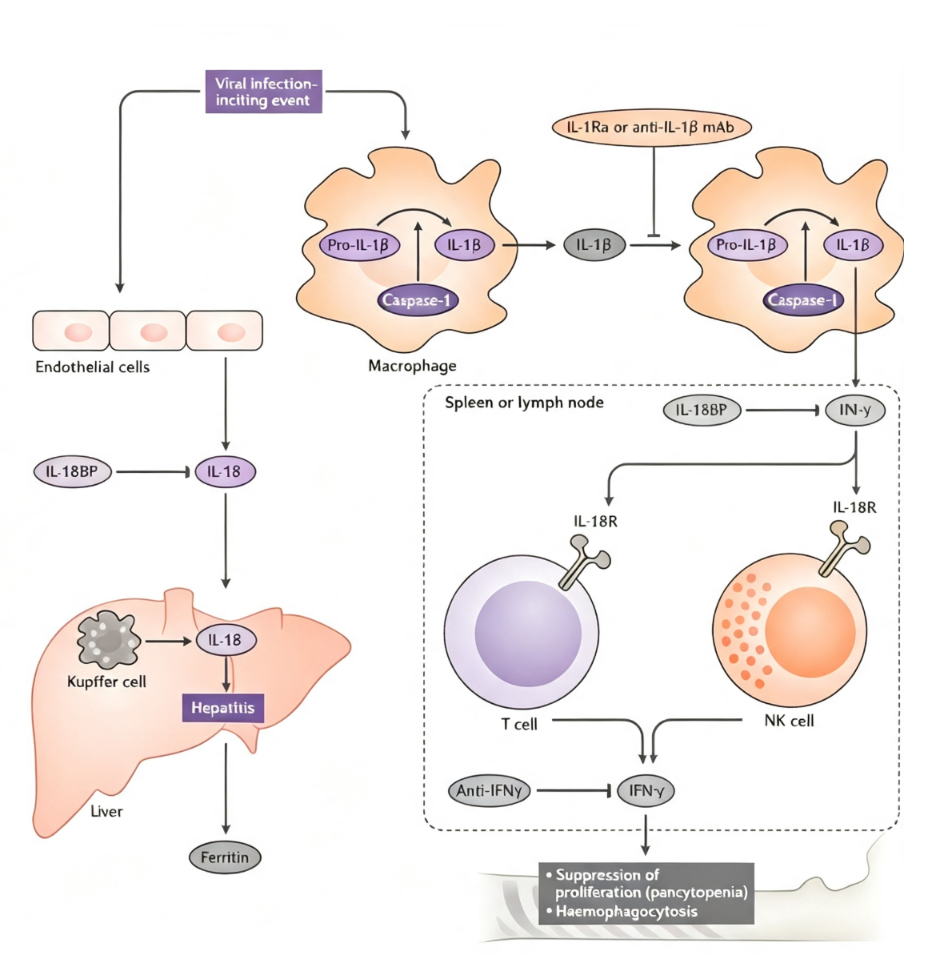
II. Synthesis and Distribution of pro-IL-18
Due to the absence of a signal peptide, pro-IL-18 cannot be secreted extracellularly via the classical endoplasmic reticulum-Golgi pathway. This unique feature ensures that IL-18's biological activity is tightly regulated at the post-translational level. Similar to IL-1β, pro-IL-18 is constitutively expressed in various tissue cells, but its synthesis and distribution patterns have distinct characteristics.
Among mesenchymal cells, endothelial cells are a significant source of pro-IL-18. Under pathological conditions, microvascular endothelial cells can be activated to express high levels of pro-IL-18. In the gastrointestinal tract, epithelial cells throughout the digestive tract express pro-IL-18, reflecting its role in mucosal barrier immunity. In skin tissue, keratinocytes are the primary source of pro-IL-18. In the central nervous system, both neurons and glial cells can synthesize pro-IL-18, suggesting its potential role in neuroinflammation.
Additionally, pro-IL-18 is expressed to varying degrees in the liver, kidneys, lungs, and skeletal muscle, among other tissues. In the immune system, pro-IL-18 can be detected in monocytes, macrophages, and dendritic cells.
III. Activation and Release Mechanisms of pro-IL-18
pro-IL-18 requires proteolytic processing to acquire biological activity, a maturation process primarily mediated by caspase-1 (also known as IL-1β-converting enzyme). Caspase-1 undergoes auto-catalytic activation upon the assembly of the inflammasome complex, cleaving pro-IL-18 at Asp-X sites to release mature IL-18 (composed of 157–159 amino acid residues with a molecular weight of approximately 18 kDa). Other proteases, such as granzyme B and proteinase 3, can also cleave pro-IL-18 under certain conditions, indicating the existence of caspase-1-independent alternative activation pathways.
IV. Physiological Functions and Signal Transduction of IL-18
Mature IL-18 initiates signal transduction by binding to the IL-18 receptor α chain (IL-18Rα), which then recruits the IL-18Rβ chain to form a high-affinity receptor complex. This complex activates the MyD88 and IRAK signaling pathways, ultimately inducing downstream gene expression via the NF-κB and MAPK pathways.
The synergistic effect of IL-18 and IL-12 is one of its most classic functions in immune responses. Together, they activate T cells and NK cells to produce large amounts of IFN-γ, inducing Th1-type immune responses and enhancing the antiviral and antitumor activities of cytotoxic T cells and NK cells. IL-18 also promotes Th1 cell differentiation, inhibits Th17 cell differentiation, and participates in the balance regulation of immune responses.
V. Conclusion
As a unique pro-inflammatory cytokine, the signal peptide-free molecular structure of IL-18 ensures that its synthesis, processing, and release are precisely regulated at multiple levels. The widespread distribution of pro-IL-18 in endothelial cells, epithelial cells, keratinocytes, and the central nervous system, combined with the caspase-1-mediated release mechanism of mature IL-18, constitutes a dual safeguard for IL-18's biological functions. Human recombinant IL-18 protein, as a critical tool for basic research and drug development, will continue to provide essential support for in-depth analysis of the IL-18 signaling network and its role in inflammatory diseases.
In IL-18-related basic research and drug screening, high-quality human recombinant IL-18 protein is a core tool for receptor binding analysis, cellular function studies, and signaling pathway exploration. To meet this research demand, Univ offers IL-18 Protein, Human, suitable for IL-18 receptor binding analysis, T cell and NK cell function studies, and IL-18/IL-18R signaling pathway mechanism exploration.
This article is reviewed and published by the technical expert team of UA
Disclaimer: This article partially utilizes artificial intelligence assistance in its creation. If any content involves copyright or intellectual property issues, please let us know and we promise to verify and remove it as soon as possible.
Purchase recombinant protein, choose Nanjing UA-Bio
UA protein focuses on providing various protein reagents, raw materials, and services required for drug research and development, cell therapy, gene therapy, and basic scientific research, including drug target proteins, immune checkpoint proteins, cytokines, tool enzymes, customized protein expression, and full-length transmembrane protein development. Youai is committed to providing customers with high-quality products and professional services, and building a High-tech Biological Enterprise with International Competitiveness.
Target proteins | membrane proteins | cytokines | enzymes | viral antigens | protein customization
Nanjing UA Biotechnology Co., Ltd. Email:order@ua-bio.com Phone:+86-25-56221161

Product Information

Link:





©2021-2026 all rights reserved UA Biotechnology Co.,Ltd.
Privacy Policy 
网站备案号 浙ICP备2022019033号-2 浙公网安备33010202004867号
 Business license (three certificates in one)
 Tel:+86-25-56221161
E-mail:order@ua-bio.com
All products sold on this website shall not be used for clinical diagnosis or treatment of humans or animals, and shall only be used for non-medical purposes such as industrial or scientific research.
