




IL-21: A Synergistic Enhancer in CAR-T Cell Therapy and Novel Strategy for Tumor Immunomodulation
Author: Senior Product Manager of UA Views:4 


This article systematically elaborates on the molecular characteristics and biological functions of IL-21, focusing on its core role as a member of the IL-2 cytokine superfamily in regulating the proliferation, differentiation, and effector functions of T cells, NK cells, and NKT cells. It also analyzes its potential value in enhancing the anti-tumor activity of CAR-T cells and improving treatment safety.
- Recent Advances
- Product Information
Recent Advances
IL-21: A Synergistic Enhancer for CAR-T Cell Therapy and Novel Strategy for Tumor Immune Modulation
Overview
This article systematically elaborates on the molecular characteristics and biological functions of IL-21 as a member of the IL-2 cytokine superfamily, focusing on its central role in regulating the proliferation, differentiation, and effector functions of T cells, NK cells, and NKT cells. It also analyzes its potential value in enhancing the anti-tumor activity of CAR-T cells and improving treatment safety.
This article systematically elaborates on the molecular characteristics and biological functions of IL-21 as a member of the IL-2 cytokine superfamily, focusing on its central role in regulating the proliferation, differentiation, and effector functions of T cells, NK cells, and NKT cells. It also analyzes its potential value in enhancing the anti-tumor activity of CAR-T cells and improving treatment safety.
I. Molecular Characteristics and Cellular Sources of IL-21
Interleukin-21 (IL-21) is a key member of the IL-2 cytokine superfamily. Its gene is located on the q26-q27 region of human chromosome 4, encoding a mature protein composed of 133 amino acid residues with four α-helical structures and a molecular weight of approximately 15.4 kDa. IL-21 is primarily produced by activated CD4⁺ T cells, with follicular helper T cells and Th17 cells being its main sources. Additionally, natural killer T cells (NKT cells) and some CD8⁺ T cells can secrete IL-21, while certain hematopoietic cells may also produce it in small amounts. The IL-21 receptor (IL-21R) is widely distributed in immune organs such as the spleen, thymus, peripheral blood, and lymph nodes, mainly expressed on the surfaces of B lymphocytes, dendritic cells, NK cells, NKT cells, CD4⁺ T cells, and CD8⁺ T cells. This broad receptor distribution pattern determines IL-21's regulatory capacity over multiple immune cell types.
II. Signal Transduction Mechanism Mediated by IL-21
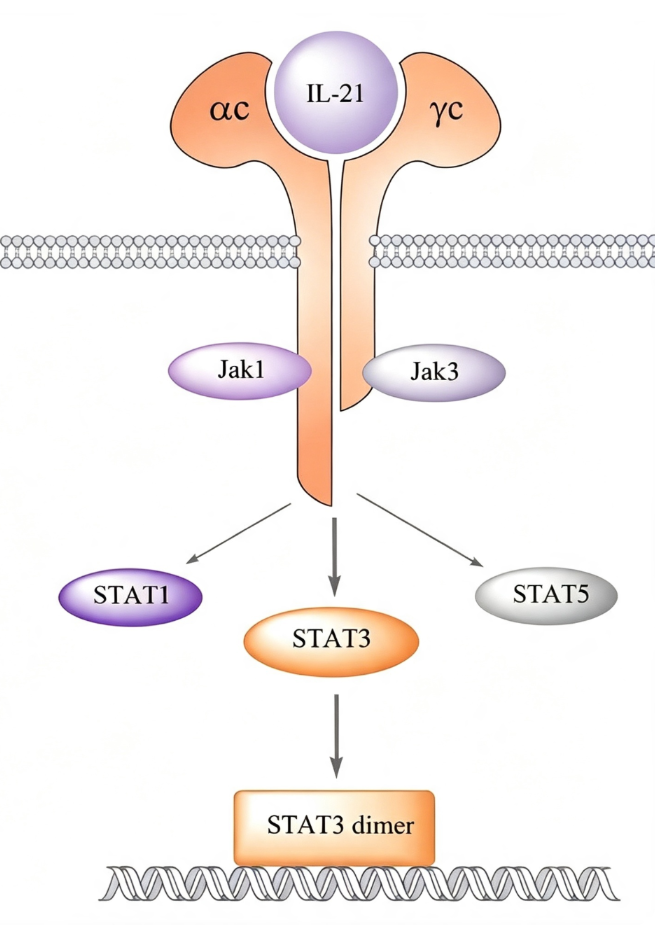
IL-21 initiates downstream signaling cascades by binding to its receptor complex. The IL-21R consists of the IL-21Rα subunit and the common γ-chain (γc, also a shared subunit of IL-2, IL-4, IL-7, IL-9, and IL-15 receptors), with the common γ-chain ensuring synergistic and cross-regulatory interactions between IL-21 signaling and other γc family cytokine pathways.
Upon IL-21 binding, IL-21Rα and γc phosphorylate and activate JAK1 and JAK3, respectively, leading to the recruitment and phosphorylation of STAT family members (primarily STAT3, with partial involvement of STAT1 and transient activation of STAT5a/b). Phosphorylated STAT3 forms homodimers that translocate to the nucleus, binding to interferon-γ-activated sequences in the promoter regions of target genes to initiate transcription. These target genes include granzyme A, granzyme B, B-cell lymphoma 6 protein (Bcl6), orphan nuclear receptor γt (RORγt), tumor suppressor Bim, Prdm1, and IL-10, among others. Through this signaling network, IL-21 achieves precise regulation of the functional states of various immune cells.
III. Effects of IL-21 on CD8+ T Cells
The regulatory role of IL-21 on CD8⁺ T cells is one of its core mechanisms in tumor immunity. IL-21 significantly promotes the proliferation of memory and naive CD8⁺ T cells and enhances their secretion of IL-2, IFN-γ, and perforin. Studies show that when IL-21 acts synergistically with IL-15, its proliferative and functional enhancement effects on CD8⁺ T cells are more pronounced. Conversely, CD8⁺ T cells from IL-21R knockout mice exhibit impaired proliferation and cytotoxic functions. In anti-tumor immune responses, IL-21-treated T cells show significantly lower apoptosis rates compared to IL-2-treated counterparts, favoring the formation of persistent CD8⁺ memory T cell responses.
IV. Effects of IL-21 on NK Cells
As critical effector cells in tumor immune surveillance, NK cells face limitations such as low abundance in vivo, difficulty in in vitro expansion, and short survival times. IL-21 regulates NK cells at multiple levels. Through its receptor, IL-21 promotes NK cell proliferation, differentiation, and maturation, enhancing their secretion of IFN-γ and perforin. In vitro expansion studies demonstrate that antigen-presenting cells expressing membrane-bound IL-21 can effectively enhance NK cell proliferation and cytotoxicity, enabling them to kill various tumor cells. IL-21 also promotes NK cell secretion of IFN-γ via IL-21R, augmenting antibody-dependent cell-mediated cytotoxicity (ADCC) against antibody-coated tumor cells.
V. Synergistic Potential of IL-21 with CAR-T Cell Therapy
CAR-T cell therapy has achieved breakthrough clinical efficacy in B-cell malignancies but faces challenges in solid tumors, such as insufficient T cell persistence and immunosuppressive tumor microenvironments. IL-21's unique advantages lie in its ability to significantly enhance T cell proliferation and anti-tumor effector functions while exhibiting good in vivo tolerability, making it an ideal candidate for combination strategies with CAR-T. Preclinical studies show that in melanoma-bearing mouse models, IL-21 combined with IL-15 leads to complete tumor regression and improved long-term survival. In a thymoma model, IL-21 doubled the survival time of 50% of mice, with long-term survivors remaining tumor-free upon rechallenge, confirming IL-21's dependence on persistent CD8⁺ memory T cells.
IL-21 also demonstrates favorable safety profiles. In Phase I clinical trials with melanoma patients, IL-21 was well-tolerated with mild side effects. Compared to IL-2, IL-21 induces less regulatory T cell expansion and reduces T cell exhaustion caused by overactivation, thereby enhancing anti-tumor efficacy while improving the therapeutic safety window.
VI. Conclusion
As a core member of the IL-2 cytokine superfamily, IL-21 plays an irreplaceable role in anti-tumor immune responses through its broad regulatory effects on CD8⁺ T cells, NK cells, and NKT cells. Its unique advantages in enhancing CAR-T cell anti-tumor activity, promoting memory T cell formation, and improving treatment safety provide critical insights for optimizing next-generation CAR-T strategies. Recombinant human IL-21 protein serves as a vital tool for fundamental research and preclinical development, continuing to support in-depth exploration in tumor immunotherapy.
In IL-21-related basic research and cell therapy development, high-quality recombinant human IL-21 protein is essential for immune cell expansion and functional studies, signaling pathway analysis, and combination therapy optimization. To meet these research needs, U-Apply offers IL-21 Protein, Human, suitable for CAR-T cell in vitro expansion and functional modulation, NK cell proliferation and activation studies, and JAK/STAT signaling pathway investigations.
This article is reviewed and published by the technical expert team of UA
Disclaimer: This article partially utilizes artificial intelligence assistance in its creation. If any content involves copyright or intellectual property issues, please let us know and we promise to verify and remove it as soon as possible.
Purchase recombinant protein, choose Nanjing UA-Bio
UA protein focuses on providing various protein reagents, raw materials, and services required for drug research and development, cell therapy, gene therapy, and basic scientific research, including drug target proteins, immune checkpoint proteins, cytokines, tool enzymes, customized protein expression, and full-length transmembrane protein development. Youai is committed to providing customers with high-quality products and professional services, and building a High-tech Biological Enterprise with International Competitiveness.
Target proteins | membrane proteins | cytokines | enzymes | viral antigens | protein customization
Nanjing UA Biotechnology Co., Ltd. Email:order@ua-bio.com Phone:+86-25-56221161

Product Information

Link:





©2021-2026 all rights reserved UA Biotechnology Co.,Ltd.
Privacy Policy 
网站备案号 浙ICP备2022019033号-2 浙公网安备33010202004867号
 Business license (three certificates in one)
 Tel:+86-25-56221161
E-mail:order@ua-bio.com
All products sold on this website shall not be used for clinical diagnosis or treatment of humans or animals, and shall only be used for non-medical purposes such as industrial or scientific research.
