




Application of pH-sensitive fluorescent labeling technology in antibody internalization research
Views:6 


This article focuses on the technical principles of pH-sensitive IgG fluorescent labeling reagents, systematically elucidating their molecular mechanism of distinguishing cell surface-bound antibodies from internalized antibodies through pH-dependent fluorescence signal changes. It analyzes the application value of this technology in antibody-drug conjugate (ADC) screening and receptor internalization kinetics studies.
- Recent Advances
- Product Information
Recent Advances
Application of pH-Sensitive Fluorescent Labeling Technology in Antibody Internalization Studies
Abstract
This article systematically explains the molecular mechanism of pH-sensitive IgG fluorescent labeling reagents in distinguishing cell surface-bound antibodies from internalized antibodies through pH-dependent fluorescence signal changes, and analyzes the application value of this technology in antibody-drug conjugate (ADC) screening and receptor internalization kinetics research.
This article systematically explains the molecular mechanism of pH-sensitive IgG fluorescent labeling reagents in distinguishing cell surface-bound antibodies from internalized antibodies through pH-dependent fluorescence signal changes, and analyzes the application value of this technology in antibody-drug conjugate (ADC) screening and receptor internalization kinetics research.
I. The Importance of Antibody Internalization Evaluation in Biopharmaceutical Development
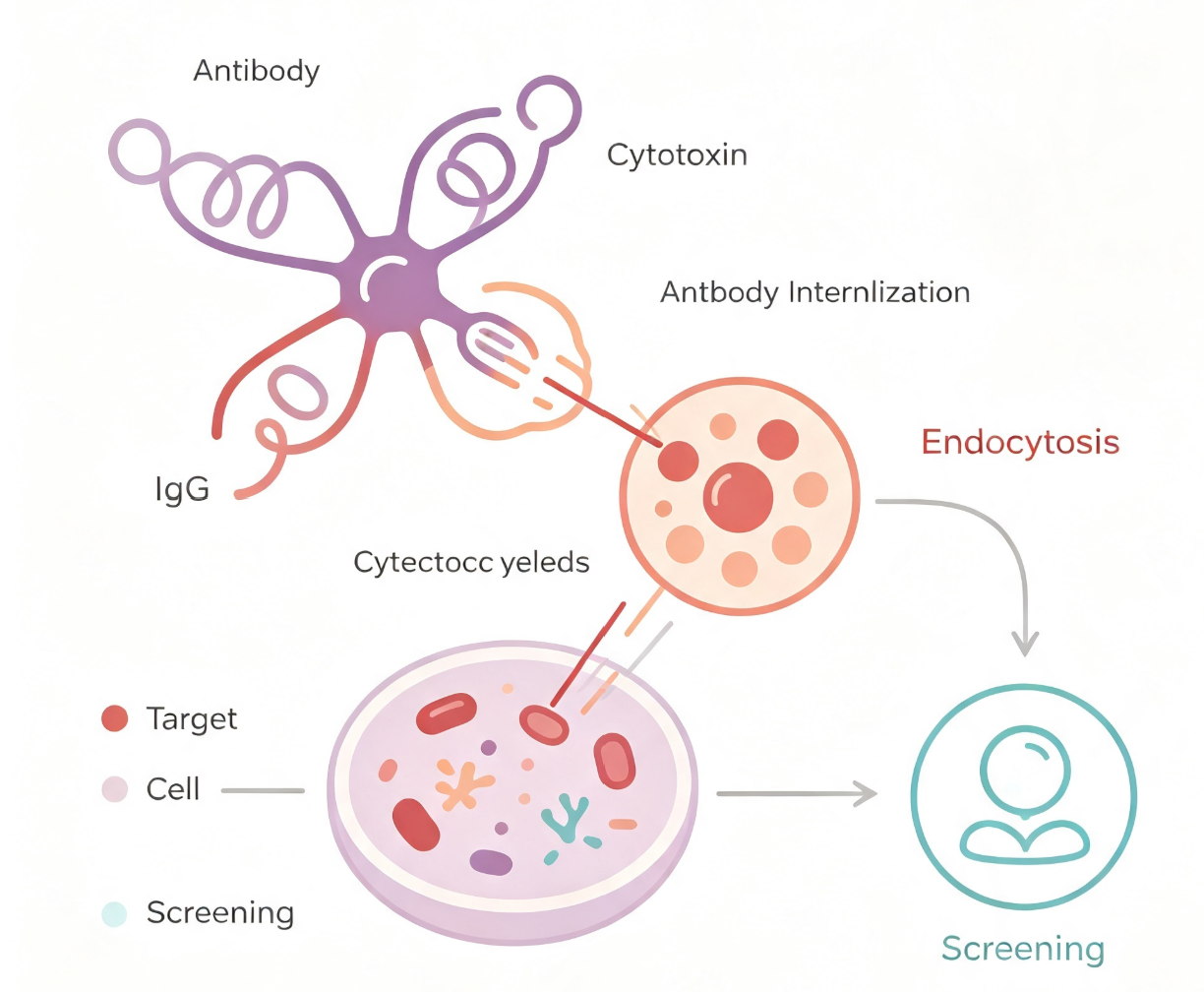
Antibody drugs exhibit diverse mechanisms of action, among which the strategy of utilizing antibody-mediated internalization to deliver drugs into cells is a core component for the efficacy of antibody-drug conjugates (ADCs) and certain immunotoxins. For ADC drugs, the antibody portion not only requires high target specificity and strong affinity but, more importantly, must possess efficient internalization activity to deliver the conjugated cytotoxic payload into target cells. Therefore, during the early discovery phase of ADC drugs, systematic evaluation of candidate antibodies' internalization efficiency is a critical screening criterion to determine whether a molecule warrants further development. Traditional internalization detection methods often rely on low-pH elution or fluorescence quenching techniques, which are cumbersome and prone to background signal interference.
II. The Scientific Logic of pH-Sensitive Labeling Technology in Addressing Internalization Detection Bottlenecks
The design concept of pH-sensitive IgG labeling reagents stems from the precise utilization of pH changes during cellular internalization pathways. When antibodies enter cells via receptor-mediated internalization, they sequentially pass through early endosomes (pH ~6.0), late endosomes (pH ~5.5), and lysosomes (pH ~4.5-5.0). This gradual acidification process is a hallmark feature of cellular internalization pathways. The design of pH-sensitive fluorescent dyes is based on this biological characteristic—their fluorescence intensity significantly increases in acidic environments while remaining low in neutral environments.
When antibodies are labeled with pH-sensitive reagents, those bound to the cell surface in the neutral extracellular environment exhibit "off" fluorescence signals, whereas antibody-receptor complexes internalized into acidic vesicles within the cell show "on" fluorescence signals. This intelligent response mechanism allows researchers to directly distinguish surface-bound antibodies from internalized antibodies using flow cytometry without complex acid-wash steps, significantly reducing background signal interference and improving detection accuracy and reproducibility.
III. Technical Features and Broad Compatibility of IgG Labeling Reagents
Max(Green) pH-sensitive IgG labeling reagents belong to a class of fluorescently labeled proteins that specifically bind to the Fc region of IgG antibodies, with a molecular weight of approximately 31-33 kDa. These reagents can form stable non-covalent complexes with IgG antibodies from various common experimental species, including human IgG (subtypes 1-4), rabbit IgG, and mouse IgG (subtypes 1, 2a, 2b, 3). This broad compatibility eliminates the need for individual chemical labeling conjugation for each antibody and avoids potential damage to antibody binding activity caused by chemical labeling.
The standard application protocol typically includes the following steps: mix the test antibody with the pH-sensitive labeling reagent at the recommended ratio and incubate at room temperature in the dark for 15-30 minutes to form the labeled complex; co-incubate the labeled complex with target cells at 37°C for different time points (usually 0.5-4 hours) to initiate internalization; detect cellular fluorescence signals using flow cytometry in the FITC or AF488 channel, combined with appropriate control settings, to quantitatively analyze antibody internalization efficiency.
IV. Conclusion
pH-sensitive fluorescent labeling technology, with its intelligent fluorescence response to acidic microenvironments, provides a precise and simple detection solution for antibody internalization studies. As a representative product of this technological approach, Max(Green) offers broad IgG compatibility, flow cytometry platform adaptability, and a simple operational workflow, making it highly valuable in ADC drug discovery and basic internalization mechanism research. Accurate evaluation of internalization efficiency will accelerate the screening of antibodies with high internalization activity and promote the development of more effective ADC drugs.
The pH-sensitive IgG labeling reagent Max(Green) launched by Uni is a specialized tool designed for flow cytometry platforms. Its key performance parameters include: excitation/emission wavelengths of 488/520 nm, matching the green fluorescence channel of most flow cytometers; provided in lyophilized form, stable for 12 months when stored in the dark at -20 to -80°C, and stable for 1-2 weeks when reconstituted and stored under sterile conditions at 2-8°C, avoiding repeated freeze-thaw cycles; forms antibody-reagent complexes compatible with conventional flow cytometry and fluorescence imaging analysis.
The main application scenarios of this reagent include: high-throughput screening and ranking of candidate antibody internalization efficiency in early ADC drug development; studying kinetic parameters of receptor-mediated internalization; evaluating the impact of different antigen epitopes, antibody affinities, or antibody formats on internalization efficiency; tracking intracellular distribution pathways of antibodies in antibody drug intracellular transport and metabolism studies; optimizing ADC drug linker and payload design to improve drug release efficiency post-internalization.
Disclaimer: This article partially utilizes artificial intelligence assistance in its creation. If any content involves copyright or intellectual property issues, please let us know and we promise to verify and remove it as soon as possible.
Purchase recombinant protein, choose Nanjing UA-Bio
UA protein focuses on providing various protein reagents, raw materials, and services required for drug research and development, cell therapy, gene therapy, and basic scientific research, including drug target proteins, immune checkpoint proteins, cytokines, tool enzymes, customized protein expression, and full-length transmembrane protein development. Youai is committed to providing customers with high-quality products and professional services, and building a High-tech Biological Enterprise with International Competitiveness.
Target proteins | membrane proteins | cytokines | enzymes | viral antigens | protein customization
Nanjing UA Biotechnology Co., Ltd. Email:order@ua-bio.com Phone:+86-25-56221161

Product Information

Link:





©2021-2026 all rights reserved UA Biotechnology Co.,Ltd.
Privacy Policy 
网站备案号 浙ICP备2022019033号-2 浙公网安备33010202004867号
 Business license (three certificates in one)
 Tel:+86-25-56221161
E-mail:order@ua-bio.com
All products sold on this website shall not be used for clinical diagnosis or treatment of humans or animals, and shall only be used for non-medical purposes such as industrial or scientific research.
