




The IL-15/IL-15Rα Signaling Axis: A Pivotal Hub in Immune Regulation and Core Strategy for Anti-Tumor Therapy
Views:10 


This article systematically elaborates on the molecular characteristics of IL-15, its cellular sources, and its unique receptor trans-presentation mechanism. It analyzes the extensive regulatory functions of this signaling axis on key immune cell populations such as NK cells and memory CD8+ T cells through multiple pathways including JAK/STAT, PI3K/AKT, and MAPK.
- Recent Advances
- Product Information
Recent Advances
IL-15/IL-15Rα Signaling Axis: The Hub of Immune Regulation and Core of Anti-Tumor Strategies
Summary
This article systematically elaborates on the molecular characteristics of IL-15, its cellular sources, and its unique receptor trans-presentation mechanism, analyzing the extensive regulatory functions of this signaling axis on key immune cell populations such as NK cells and memory CD8⁺ T cells through multiple pathways including JAK/STAT, PI3K/AKT, and MAPK.
This article systematically elaborates on the molecular characteristics of IL-15, its cellular sources, and its unique receptor trans-presentation mechanism, analyzing the extensive regulatory functions of this signaling axis on key immune cell populations such as NK cells and memory CD8⁺ T cells through multiple pathways including JAK/STAT, PI3K/AKT, and MAPK.
1. Molecular Characteristics and Tissue Expression Profile of IL-15.
Interleukin-15 (IL-15) is a member of the four-α-helix bundle cytokine family, discovered simultaneously by two independent research groups in 1994 and named for its ability to mimic IL-2-dependent T-cell proliferation effects. The human IL-15 gene is located on chromosome 4q31, and its coding sequence is highly conserved across species—with 97% homology between humans and primates and approximately 73% between humans and mice.
IL-15 is primarily produced by monocytes and macrophages, and its mRNA is expressed in various human tissues such as the heart, lungs, kidneys, skeletal muscles, and placenta. A distinguishing feature of IL-15 compared to other cytokines is the complexity of its expression—IL-15 transcripts contain multiple upstream open reading frames that normally inhibit IL-15 translation, resulting in widespread transcriptional presence but tightly regulated protein levels. This characteristic is crucial for maintaining immune homeostasis.
2. Structure of IL-15 Receptor and Unique "Trans-Presentation" Mechanism.
The IL-15 receptor system consists of three chains: IL-15Rα (CD215, high-affinity specific binding chain, Kd ≈ 100 pM), IL-2/IL-15Rβ (CD122), and the common γ-chain (γc, CD132). IL-15Rα and IL-2Rα are closely related in gene structure and evolution, with their genes tightly linked in both human and mouse genomes, suggesting they may originate from a common ancestral gene.
The most unique mechanism of IL-15 signal transduction is "trans-presentation." After IL-15Rα binds to IL-15 with high affinity on the surface of antigen-presenting cells (e.g., dendritic cells, monocytes), the entire IL-15/IL-15Rα complex is presented to the IL-2/IL-15Rβγc heterodimer on the surface of neighboring effector cells (NK cells or T cells), forming an immunological synapse. This cell-contact-dependent presentation is the core mechanism by which IL-15 functions in vivo, rather than through traditional autocrine or endocrine pathways.
3. Signal Transduction Network Mediated by IL-15.
Upon binding to the receptor complex, IL-15 activates three major signaling cascades. In the JAK1/JAK3-STAT3/STAT5 pathway, receptor-proximal JAK kinases phosphorylate STAT proteins, which dimerize and translocate to the nucleus to initiate transcription. In the PI3K/AKT pathway, the adaptor protein Shc binds to phosphorylated tyrosine residues on IL-2/IL-15Rβ, activating downstream survival signals. In the Ras/Raf/MAPK pathway, the formation of the Grb2/SOS complex activates cell proliferation signals. The coordinated activation of these pathways ultimately induces the expression of key transcription factors and anti-apoptotic proteins such as Bcl-2, c-Myc, c-Fos/c-Jun, and NF-κB.
4. Core Regulatory Functions of IL-15 on Immune Cell Populations.
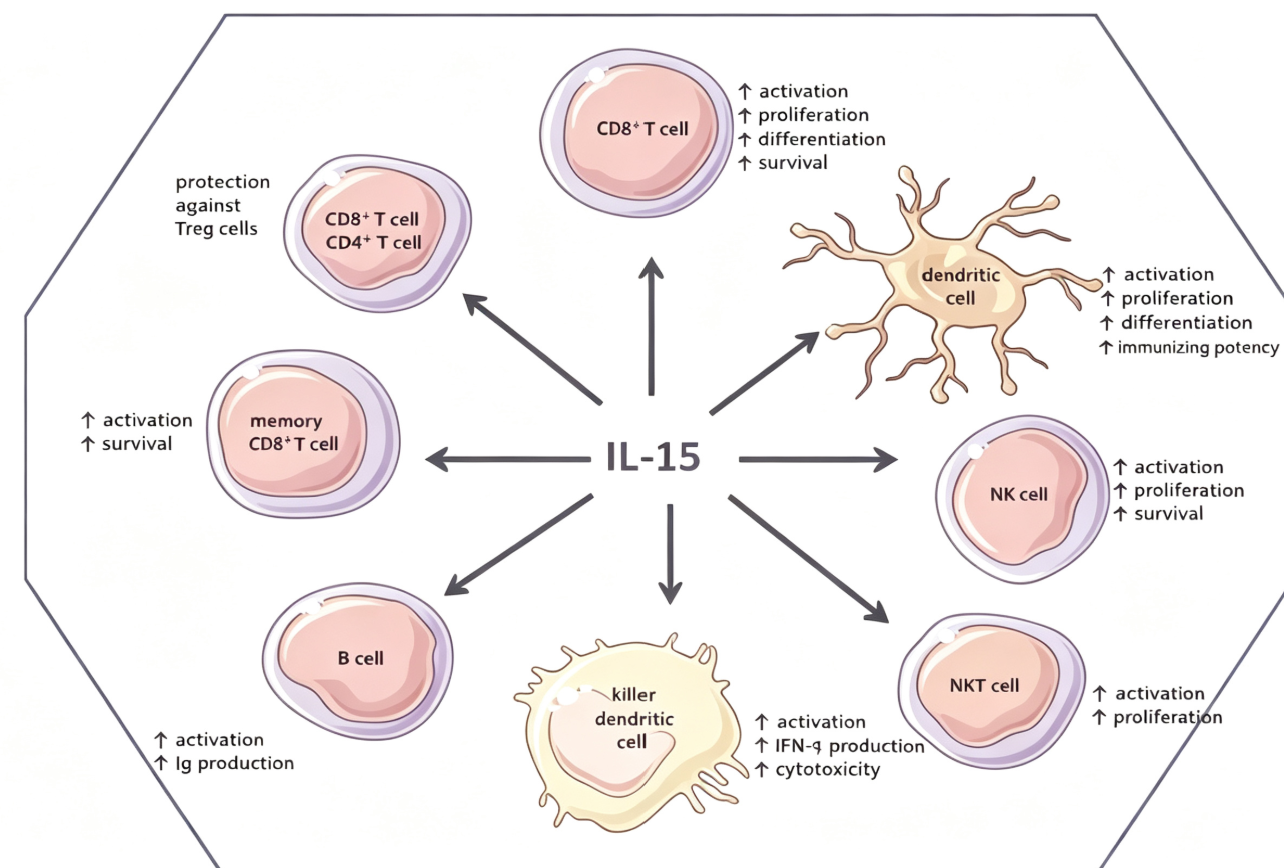
IL-15 is essential for the maintenance of memory CD8⁺ T cells, being both necessary for their generation and a key driver of their long-term survival. IL-15 promotes the survival, proliferation, activation, and cytotoxic functions of NK cells and is indispensable for NK/NKT cell development. In vitro, IL-15 can induce CTL generation and inhibit lymphocyte apoptosis.
5. Conclusion.
With its unique receptor system and trans-presentation mechanism, IL-15 plays an irreplaceable role in the homeostasis and functional regulation of various immune cell populations, including NK cells and memory CD8⁺ T cells. Its broad regulatory functions in the immune system make it a key target for tumor immunotherapy and autoimmune disease intervention. IL-15Rα recombinant proteins, as core tools for studying this signaling axis, will continue to provide critical support for basic scientific exploration and clinical translation.
Based on the biological effects of IL-15, it has become a key strategy in tumor immunotherapy. The inherent advantages of IL-15 lie in its ability to activate CD8⁺ T cells and NK cells independent of specific tumor antigens, enabling broad-spectrum tumor clearance. However, recombinant IL-15 has short pharmacokinetics and high toxicity. Improvement strategies include IL-15/IL-15Rα complexes (e.g., N-803) and long-acting IL-15 fusion proteins, which have shown efficacy in clinical trials by sustaining NK and CD8⁺ T cell expansion.
For basic research and drug development targeting the IL-15/IL-15Rα signaling axis, U-Pharm provides IL-15R alpha/CD215 Fc Chimera Protein, Human. This product is suitable for blocking analysis of IL-15/IL-15Rα binding, screening and evaluation of anti-IL-15Rα antibodies, and mechanistic studies of IL-15 signaling pathways.
Disclaimer: This article partially utilizes artificial intelligence assistance in its creation. If any content involves copyright or intellectual property issues, please let us know and we promise to verify and remove it as soon as possible.
Purchase recombinant protein, choose Nanjing UA-Bio
UA protein focuses on providing various protein reagents, raw materials, and services required for drug research and development, cell therapy, gene therapy, and basic scientific research, including drug target proteins, immune checkpoint proteins, cytokines, tool enzymes, customized protein expression, and full-length transmembrane protein development. Youai is committed to providing customers with high-quality products and professional services, and building a High-tech Biological Enterprise with International Competitiveness.
Target proteins | membrane proteins | cytokines | enzymes | viral antigens | protein customization
Nanjing UA Biotechnology Co., Ltd. Email:order@ua-bio.com Phone:+86-25-56221161

Product Information

Link:





©2021-2026 all rights reserved UA Biotechnology Co.,Ltd.
Privacy Policy 
网站备案号 浙ICP备2022019033号-2 浙公网安备33010202004867号
 Business license (three certificates in one)
 Tel:+86-25-56221161
E-mail:order@ua-bio.com
All products sold on this website shall not be used for clinical diagnosis or treatment of humans or animals, and shall only be used for non-medical purposes such as industrial or scientific research.
