




The critical sex-specific role of myeloid cell ErbB3 signaling in early adaptation to pressure overload cardiomyopathy
Views:11 


This study, based on a mouse model of aortic constriction, systematically elucidates the critical role of myeloid cell-specific ErbB3 signaling in the early adaptation of non-ischemic cardiomyopathy. It focuses on analyzing the mechanism by which this signaling pathway mediates cardiac myeloid cell recruitment and promotes non-immune cell proliferation in male mice, while revealing the sex-specific characteristics of acute heart failure induced by ErbB3 signaling deficiency.
- Recent Advances
- Product Information
Recent Advances
Sex-Dimorphic Role of Myeloid Cell ErbB3 Signaling in Early Adaptation to Pressure Overload Cardiomyopathy
Summary
This study, based on a mouse model of transverse aortic constriction (TAC), systematically elucidates the critical role of myeloid cell-specific ErbB3 signaling in early adaptation to non-ischemic cardiomyopathy. It focuses on the mechanism by which this signaling pathway mediates cardiac myeloid cell recruitment and promotes non-immune cell proliferation in male mice, while revealing the sex-dimorphic characteristics of acute heart failure caused by ErbB3 signaling deficiency.
This study, based on a mouse model of transverse aortic constriction (TAC), systematically elucidates the critical role of myeloid cell-specific ErbB3 signaling in early adaptation to non-ischemic cardiomyopathy. It focuses on the mechanism by which this signaling pathway mediates cardiac myeloid cell recruitment and promotes non-immune cell proliferation in male mice, while revealing the sex-dimorphic characteristics of acute heart failure caused by ErbB3 signaling deficiency.
I. Research Background: Pathological Links Between Myeloid Cells and Cardiomyopathy
Myeloid cells play significant pathophysiological roles in various cardiovascular diseases, including both ischemic and non-ischemic cardiomyopathy. Following ischemic injury, the neuregulin-1/ErbB signaling pathway has been identified as a key regulator of inflammation-related myeloid cell activation. However, the specific role of myeloid cell ErbB signaling in non-ischemic cardiomyopathy remains unclear, limiting our understanding of the early inflammatory regulatory network in cardiomyopathy.
II. Experimental Model and Study Design
To investigate the regulatory role of myeloid cell ErbB3 receptor in early adaptive responses to non-ischemic cardiomyopathy, researchers employed a mouse model of pressure overload cardiomyopathy induced by transverse aortic constriction (TAC). The study subjects included myeloid cell-specific ErbB3-deficient mice and their littermate controls. By comparing survival rates, organ edema levels, and cardiac cell population changes post-TAC, the functional significance of ErbB3 signaling was systematically evaluated. Flow cytometry was used to quantify CD45+ immune cells, CD11b+ myeloid cells, Ly6G+ neutrophils, and Ly6C+ monocytes in the heart, combined with protein and antibody microarray techniques to detect key cytokine expression changes.
III. Sex-Dimorphic Findings: ErbB3 Deficiency Leads to Acute Heart Failure in Male Mice
The study revealed a striking sex-dimorphic phenomenon: five days post-TAC, male ErbB3-deficient mice exhibited significantly lower survival rates compared to female ErbB3-deficient mice or control animals. Further analysis of lung weight/body weight ratios showed acute pulmonary edema in male ErbB3-deficient mice post-TAC, indicating acute heart failure. This finding is the first to demonstrate the indispensable protective role of myeloid cell ErbB3 signaling in early adaptation to cardiac pressure overload in male mice, while female mice may compensate through alternative mechanisms.
IV. Molecular Mechanism of ErbB3 in Regulating Cardiac Myeloid Cell Recruitment and Non-Immune Cell Proliferation
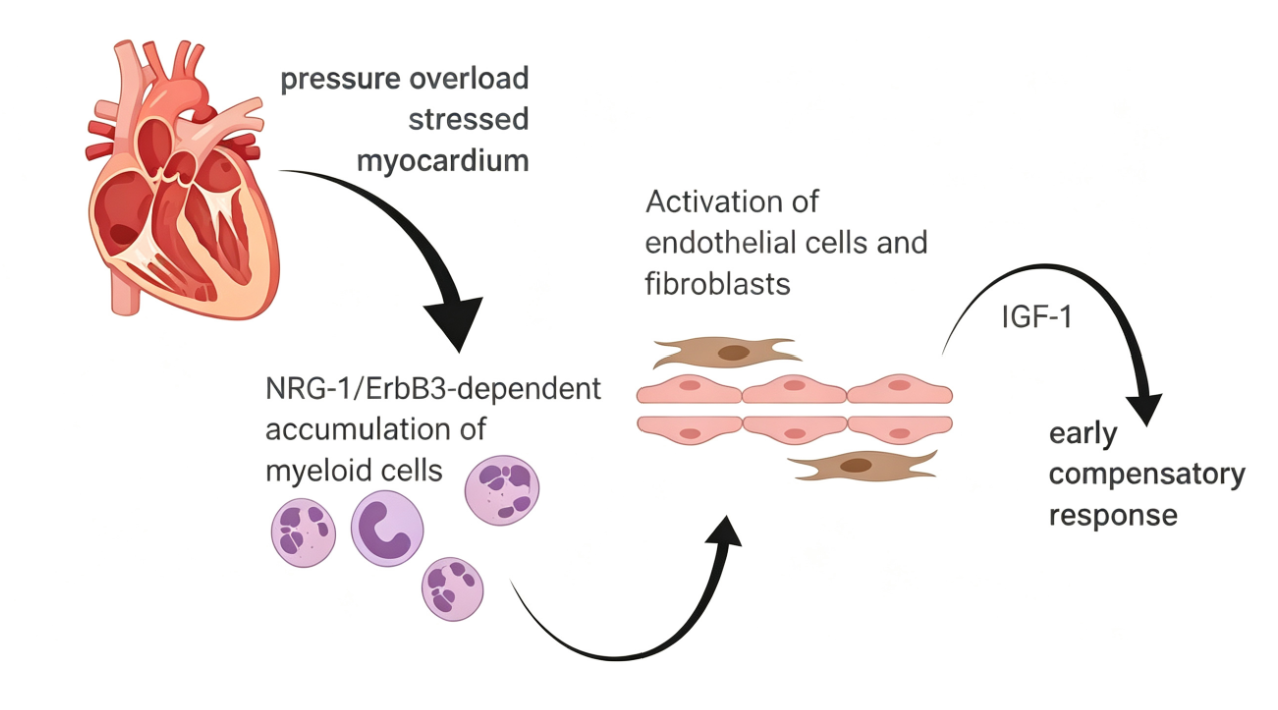
To elucidate the cellular basis of increased mortality in male ErbB3-deficient mice, researchers analyzed cardiac cell populations three days post-TAC using flow cytometry. Results showed that control mice exhibited significant increases in myeloid cell numbers and Sca-1-positive non-immune cell (primarily endothelial cells and fibroblasts) proliferation, representing an early adaptive response to pressure overload. However, these cellular expansions were absent in the hearts of male ErbB3-deficient mice. Female mice showed no significant differences in these metrics regardless of genotype, further highlighting the sex-dimorphic nature of these responses.
V. Molecular Link Between IGF-1 Downregulation and ErbB3 Deficiency
Protein and antibody microarray analysis revealed significant downregulation of insulin-like growth factor-1 (IGF-1) expression in the hearts of ErbB3-deficient mice post-TAC compared to controls. IGF-1, a critical pro-survival and pro-proliferation factor, may directly influence the activation and proliferation of cardiac non-immune cells, thereby impairing cardiac compensation to pressure overload. The combined effects of IGF-1 downregulation, impaired myeloid cell recruitment, and blocked Sca-1+ cell proliferation form a pathological chain explaining how ErbB3 deficiency leads to failed early adaptation and progression to acute heart failure in male mice.
VI. Conclusion
This study is the first to reveal the critical protective role of myeloid cell ErbB3 signaling in early adaptation to pressure overload cardiomyopathy, demonstrating significant sex dimorphism. Myeloid cell ErbB3 mediates early cardiac compensatory responses to pressure overload by promoting cardiac myeloid cell recruitment, non-immune cell proliferation, and IGF-1 upregulation. This discovery not only provides new insights into the inflammatory regulatory mechanisms of cardiomyopathy but also identifies potential therapeutic targets for cardiovascular disease interventions based on ErbB3 signaling pathways.
In these mechanistic studies, detection and functional validation of ErbB3 protein are crucial for elucidating its signaling pathway. ErbB3 (HER3), a member of the HER/ErbB receptor family, shares high homology with EGFR and HER2 but requires heterodimerization with HER2 to initiate downstream PI3K/AKT signaling due to its minimal tyrosine kinase activity. To support such research, U-Impact offers ErbB3/Her3 Fc Chimera Protein, Human, which can be used for analyzing ErbB3 binding activity with its ligand NRG, screening and evaluating anti-ErbB3 antibodies, and studying ErbB3 signaling mechanisms in cardiomyopathy models.
Disclaimer: This article partially utilizes artificial intelligence assistance in its creation. If any content involves copyright or intellectual property issues, please let us know and we promise to verify and remove it as soon as possible.
Purchase recombinant protein, choose Nanjing UA-Bio
UA protein focuses on providing various protein reagents, raw materials, and services required for drug research and development, cell therapy, gene therapy, and basic scientific research, including drug target proteins, immune checkpoint proteins, cytokines, tool enzymes, customized protein expression, and full-length transmembrane protein development. Youai is committed to providing customers with high-quality products and professional services, and building a High-tech Biological Enterprise with International Competitiveness.
Target proteins | membrane proteins | cytokines | enzymes | viral antigens | protein customization
Nanjing UA Biotechnology Co., Ltd. Email:order@ua-bio.com Phone:+86-25-56221161

Product Information

Link:





©2021-2026 all rights reserved UA Biotechnology Co.,Ltd.
Privacy Policy 
网站备案号 浙ICP备2022019033号-2 浙公网安备33010202004867号
 Business license (three certificates in one)
 Tel:+86-25-56221161
E-mail:order@ua-bio.com
All products sold on this website shall not be used for clinical diagnosis or treatment of humans or animals, and shall only be used for non-medical purposes such as industrial or scientific research.
