




The pleiotropic functional network of IL-27: Dual roles in tumors, autoimmunity, obesity, and viral infections
Views:9 


This article systematically elucidates the molecular structure of IL-27 as a member of the IL-6/IL-12 family, its signal transduction mechanisms, and its complex regulatory functions in tumor immunity, autoimmune diseases, obesity-related inflammation, and viral infections. It reveals its dual effects mediated through the JAK/STAT pathway—both anti-tumor and pro-tumor—as well as its context-dependent anti-inflammatory and pro-inflammatory characteristics.
- Recent Advances
- Product Information
Recent Advances
The Pleiotropic Functional Network of IL-27: Dual Roles in Tumors, Autoimmunity, Obesity, and Viral Infections
Summary
This article systematically elaborates on the molecular structure and signaling transduction mechanisms of IL-27 as a member of the IL-6/IL-12 family, as well as its complex regulatory functions in tumor immunity, autoimmune diseases, obesity-related inflammation, and viral infections. It reveals its dual effects—anti-tumor and pro-tumor, anti-inflammatory and pro-inflammatory—mediated through the JAK/STAT pathway, highlighting its context-dependent characteristics.
This article systematically elaborates on the molecular structure and signaling transduction mechanisms of IL-27 as a member of the IL-6/IL-12 family, as well as its complex regulatory functions in tumor immunity, autoimmune diseases, obesity-related inflammation, and viral infections. It reveals its dual effects—anti-tumor and pro-tumor, anti-inflammatory and pro-inflammatory—mediated through the JAK/STAT pathway, highlighting its context-dependent characteristics.
1. Molecular Structure and Signaling Transduction Mechanisms of IL-27.
IL-27 is a heterodimeric cytokine composed of two subunits, IL-27p28 and EBI3, linked by non-covalent bonds. It belongs to the IL-12 family while also being structurally related to the IL-6 family. Its receptor complex consists of two chains: IL-27Rα (also known as WSX-1) and gp130, with gp130 serving as a common signal-transducing subunit for multiple cytokines such as IL-35, IL-6, and IL-11. The receptor complex is expressed in various cell types, including T cells, B cells, NK cells, dendritic cells, monocytes, mast cells, endothelial cells, and adipocytes.
Upon binding to its receptor, IL-27 primarily activates the JAK-STAT signaling pathway, with the phosphorylation of STAT1 and STAT3 being the core steps in signal transduction. In healthy individuals, IL-27 is mainly produced by activated antigen-presenting cells (such as dendritic cells, macrophages, and monocytes) in a TLR- and IFN-γ-dependent manner.
2. The Dual-Edged Sword Effect of IL-27 in Tumor Immunity.
IL-27 exhibits complex dual regulatory roles in tumor immunity, possessing both anti-tumor and pro-tumor potential.
In its anti-tumor role, IL-27 can induce IFN-γ production, enhance the survival and differentiation of tumor-specific CD8⁺ T cells. Recent studies confirm that IL-27 directly acts on tumor-specific CD8⁺ T cells, promoting their persistence and effector function in the tumor microenvironment and driving an enhanced cytotoxic program. IL-27 can also activate NK cells, inducing tumor cell apoptosis via the Fas/FasL-dependent pathway, and inhibit tumor angiogenesis by downregulating pro-angiogenic genes (e.g., VEGFR1, PTGS1) and upregulating anti-angiogenic genes (e.g., IP-10). Additionally, IL-27 can induce apoptosis in cancerous B cells and promote tumor cell apoptosis by enhancing TLR3 expression.
In its pro-tumor role, IL-27 can drive Treg expression of CD39 via the STAT1 pathway, exerting Treg-mediated pro-tumor effects. It can also induce PD-L1 expression, mediating immune suppression. IL-27 has been shown to inhibit Th17 cell development and reduce IL-17 production through a STAT1-dependent pathway. IL-27 has been explored for predicting breast cancer survival, immune checkpoint expression, and immune cell infiltration status, suggesting that combination therapies with PD-1/PD-L1 or IDO inhibitors may be superior treatment strategies.
3. Regulatory Role of IL-27 in Autoimmune Diseases.
Taking rheumatoid arthritis as an example, IL-27 simultaneously exhibits anti-inflammatory and pathogenic properties. In the early stages of the disease, IL-27 can delay disease progression by inhibiting IL-17 and IL-6 secretion and suppressing the differentiation of naive CD4⁺ T cells into Th17 cells. It can also inhibit TNF-α-induced CCL20 production, indirectly hindering the recruitment of CCR6⁺ cell populations (including Th17 cells). In RA synovium, IL-27 can suppress IL-6 production by fibroblast-like synoviocytes stimulated by TNF-α or IL-17A.
However, IL-27 can also exacerbate RA by inducing FLS expression of adhesion molecules and the release of inflammatory chemokines, and it can activate the mTOR signaling pathway, leading to abnormal peripheral B cell function. Notably, gut-resident Treg cells produce IL-27 during intestinal inflammation to limit Th17 cell differentiation, thereby suppressing pro-inflammatory responses to gut bacteria and mitigating autoimmune damage. In experimental autoimmune encephalomyelitis models, IL-27 exerts neuroprotective effects by promoting the anti-inflammatory functions of Treg and Tr1 cells while inhibiting pro-inflammatory Th1 and Th17 responses.
4. Dual Roles of IL-27 in Obesity-Related Inflammation.
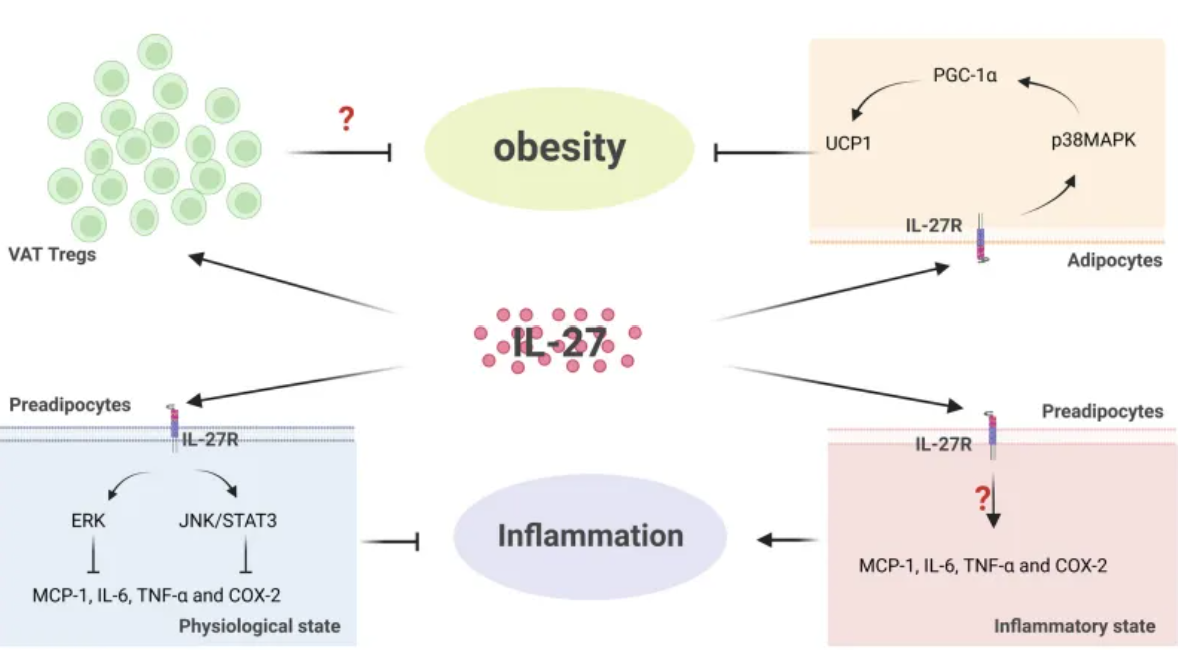
IL-27 also exhibits context-dependent roles in regulating adipose tissue inflammation. Theoretically, IL-27 signaling can protect against obesity and insulin resistance by promoting thermogenesis and energy expenditure. Specific mechanisms include regulating the number of Tregs in visceral adipose tissue via WSX-1 signaling and directly acting on adipocytes to induce the expression of the thermogenic effector UCP1 through the p38MAPK/PGC-1α signaling pathway.
However, when obesity has already triggered inflammation, IL-27 can exacerbate the progression of adipose tissue inflammation. In vitro experiments show that IL-27 synergizes with TNF-α to significantly increase the expression of MCP-1, IL-6, COX-2, and TNF-α. Notably, the role of IL-27 differs between adults and children—serum IL-27 levels decrease with increasing obesity in adults, whereas IL-27 levels in the plasma of obese children are elevated.
5. Inhibitory Role of IL-27 in Viral Infections.
IL-27 exhibits multifaceted inhibitory effects in HIV infection. In various immune cells, including PBMCs, CD4⁺ T cells, monocyte-derived macrophages, and dendritic cells, IL-27 can hinder HIV replication. The mechanisms involve activating antiviral protein genes in CD4⁺ T cells, modulating the Th1/Th2 ratio, inducing IFIG expression in MDMs, upregulating immune restriction factors such as APOBEC3G and BST-2 in macrophages, and downregulating the host factor SPTBN1 while inhibiting YB-1 acetylation.
6. Conclusion.
As a key member of the IL-12 family, IL-27 mediates complex regulatory functions in various fields, including tumors, autoimmunity, obesity, and viral infections, through the JAK/STAT pathway. Its "dual-edged sword" effects—anti-tumor and pro-tumor, anti-inflammatory and pro-inflammatory—in different pathological contexts and disease stages highlight its highly context-dependent functionality. In-depth analysis of IL-27's fine regulatory network and preclinical translational studies using non-human primate models, such as cynomolgus monkeys, will provide critical support for optimizing immune therapy strategies targeting the IL-27 pathway. Uni offers IL-27 Protein, Cynomolgus, which can be used for IL-27-receptor (IL-27Rα/gp130) binding analysis, neutralizing antibody screening, JAK/STAT signaling pathway mechanism studies, and in vivo drug activity evaluation. It is suitable for translational research in autoimmune diseases, tumor immunology, and infectious diseases.
Disclaimer: This article partially utilizes artificial intelligence assistance in its creation. If any content involves copyright or intellectual property issues, please let us know and we promise to verify and remove it as soon as possible.
Purchase recombinant protein, choose Nanjing UA-Bio
UA protein focuses on providing various protein reagents, raw materials, and services required for drug research and development, cell therapy, gene therapy, and basic scientific research, including drug target proteins, immune checkpoint proteins, cytokines, tool enzymes, customized protein expression, and full-length transmembrane protein development. Youai is committed to providing customers with high-quality products and professional services, and building a High-tech Biological Enterprise with International Competitiveness.
Target proteins | membrane proteins | cytokines | enzymes | viral antigens | protein customization
Nanjing UA Biotechnology Co., Ltd. Email:order@ua-bio.com Phone:+86-25-56221161

Product Information

Link:





©2021-2026 all rights reserved UA Biotechnology Co.,Ltd.
Privacy Policy 
网站备案号 浙ICP备2022019033号-2 浙公网安备33010202004867号
 Business license (three certificates in one)
 Tel:+86-25-56221161
E-mail:order@ua-bio.com
All products sold on this website shall not be used for clinical diagnosis or treatment of humans or animals, and shall only be used for non-medical purposes such as industrial or scientific research.
