

Study on antigen-specific T cell detection using UA-MHC H-2Kb/KSPWFTTL murine leukemia virus p15E tetramers
Views:9 


The p15E antigen epitope of murine leukemia virus and its immunology research value.
- Recent Advances
- Product Information
Recent Advances
Research on Antigen-Specific T Cell Detection Using UA-MHC H-2Kb/KSPWFTTL Murine Leukemia Virus p15E Tetramer
Murine Leukemia Virus p15E Antigen Epitope and Its Immunological Research Value.
Murine leukemia virus (MuLV) is a retrovirus with oncogenic potential in murine hosts, whose genome consists of single-stranded positive-sense RNA and replicates through reverse transcription. Among the various structural proteins encoded by MuLV, the p15E protein serves as the transmembrane subunit of the envelope glycoprotein, playing a critical role in viral entry into host cells and also acting as a key target antigen for the host's antiviral immune response. Studies have shown that specific peptide epitopes derived from the p15E protein can be effectively presented by major histocompatibility complex (MHC) class I molecules, thereby activating CD8+ cytotoxic T lymphocyte (CTL)-mediated immune responses.
Particularly noteworthy is the nonapeptide sequence KSPWFTTL (also known as the M8 epitope), located at amino acid positions 604-611 of the p15E protein, which has been identified as an immunodominant CTL epitope in H-2Kb haplotype mice. The immunological significance of this epitope extends beyond virology: the p15E protein can be endogenously expressed in various H-2b haplotype tumor cells, including common tumor models such as B16 melanoma, MC38 colorectal adenocarcinoma, and MCA205 sarcoma cells. Consequently, M8 epitope-specific CD8+ T cells can be effectively detected in tumor-infiltrating lymphocytes. This characteristic makes the KSPWFTTL/H-2Kb system an important bridge connecting antiviral immunity and antitumor immunity research, providing a reliable animal model platform for preclinical validation of tumor immunotherapy strategies.
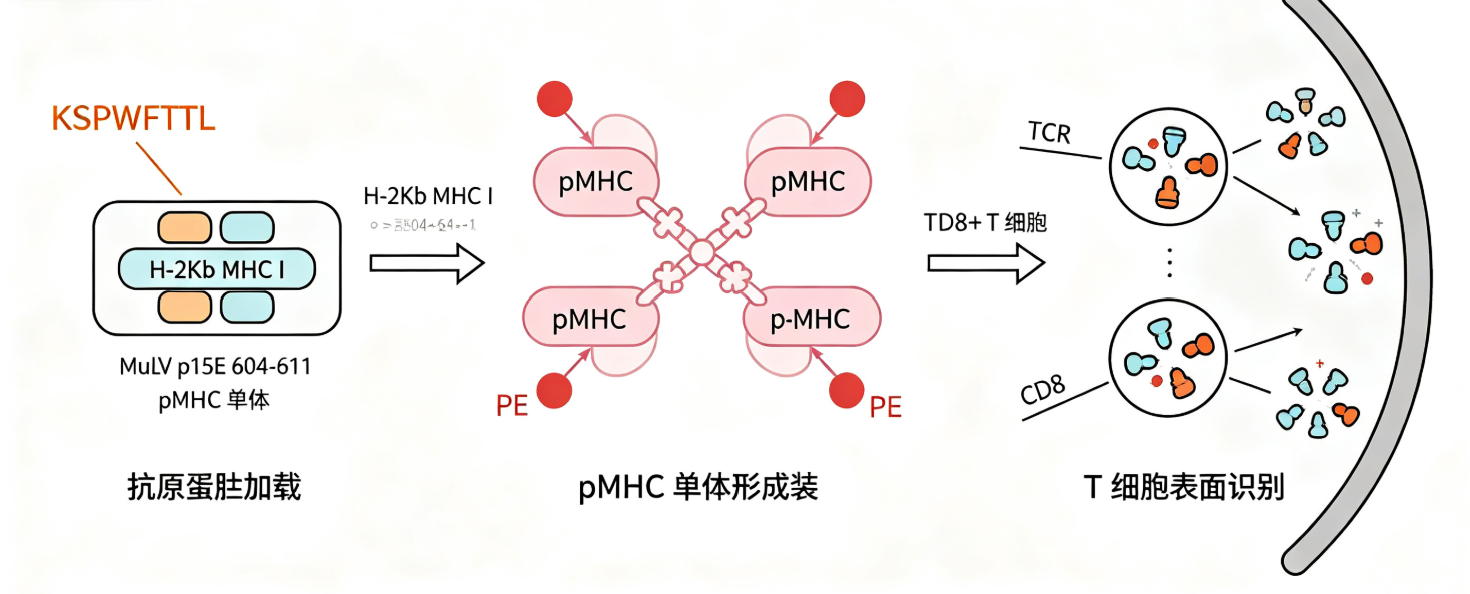
Core Principles of MHC-Peptide Tetramer Technology in Antigen-Specific T Cell Detection.
Accurate quantitative detection and phenotypic analysis of antigen-specific CD8+ T cells are critical for understanding adaptive immune response mechanisms. MHC-peptide tetramer technology has been recognized as the gold standard method in this field. The core design principle of this technology lies in: in vitro recombinant expression of biotinylated MHC class I molecules, which are correctly folded with specific antigen peptides to form pMHC monomer complexes, followed by the assembly of four pMHC monomers into a tetramer structure through the high-affinity binding of streptavidin and biotin. This tetramer structure can simultaneously bind multiple T cell receptors (TCRs) on the T cell surface, significantly enhancing binding affinity and enabling stable capture of low-affinity T cells. When conjugated with fluorescent dyes, this probe can precisely quantify CD8+ T cells reacting to specific epitopes via flow cytometry. Since this method relies directly on the physical binding of TCR to pMHC complexes and does not involve T cell activation or effector function, it can comprehensively reflect the true frequency of antigen-specific T cell populations, including functionally impaired or quiescent cells.
Product Characteristics and Key Technical Parameters of UA-MHC H-2Kb/KSPWFTTL MuLV p15E Tetramer-PE.
To address the above research needs, UA-Biotech offers the high-performance UA-MHC H-2Kb/KSPWFTTL MuLV p15E Tetramer-PE product. The design and preparation of this product strictly adhere to the core technical standards of MHC tetramers, with the following key features: In terms of molecular composition, the reagent contains murine MHC class I molecule H-2Kb allele products, pre-loaded with the KSPWFTTL antigen peptide (corresponding to amino acid positions 604-611) derived from the MuLV p15E protein. The peptide-H-2Kb complex is assembled into a tetramer, ensuring stability and affinity for specific TCR binding. In terms of fluorescent labeling, the tetramer is conjugated with phycoerythrin (PE) fluorophore, with excitation wavelengths of 486-580 nm and emission wavelengths of 586-590 nm, highly compatible with standard detection channels of flow cytometers, facilitating the design of multicolor fluorescence analysis schemes. The product is supplied in 50-test quantities and should be stored at 4°C protected from light.
In terms of applications, this tetramer reagent is suitable for flow cytometric detection of H-2Kb-restricted, MuLV p15E (KSPWFTTL)-specific CD8+ T cells in mouse-derived samples such as peripheral blood, spleen, lymph nodes, and tumor-infiltrating lymphocytes. Notably, published academic literature has reported examples of this tetramer reagent's use in tumor immunology research, such as analyzing the frequency of antigen-specific CD8+ T cells in tumor-infiltrating lymphocytes in the MC38 tumor model and evaluating the effects of immunotherapy strategies like STING agonists on CD8+ T cell responses.
Research Applications and Experimental Strategies Based on H-2Kb/KSPWFTTL Tetramer.
The following key strategies should be noted when using the UA-MHC H-2Kb/KSPWFTTL MuLV p15E Tetramer-PE in experiments. First, when selecting anti-mouse CD8 antibodies, caution should be exercised as certain clones (e.g., 53-6.7) may cause high background staining in all CD8+ T cells rather than specifically recognizing antigen-specific T cells. It is recommended to prioritize the KT15 clone (e.g., MBL-K0227-4) for optimal staining results. Second, checkerboard titration experiments with tetramers and anti-CD8 antibodies are advised to determine the optimal working concentrations for specific experimental systems. In the sample staining protocol, the tetramer is typically incubated with the sample at room temperature or 2-8°C protected from light for 30-60 minutes, followed by the addition of anti-CD8 antibodies for further incubation. After washing and red blood cell lysis (for whole blood samples), the samples are ready for analysis. For rare event analysis, pre-expansion and enrichment of antigen-specific T cells in vitro may be necessary.
The value of this reagent in tumor immunology research has been validated by multiple independent research teams. For example, in the MC38 tumor-bearing mouse model, researchers successfully used this KSPWFTTL/H-2Kb tetramer to detect the presence of antigen-specific CD8+ T cells in tumor-infiltrating lymphocytes and observed the regulatory effects of different combination immunotherapy regimens on the frequency of this cell population. Additionally, as the MuLV model is a reliable animal model for preclinical validation of tumor immunotherapy, this tetramer provides a direct and sensitive detection tool for evaluating the pharmacodynamic effects of novel immunotherapeutic agents such as immune checkpoint inhibitors and STING agonists.
Summary.
In summary, the UA-MHC H-2Kb/KSPWFTTL MuLV p15E Tetramer-PE is a high-performance research tool that combines the specificity of MHC-peptide tetramer technology with the sensitivity of PE fluorescent labeling to achieve precise detection of p15E antigen-specific CD8+ T cells. This reagent not only provides a core method for studying immune responses to MuLV infection but also serves as an indispensable detection tool for tumor immunotherapy research based on p15E-positive tumor models such as MC38. UA-Biotech offers this high-quality product to support researchers in conducting in-depth studies in the frontier fields of antiviral immunity and tumor immunology.
Disclaimer: This article partially utilizes artificial intelligence assistance in its creation. If any content involves copyright or intellectual property issues, please let us know and we promise to verify and remove it as soon as possible.
Purchase recombinant protein, choose Nanjing UA-Bio
UA protein focuses on providing various protein reagents, raw materials, and services required for drug research and development, cell therapy, gene therapy, and basic scientific research, including drug target proteins, immune checkpoint proteins, cytokines, tool enzymes, customized protein expression, and full-length transmembrane protein development. Youai is committed to providing customers with high-quality products and professional services, and building a high-tech enterprise with international competitiveness.
Target proteins | membrane proteins | cytokines | enzymes | viral antigens | protein customization
Nanjing UA Biotechnology Co., Ltd. Email:order@ua-bio.com Phone:0571-87565022

Product Information

Link:





©2021-2026 all rights reserved UA Biotechnology Co.,Ltd.

网站备案号 浙ICP备2022019033号-2 浙公网安备33010202004867号
 Business license (three certificates in one)
 Tel:+86-0571-87565022
E-mail:order@ua-bio.com
All products sold on this website shall not be used for clinical diagnosis or treatment of humans or animals, and shall only be used for non-medical purposes such as industrial or scientific research.
