

Application of the UniOne® TR-FRET Technology Platform in CDK4/CRBN PROTAC Binding Assays
Views:10 


Detection principle and technical advantages based on time-resolved fluorescence resonance energy transfer.
- Recent Advances
- Product Information
Recent Advances
Application of UniOne® TR-FRET Technology Platform in CDK4/CRBN PROTAC Binding Assays
Principles and Technical Advantages of Time-Resolved Fluorescence Resonance Energy Transfer.
Time-Resolved Fluorescence Resonance Energy Transfer (TR-FRET) technology combines the dual advantages of fluorescence resonance energy transfer and time-resolved fluorescence detection, making it a highly valuable homogeneous assay method in modern drug screening. The core of this technology lies in the use of lanthanide chelates (such as europium Eu³⁺ or terbium Tb³⁺) as energy donors, whose fluorescence half-life extends to the millisecond range, far exceeding the nanosecond-level half-life of ordinary fluorescent substances. By setting an appropriate delay detection time (typically 50 to 150 microseconds), short-lived background fluorescence and non-specific scattered light are sufficiently attenuated, while the specific fluorescence signals from the donor and acceptor are retained, significantly improving the signal-to-noise ratio and sensitivity of the assay.
In the fluorescence resonance energy transfer mechanism, when the distance between the donor and acceptor molecules is less than 10 nanometers, the energy from the excited donor can be transferred to the acceptor through non-radiative means, causing the acceptor to emit fluorescence at a specific wavelength. This distance-dependent characteristic enables TR-FRET technology to accurately reflect the interaction states between biomacromolecules. When the target protein binds or dissociates from a ligand, the spatial distance between the donor and acceptor changes accordingly, altering the energy transfer efficiency, which is ultimately quantified by analyzing the fluorescence signal ratio at 620 nm and 665 nm.
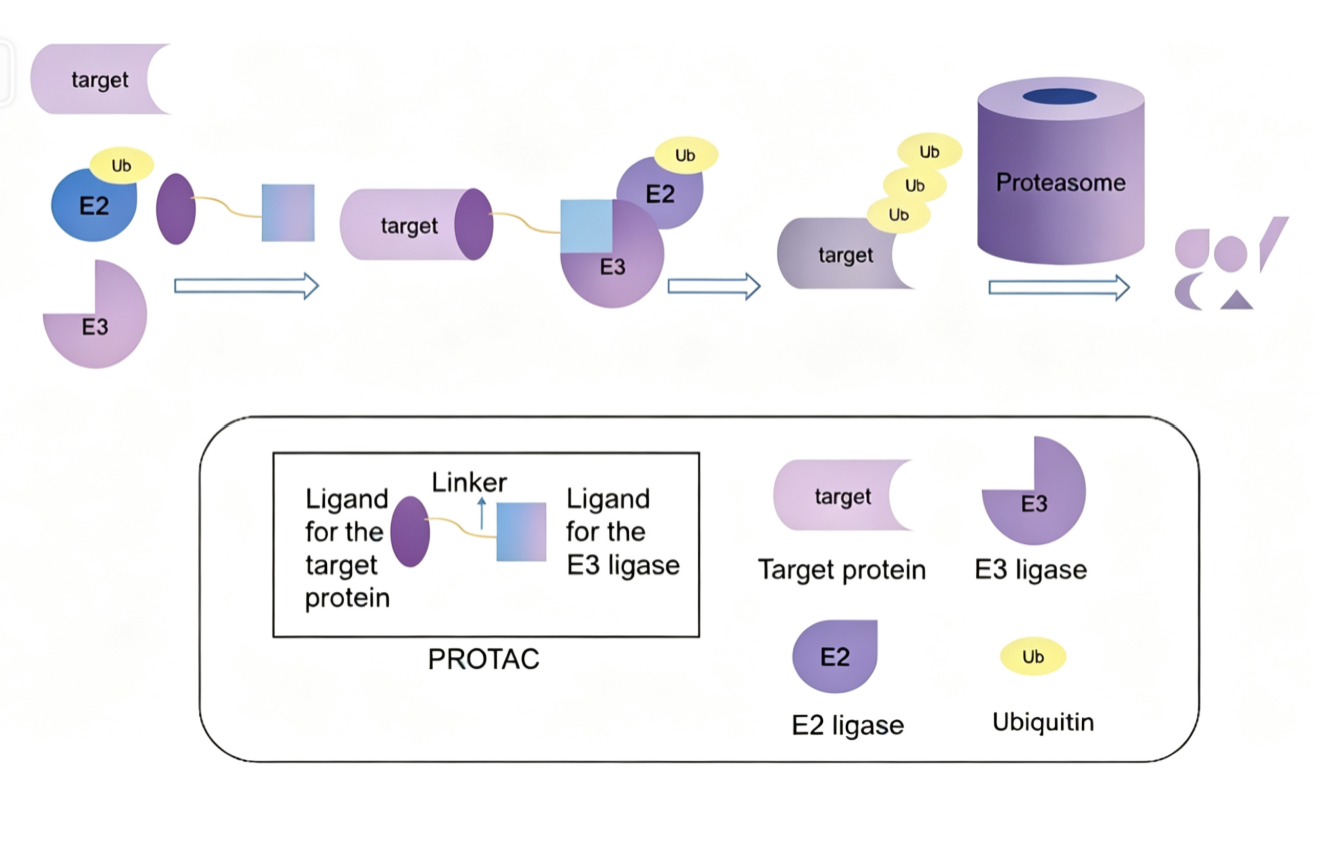
Mechanism of PROTAC Technology and Biological Significance of CDK4/CRBN Targets.
Proteolysis Targeting Chimera (PROTAC) is a class of heterobifunctional small molecules, where one end binds to the target protein (Protein of Interest, POI) and the other end binds to the substrate recognition subunit of an E3 ubiquitin ligase, thereby inducing the formation of a ternary complex between the target protein and the E3 ligase. The target protein is ubiquitinated by the E3 ligase complex and subsequently degraded via the ubiquitin-proteasome pathway, achieving protein-level regulation.
Cyclin-Dependent Kinase 4 (CDK4) is a key kinase in the cell cycle regulation network. When complexed with cyclin D (Cyclin D), it phosphorylates the retinoblastoma protein (Rb), driving the cell from the G1 phase into the S phase. Abnormal activation of the CDK4 signaling pathway is closely associated with the development of various cancers, making it an important target for anti-tumor drug development. Cereblon (CRBN) is the substrate recognition component of the CUL4-RBX1-DDB1 E3 ubiquitin ligase complex, capable of recruiting various substrate proteins for ubiquitination and proteasomal degradation. Given CRBN's central role in PROTAC molecule design, developing efficient ligand screening tools for CRBN is crucial for the discovery of novel PROTAC drugs.
Design and Experimental Workflow of the CDK4/CRBN PROTAC Binding Assay Kit.
Based on the above technical principles and biological background, the UniOne® TR-FRET Human CDK4/CRBN PROTAC Binding Kit employs a competitive binding mode to quantitatively detect the formation of PROTAC-induced ternary complexes. In this system, recombinant CDK4 protein with specific tags (e.g., GST-His dual tags) binds to a fluorescence donor-labeled anti-tag antibody, while FLAG-tagged CRBN protein binds to a fluorescence acceptor-labeled anti-FLAG antibody. When the tested PROTAC molecule simultaneously binds to CDK4 and CRBN, the two proteins are brought within the effective FRET distance, and energy from the excited donor is transferred to the acceptor, generating characteristic fluorescence signals at 665 nm. The signal intensity is positively correlated with the amount of ternary complex formed, reflecting the bridging activity of the PROTAC molecule.
The kit's experimental workflow follows a homogeneous three-step process of "add-incubate-read," eliminating the need for cumbersome washing and separation steps. Specifically: first, the tested PROTAC sample is co-incubated with CDK4 and CRBN proteins in a microplate to allow full formation of the ternary complex; then, the acceptor and donor fluorescent labels are added sequentially; finally, the TR-FRET signals are read on a multifunctional microplate reader. The entire process can be completed within hours and is compatible with high-throughput operations in 96-well or 384-well plates.
Key Components, Performance Validation, and Application Scenarios of the Kit.
The UniOne® TR-FRET Human CDK4/CRBN PROTAC Binding Kit contains all core components required for the assay, including purified recombinant CDK4/Cyclin D3 complex (with GST-His tags), purified recombinant CRBN protein (with FLAG tags), a positive control PROTAC molecule (e.g., BSJ-03-204), a negative control compound (e.g., the CDK inhibitor Palbociclib), and optimized reaction buffers. All components undergo rigorous quality control to ensure batch-to-batch consistency and experimental reproducibility.
This kit is primarily used for activity evaluation and structural optimization studies of PROTAC molecules. By measuring the TR-FRET signal intensity induced by different concentrations of PROTAC, dose-response curves can be constructed to calculate the half-maximal effective concentration (EC₅₀), enabling direct comparison of the bridging efficiency of different PROTAC candidates. Additionally, this platform can be used to assess the cooperativity of PROTAC-induced ternary complexes by analyzing the shape of the signal-dose curve to determine whether the binding between the PROTAC and CDK4/CRBN exhibits positive or negative cooperative effects.
Compared to traditional assay methods, the TR-FRET technology platform offers significant advantages. First, the homogeneous reaction mode eliminates error accumulation from washing steps, improving data stability and reproducibility. Second, time-resolved detection effectively shields interference from compound autofluorescence and buffer background, enhancing assay sensitivity and specificity. Third, the system is easily automated and compatible with high-throughput screening platforms, significantly accelerating the drug discovery process.
Conclusion and Product Description.
In summary, the UniOne® TR-FRET-based Human CDK4/CRBN PROTAC Binding Kit provides an efficient, sensitive, and reliable detection tool for PROTAC drug development, enabling precise evaluation of PROTAC molecules' ability to induce ternary complex formation between CDK4 and CRBN. This product integrates advanced TR-FRET technology, high-quality protein reagents, and optimized experimental protocols, making it widely applicable for activity comparison, structure-activity relationship studies, and functional validation of small-molecule PROTACs.
UniOne Biotechnology offers the corresponding product: UniOne® TR-FRET Human CDK4/CRBN PROTAC Binding Kit. The kit is supplied as a complete ready-to-use package, including all necessary reagents and detailed instructions, meeting the needs of drug discovery laboratories for high-throughput PROTAC activity screening.
Disclaimer: This article partially utilizes artificial intelligence assistance in its creation. If any content involves copyright or intellectual property issues, please let us know and we promise to verify and remove it as soon as possible.
Purchase recombinant protein, choose Nanjing UA-Bio
UA protein focuses on providing various protein reagents, raw materials, and services required for drug research and development, cell therapy, gene therapy, and basic scientific research, including drug target proteins, immune checkpoint proteins, cytokines, tool enzymes, customized protein expression, and full-length transmembrane protein development. Youai is committed to providing customers with high-quality products and professional services, and building a high-tech enterprise with international competitiveness.
Target proteins | membrane proteins | cytokines | enzymes | viral antigens | protein customization
Nanjing UA Biotechnology Co., Ltd. Email:order@ua-bio.com Phone:0571-87565022

Product Information

Link:





©2021-2026 all rights reserved UA Biotechnology Co.,Ltd.

网站备案号 浙ICP备2022019033号-2 浙公网安备33010202004867号
 Business license (three certificates in one)
 Tel:+86-0571-87565022
E-mail:order@ua-bio.com
All products sold on this website shall not be used for clinical diagnosis or treatment of humans or animals, and shall only be used for non-medical purposes such as industrial or scientific research.
