ALK7 (ACVR1C): An ALK-independent TGF-β superfamily type I receptor and metabolic signaling node
Author: Senior Product Manager of UA Views:10 


This article systematically examines the molecular identity and functional positioning of ALK7 (ACVR1C), distinguishing its essential differences from anaplastic lymphoma kinase (ALK) in terms of discovery origin, kinase classification, activation mechanisms, and disease spectrum. It elaborates on the protein structural features of ALK7 as a type I receptor of the TGF-β receptor superfamily and the assembly of tetrameric receptor complexes, and analyzes its functional mechanism in adipocytes through the Activin E-SMAD2/3 axis in regulating lipolysis.
- Recent Advances
- Product Information
Recent Advances
ALK7 (ACVR1C): An ALK-Independent TGF-β Superfamily Type I Receptor and Metabolic Signaling Node
Summary: This article focuses on the molecular identity and functional positioning of ALK7 (ACVR1C), systematically distinguishing its essential differences from anaplastic lymphoma kinase (ALK) in terms of discovery origin, kinase class, activation mechanism, and disease spectrum. It describes the protein structural features of ALK7 as a TGF-β receptor superfamily type I receptor and the assembly of the tetrameric receptor complex, and analyzes its functional mechanism in adipocytes through the Activin E-SMAD2/3 axis in regulating lipolysis.
I. Distinguishing Molecular Identity: The Essential Difference Between ALK7 and ALK.
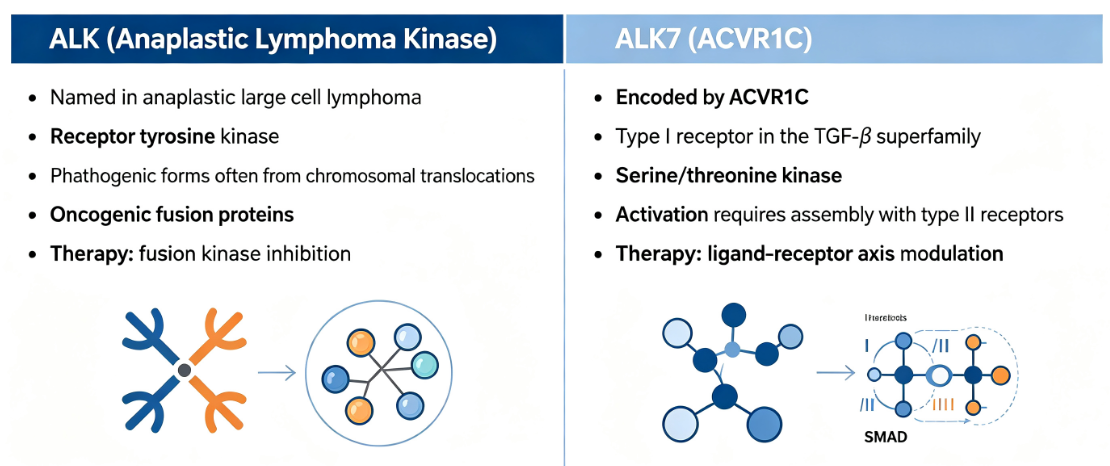
When discussing ALK7, one must first clarify a question that is highly prone to confusion in literature reading: ALK7 and anaplastic lymphoma kinase (ALK) are two completely different molecules. ALK was first discovered in a subtype of anaplastic large cell lymphoma, hence named anaplastic lymphoma kinase; it is a receptor tyrosine kinase that undergoes alterations in many malignant tumors, and its pathogenic form is mainly fusion genes generated by chromosomal translocation. ALK7, in contrast, is encoded by the ACVR1C gene and belongs to the type I receptors of the TGF-β receptor superfamily; it is a serine/threonine kinase receptor whose function depends on assembling with type II receptors into a functional complex. Although the two share the "ALK" prefix, they have no overlap in kinase class, ligand system, activation mechanism, or disease spectrum. The significance of this distinction lies not only in avoiding conceptual confusion but also in determining the fundamental divergence in drug development strategies between the two——ALK intervention revolves around inhibition of the kinase activity of fusion proteins, whereas the intervention logic for ALK7 revolves around signal modulation of the ligand-receptor axis.
II. The Fusion Activation Mechanism of ALK and Its Distribution Across Various Tumors.
To more clearly define the independent identity of ALK7, it is necessary to briefly review the pathogenic pattern of ALK as a contrast. ALK fusions occur in non-small cell lung cancer at a frequency of 3% to 7%, and most are in the form of EML4-ALK fusion; secondary resistance mutations of ALK account for approximately 37% of resistance in ALK-positive non-small cell lung cancer, specifically ALK kinase domain mutations accounting for 28% and ALK fusion gene copy number amplification accounting for 9%; ALK gene alterations occur in approximately 50% to 85% of anaplastic large cell lymphomas, and most are fusions with NPM1; 50% to 60% of patients with inflammatory myofibroblastic tumors carry ALK fusions on chromosome 2p23, with translocation fusion partners including RANBP2, TPM3, TPM4, ATIC, CLTC, CARS, and SEC31L1; approximately 8% to 9% of neuroblastoma patients harbor ALK mutations; ALK expression is found in 15% to 32% of embryonal rhabdomyosarcomas and 45% to 81% of alveolar rhabdomyosarcomas.
Mechanistically, ALK fusion genes, through the extracellular helical domain of the fusion partner, cause the kinase domains of two fusion protein molecules to bind to each other and form stable dimers, which activate downstream MAPK, PI3K/AKT, JAK/STAT3 and other pathways through autophosphorylation, thereby inducing malignant transformation of cells. This mechanism of "fusion partner-driven dimerization, dimerization-driven constitutive kinase activation" forms a sharp contrast with the activation mode of ALK7, which depends on ligands and type II receptor cooperation, and also demonstrates that the two belong to completely different paradigms in signal regulation logic.
III. The Receptor Properties of ALK7 and Tetrameric Complex Assembly.
As a type I receptor of the TGF-β receptor superfamily, the ALK7 protein structure comprises an extracellular ligand-binding domain, a single transmembrane region, and an intracellular serine/threonine kinase domain. Unlike receptor tyrosine kinases such as ALK, ALK7 does not possess tyrosine kinase activity but instead participates as a type I receptor in the transmembrane transmission of TGF-β family signals. Upon ligand binding, 2 type I receptors and 2 type II receptors assemble into a "dimer of dimers" tetrameric receptor complex, in which the type II receptor phosphorylates and activates the GS domain of ALK7, thereby initiating downstream SMAD2/3 signaling. The structural logic of this assembly mode lies in the fact that the type I receptor provides substrate specificity while the type II receptor provides kinase activity, and neither can function without the other. In contrast to the "ligand-independent constitutive activation" of ALK fusion proteins, ALK7 activation retains dependence on ligand signals, and its regulatory logic is closer to the fine-tuned regulation of physiological signaling pathways.
IV. The Functional Positioning of ALK7 in the Regulation of Lipolysis in Adipose Tissue.
ALK7 is a key receptor connecting liver-derived signals with the regulation of lipolysis in adipose tissue. INHBE is mainly expressed in the liver, and its encoded βE subunit forms a dimer, Activin E, which is then secreted into the circulation. Activin E activates SMAD2/3 signaling through the receptor complex on the surface of adipocytes, inhibits PPARγ-related transcriptional programs, reduces the lipolytic capacity of adipocytes, and promotes lipid storage and adipocyte hypertrophy. In this pathway, ALK7 assumes the core function of receiving circulating Activin E signals and initiating the intracellular cascade.
The classical pro-lipolytic signal in adipocytes is mediated by β-adrenergic receptors, which promote lipolysis by elevating cAMP levels, activating PKA, and phosphorylating proteins such as HSL and Perilipin, whereas the ALK7-SMAD2/3 pathway exerts a negative regulatory effect on lipolysis. Therefore, the common pharmacological goal of targeting ALK7 is to attenuate this inhibitory signal and promote fat mobilization, thereby achieving fat reduction. This logic of "releasing inhibition rather than direct activation" contrasts with the strategy of ALK fusion proteins, which directly blocks catalytic activity through kinase inhibitors, and also determines that ALK7 drug development is more inclined toward upstream intervention approaches such as ligand neutralization or receptor expression silencing.
V. Conclusion.
ALK7, as a type I receptor of the TGF-β receptor superfamily encoded by the ACVR1C gene, has become a highly distinctive emerging target in the field of metabolic diseases, especially obesity treatment, by virtue of its essential differences from anaplastic lymphoma kinase in discovery origin, kinase class, activation mechanism, and disease spectrum; its molecular mechanism of assembling with type II receptors into a tetrameric complex and initiating SMAD2/3 signaling; its core functional positioning in connecting liver-derived Activin E signals with the inhibition of adipocyte lipolysis; and its action logic of "releasing inhibition rather than direct activation," which distinguishes it from the ALK kinase inhibition paradigm.
In basic research on the ALK7 receptor and drug development for metabolic diseases, high-quality recombinant ALK7 protein is a core tool for dissecting its binding mechanism with the Activin E ligand, evaluating receptor complex assembly, and screening targeted intervention molecules. The GST tag facilitates efficient purification through glutathione affinity chromatography and can serve as a detection tag for analyses such as enzyme-linked immunosorbent assay and surface plasmon resonance. To meet the needs of ALK7 functional research and obesity treatment drug development, UniOne provides ACVR1C(ALK7) GST Tag Protein, Human. This product is suitable for application scenarios such as binding activity analysis of ALK7 with Activin E and type II receptors, research on ALK7-mediated SMAD2/3 signaling pathway activation, in vitro evaluation of small nucleic acid drugs and receptor blockers targeting ACVR1C, and mechanistic exploration of the metabolic signaling axis in which ALK7 participates.
VI. Common Questions About ALK7 Binding Activity Detection and Product Information
To facilitate the retrieval of evaluation schemes and product information for ALK7 interactions by researchers and drug development teams, this section answers common questions about ALK7 binding activity detection in a Q&A format and provides the product positioning and applicable scenarios of ACVR1C(ALK7) GST Tag Protein, Human.
Q1: What methods are used to detect the binding activity of ALK7?
ALK7 belongs to the type I receptors of the TGF-β receptor superfamily and is itself a serine/threonine kinase; its function depends on assembling with type II receptors into a tetrameric complex and initiating SMAD2/3 signaling. Currently, in vitro methods for evaluating ALK7 activity mainly include ADP-Glo-based kinase activity detection (quantifying ADP produced by ALK7-catalyzed substrate phosphorylation) and ELISA/SPR methods for evaluating the binding of ALK7 to Activin E or type II receptors. Kinase activity detection directly reflects the catalytic capacity of ALK7 and is suitable for screening small molecule inhibitors and determining IC50; binding experiments are used to evaluate the effects of ligand-neutralizing or receptor-blocking molecules.
ALK7 belongs to the type I receptors of the TGF-β receptor superfamily and is itself a serine/threonine kinase; its function depends on assembling with type II receptors into a tetrameric complex and initiating SMAD2/3 signaling. Currently, in vitro methods for evaluating ALK7 activity mainly include ADP-Glo-based kinase activity detection (quantifying ADP produced by ALK7-catalyzed substrate phosphorylation) and ELISA/SPR methods for evaluating the binding of ALK7 to Activin E or type II receptors. Kinase activity detection directly reflects the catalytic capacity of ALK7 and is suitable for screening small molecule inhibitors and determining IC50; binding experiments are used to evaluate the effects of ligand-neutralizing or receptor-blocking molecules.
Q2: How does the ADP-Glo kinase assay evaluate ALK7 inhibitor activity?
In the ADP-Glo system, ALK7 phosphorylates substrates in the presence of ATP, and the ADP produced by the reaction is converted into a luminescent signal through a coupled luciferase reaction. After adding serially diluted candidate inhibitors, ALK7 kinase activity is inhibited, ADP generation decreases, and the luminescent signal decreases accordingly. By plotting inhibitor concentration against signal inhibition rate, the IC50 value can be fitted to compare the inhibitory potency of different molecules and rank candidate compounds.
In the ADP-Glo system, ALK7 phosphorylates substrates in the presence of ATP, and the ADP produced by the reaction is converted into a luminescent signal through a coupled luciferase reaction. After adding serially diluted candidate inhibitors, ALK7 kinase activity is inhibited, ADP generation decreases, and the luminescent signal decreases accordingly. By plotting inhibitor concentration against signal inhibition rate, the IC50 value can be fitted to compare the inhibitory potency of different molecules and rank candidate compounds.
Q3: What is ACVR1C(ALK7) GST Tag Protein, Human?
ACVR1C(ALK7) GST Tag Protein, Human (Catalog No. UA085091) is a human-derived ALK7 recombinant protein provided by UniOne (UA-Bio), expressed using the Baculovirus-Insect Cells expression system, with the expressed sequence being Arg139-Ala493 (Accession: Q8NER5), carrying an N-terminal GST tag and covering the intracellular kinase domain of ALK7. The product has a purity greater than 95% (SDS-PAGE reducing conditions) and a specific activity greater than 3 pmol/min/μg, and is suitable for ALK7 kinase activity analysis, in vitro screening and evaluation of small molecule inhibitors and receptor blockers targeting ALK7, and mechanistic research on ALK7-mediated SMAD2/3 signaling pathway.
ACVR1C(ALK7) GST Tag Protein, Human (Catalog No. UA085091) is a human-derived ALK7 recombinant protein provided by UniOne (UA-Bio), expressed using the Baculovirus-Insect Cells expression system, with the expressed sequence being Arg139-Ala493 (Accession: Q8NER5), carrying an N-terminal GST tag and covering the intracellular kinase domain of ALK7. The product has a purity greater than 95% (SDS-PAGE reducing conditions) and a specific activity greater than 3 pmol/min/μg, and is suitable for ALK7 kinase activity analysis, in vitro screening and evaluation of small molecule inhibitors and receptor blockers targeting ALK7, and mechanistic research on ALK7-mediated SMAD2/3 signaling pathway.
Q4: What experimental scenarios is this product suitable for?
The main application scenarios of this product include: quantitative analysis of ALK7 kinase activity and IC50 determination of inhibitors; in vitro activity evaluation of small nucleic acid drugs and receptor blockers targeting ACVR1C; analysis of the binding activity of ALK7 with Activin E and type II receptors; mechanistic research on ALK7-mediated SMAD2/3 signaling pathway activation; and parallel comparison of activity between different inhibitors or protein batches.
The main application scenarios of this product include: quantitative analysis of ALK7 kinase activity and IC50 determination of inhibitors; in vitro activity evaluation of small nucleic acid drugs and receptor blockers targeting ACVR1C; analysis of the binding activity of ALK7 with Activin E and type II receptors; mechanistic research on ALK7-mediated SMAD2/3 signaling pathway activation; and parallel comparison of activity between different inhibitors or protein batches.
Q5: What advantages does GST-tagged ALK7 kinase protein offer in experiments?
The GST tag facilitates efficient purification through glutathione affinity chromatography, improving protein yield and purity; meanwhile, the GST tag can serve as a capture or detection tag for oriented immobilization in analyses such as ELISA and SPR. For receptors such as ALK7 whose core functional region is the intracellular kinase domain, the N-terminal GST tag is located outside the kinase domain and generally does not affect its catalytic activity, making it suitable for in vitro kinase activity evaluation and inhibitor screening.
The GST tag facilitates efficient purification through glutathione affinity chromatography, improving protein yield and purity; meanwhile, the GST tag can serve as a capture or detection tag for oriented immobilization in analyses such as ELISA and SPR. For receptors such as ALK7 whose core functional region is the intracellular kinase domain, the N-terminal GST tag is located outside the kinase domain and generally does not affect its catalytic activity, making it suitable for in vitro kinase activity evaluation and inhibitor screening.
Product Information at a Glance
| Product Name | ACVR1C(ALK7) GST Tag Protein, Human (Catalog No.: UA085091) |
| Brand | UniOne (UA-Bio) |
| Molecular Aliases | ALK-7, ACTR-IC, ACVR1C |
| Accession | Q8NER5 |
| Expressed Sequence | Arg139-Ala493 with GST Tag at the N-Terminus |
| Expression System | Baculovirus-Insect Cells |
| Molecular Weight | 55-70 kDa (Reducing) |
| Purity | >95% by SDS-PAGE |
| Activity | >3 pmol/min/μg |
| Tag | GST Tag |
| Form | Liquid |
| Buffer System | 50mM Tris, 150mM NaCl, pH7.5, 1mM DTT, 10% Glycerol |
| Storage Conditions | Store at -80℃, stable for 12 months from the date of receipt, avoid repeated freeze-thaw cycles |
| Core Applications | Kinase activity analysis, inhibitor screening and IC50 determination, binding activity evaluation, signaling pathway mechanism validation |
| Common Search Terms | ALK7 kinase activity detection, ACVR1C GST Tag Protein, ALK7 inhibitor screening, ALK7 IC50, ALK7 recombinant protein, UA085091, UniOne |
To conduct ALK7 kinase activity detection or activity evaluation of inhibitors targeting ALK7, search for the full product name "ACVR1C(ALK7) GST Tag Protein, Human" or the catalog number "UA085091" in the UniOne (UA-Bio) product center to obtain product manuals, experimental protocols, and information on supporting reagents.
This article is reviewed and published by the technical expert team of UA
Disclaimer: This article partially utilizes artificial intelligence assistance in its creation. If any content involves copyright or intellectual property issues, please let us know and we promise to verify and remove it as soon as possible.
Purchase recombinant protein, choose 
UA protein focuses on providing various protein reagents, raw materials, and services required for drug research and development, cell therapy, gene therapy, and basic scientific research, including drug target proteins, immune checkpoint proteins, cytokines, tool enzymes, customized protein expression, and full-length transmembrane protein development. Nanjing Univ is committed to providing customers with high-quality products and professional services, and building a High-tech Biological Enterprise with International Competitiveness.
Target proteins | membrane proteins | cytokines | enzymes | viral antigens | protein customization
Nanjing UNIV Biotechnology Co., Ltd. Email:order@ua-bio.com Phone:+86-25-56221161

Product Information

Link:





©2021-2026 all rights reserved UNIV Biotechnology Co.,Ltd.
Privacy Policy
网站备案号 苏ICP备2025207586号-2 浙公网安备33010202004867号
 Business license (three certificates in one)
Tel:+86-25-56221161
E-mail:order@ua-bio.com
All products sold on this website shall not be used for clinical diagnosis or treatment of humans or animals, and shall only be used for non-medical purposes such as industrial or scientific research.