

B7-H3 Recombinant Protein: A Double-Faced Molecule in Tumor Immune Regulation and a Broad-Spectrum Solid Tumor Therapeutic Target
Author: Senior Product Manager of UA Views:9 


This article focuses on the molecular characteristics and immunoregulatory functions of B7-H3 (CD276), systematically elaborating its protein structure as a member of the B7 immune costimulatory and coinhibitory family, the compositional differences between its two isoforms, and its bidirectional regulatory role in adaptive immunity. It analyzes the restricted expression of B7-H3 in normal tissues and its widespread high expression in various primary malignant tumors, and explores its pathological role in promoting tumor progression through immunosuppressive and non-immune mechanisms.
- Recent Advances
- Product Information
Recent Advances
B7-H3 Recombinant Protein: A Dual-Faced Molecule in Tumor Immune Regulation and a Broad-Spectrum Therapeutic Target for Solid Tumors
Summary: This article focuses on the molecular characteristics and immunoregulatory functions of B7-H3 (CD276), systematically elaborating on its protein structure as a member of the B7 immune costimulatory and coinhibitory family, the compositional differences between its two isoforms, and its bidirectional regulatory role in adaptive immunity. It analyzes the restricted expression of B7-H3 in normal tissues and its widespread high expression in various primary malignant tumors, and discusses its pathological role in promoting tumor progression through immunosuppressive and non-immune mechanisms.
I. Molecular Structure and Isoform Composition of B7-H3.
B7-H3 (also known as CD276) is a type I transmembrane protein belonging to the B7 immune costimulatory and coinhibitory family. Its exact biological function remains unclear; however, it appears to act as both a costimulatory and/or coinhibitory molecule, depending on the immune cells involved and the microenvironmental conditions. In humans, it is encoded by chromosome 15q24 and consists of an extracellular region, a transmembrane region, and a short intracellular region with no known signaling motifs. This structural feature—the lack of classical signaling motifs—suggests that B7-H3 function may depend on cis or trans interactions with other molecules to transmit signals.
B7-H3 exists in two isoforms: 2IgB7-H3 consists of a pair of immunoglobulin variable region-like and immunoglobulin constant region-like extracellular domains, while 4IgB7-H3 contains two pairs of identical IgV-like and IgC-like extracellular domains, with the latter being the predominant isoform in human cells. The difference in the number of extracellular domains between the two isoforms may affect their ligand-binding affinity and valence effects, leading to different functional outputs.
II. Bidirectional Regulatory Role of B7-H3 in Adaptive Immunity.
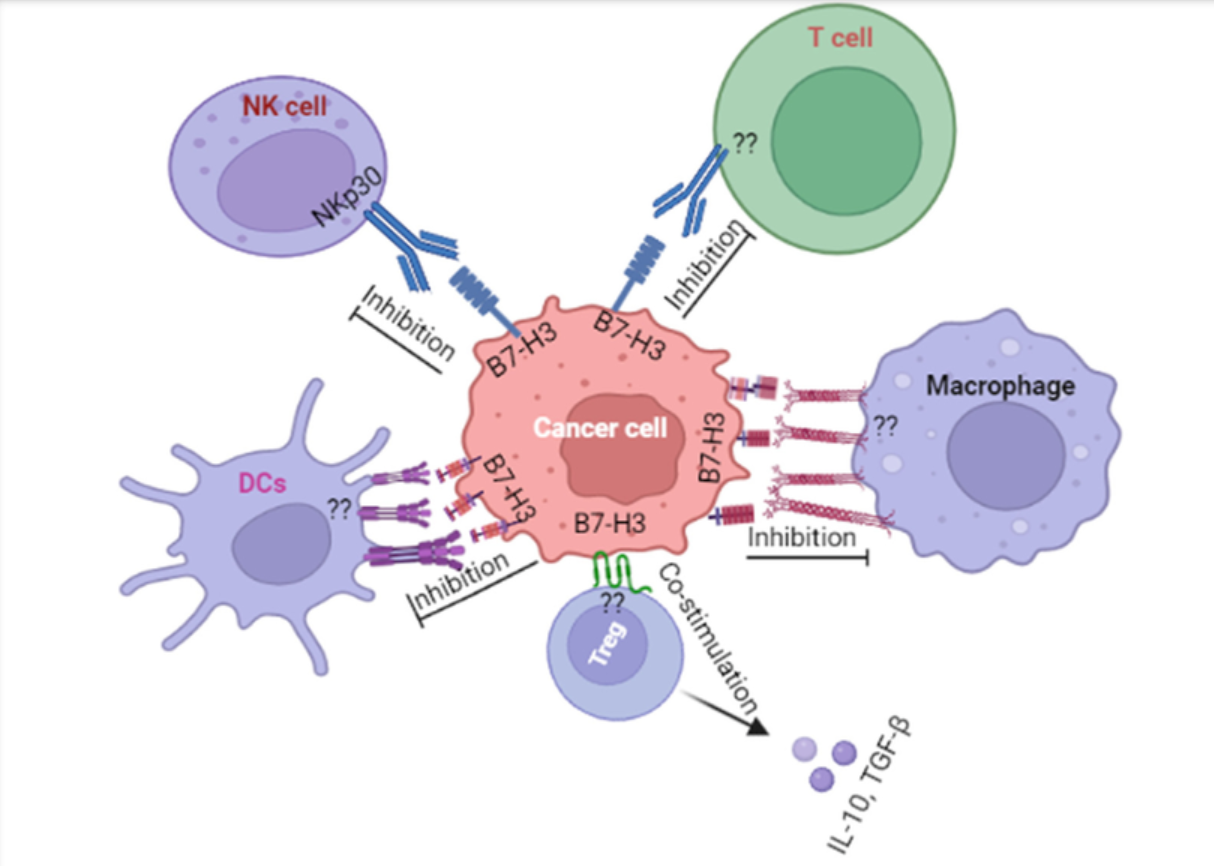
The exact function and receptor of B7-H3 have not yet been elucidated. In non-malignant tissues, B7-H3 plays an important role in adaptive immunity by regulating T cell function. Although early studies supported the view that B7-H3 serves as a costimulatory molecule required for T cell activation, recent studies have shown that B7-H3 exerts a predominantly inhibitory effect in adaptive immunity, suppressing T cell activation, proliferation, and effector cytokine release, mainly IFN-γ and IL-2. This shift in understanding from costimulation to coinhibition reflects the complexity of B7-H3 function—its effect direction may depend on the immune microenvironment, target cell type, and other simultaneously present costimulatory or coinhibitory signals.
III. Complex Role of B7-H3 in the Tumor Microenvironment.
The role of B7-H3 in the tumor microenvironment appears to be more complex. In mice, B7-H3 appears to have antitumor functions mediated by CD8-positive T cell and NK cell activation, possibly through binding to the Trem-like transcript 2 receptor on CD8-positive T cells. However, in humans, only three studies have shown a correlation between high B7-H3 expression and improved prognosis. In contrast, overwhelming evidence indicates that B7-H3 has a pro-tumor effect.
In fact, extensive preclinical and clinical evidence demonstrates that B7-H3 suppresses tumor antigen-specific immune responses through multiple mechanisms, including reducing the density of immune cell tumor infiltration, inhibiting NK cell-mediated tumor cell lysis, increasing regulatory T cell infiltration, reducing effector cytokine release, and suppressing the expression of major transcription factors. These mechanisms lead to aggressive cancer biology and metastatic potential, ultimately resulting in poor prognosis. This functional discrepancy between mice and humans suggests that careful evaluation of the net effect direction of B7-H3 is needed when translating mouse model data to human tumor immunotherapy.
IV. Non-Immune Pro-Tumor Mechanisms of B7-H3.
Finally, B7-H3 also appears to promote cancer progression through non-immune functions, such as by increasing cancer cell migration, invasion, and metastatic potential, by enhancing chemoresistance, and by promoting pro-tumor cancer cell metabolic profiles. These non-immune mechanisms, together with immunosuppressive mechanisms, constitute the complete picture of the pro-tumor effects of B7-H3, and also imply that therapeutic strategies targeting B7-H3 may exert efficacy through two pathways: relieving immunosuppression and directly inhibiting malignant behaviors of tumor cells.
V. Restricted Expression of B7-H3 in Normal Tissues and Widespread Expression in Malignant Tumors.
B7-H3 exhibits restricted expression in normal tissues. Immunohistochemical analysis of a large number of normal tissues shows that B7-H3 is only expressed at low levels in a few tissues, or even undetectable. Staining of tissue microarrays with B7-H3-specific monoclonal antibodies revealed only weak cytoplasmic staining in salivary gland acinar cells, gastric epithelial cells, and adrenal cells. In other studies, only weak staining of the basolateral membrane of the stomach, gallbladder, prostate, cervix, and endometrium was observed. This low expression feature in normal tissues provides a potential safety window for B7-H3-targeted therapy.
B7-H3 is widely expressed in primary malignant tumors. Multiple studies have shown that the expression rate of B7-H3 in renal cell carcinoma is 33.0%, and 91.8% in hepatocellular carcinoma. Notably, renal cell carcinoma and hematological malignancies have the lowest B7-H3 expression frequencies, at 33.0% and 36.7%, respectively, while all other solid cancer types have a B7-H3 expression frequency of at least 52.3%. Among gastrointestinal tumors, hepatocellular carcinoma has the highest B7-H3 expression frequency at 91.8%, while gastric cancer is the lowest at 58.0%. Among genitourinary malignancies, renal cell carcinoma has the lowest B7-H3 expression frequency, while ovarian cancer is the highest at 88.3%. When all cancers are included, the cumulative frequency of B7-H3 positivity is 59.5%. This broad-spectrum high expression feature makes B7-H3 a potential therapeutic target covering multiple solid tumors.
VI. Expression of B7-H3 in Tumor Microenvironment Stroma and Vasculature and Its Therapeutic Significance.
In addition to high expression on cancer cells, B7-H3 is also highly expressed on stromal fibroblasts and tumor-associated vasculature in the tumor microenvironment. This expression pattern may allow B7-H3-targeted therapy to even eliminate cancer cells in which B7-H3 expression is not detected. This finding has important therapeutic significance—by targeting stromal and vascular components in the tumor microenvironment, B7-H3-targeted drugs may also produce indirect killing effects on B7-H3-negative tumor cells, thereby expanding the beneficiary patient population.
VII. Conclusion.
In B7-H3-related basic research and drug development, high-quality recombinant B7-H3 protein is a core tool for dissecting its receptor binding mechanisms and evaluating the activity of targeted drugs. In response to the needs of B7-H3 function research and immunotherapy drug screening, UniA provides B7-H3/CD276 His Tag Protein, Human. This product is suitable for applications including binding activity analysis of B7-H3 with its receptors and interacting proteins, in vitro screening and evaluation of B7-H3-targeted antibody drugs and antibody-drug conjugates, research on B7-H3-mediated T cell regulatory mechanisms, and tumor immune microenvironment analysis.
As one of the most functionally complex members of the B7 immune costimulatory and coinhibitory family, B7-H3 has become a highly promising target in the field of tumor immunotherapy, owing to its structural diversity of two isoforms (2Ig and 4Ig), its functional shift from costimulation to coinhibition in adaptive immunity, the overwhelming pro-tumor evidence in human tumors, and its features of broad-spectrum solid tumor high expression and co-expression in tumor microenvironment stroma and vasculature. From restricted low expression in normal tissues to widespread high expression in malignant tumors, from immunosuppressive mechanisms to non-immune pro-tumor mechanisms, from cancer cell surface expression to tumor-associated vasculature and stromal fibroblast expression, B7-H3 continues to drive the in-depth development of the tumor immunotherapy field. B7-H3/CD276 His Tag Protein, Human provides reliable tool support for mechanistic research on the B7-H3 signaling network and targeted drug development, and will continue to facilitate innovative exploration in the field of tumor immunotherapy.
This article is reviewed and published by the technical expert team of UA
Disclaimer: This article partially utilizes artificial intelligence assistance in its creation. If any content involves copyright or intellectual property issues, please let us know and we promise to verify and remove it as soon as possible.
Purchase recombinant protein, choose 
UA protein focuses on providing various protein reagents, raw materials, and services required for drug research and development, cell therapy, gene therapy, and basic scientific research, including drug target proteins, immune checkpoint proteins, cytokines, tool enzymes, customized protein expression, and full-length transmembrane protein development. Nanjing Univ is committed to providing customers with high-quality products and professional services, and building a High-tech Biological Enterprise with International Competitiveness.
Target proteins | membrane proteins | cytokines | enzymes | viral antigens | protein customization
Nanjing UNIV Biotechnology Co., Ltd. Email:order@ua-bio.com Phone:+86-25-56221161

Product Information

Link:





©2021-2026 all rights reserved UNIV Biotechnology Co.,Ltd.
Privacy Policy
网站备案号 苏ICP备2025207586号-2 浙公网安备33010202004867号
 Business license (three certificates in one)
Tel:+86-25-56221161
E-mail:order@ua-bio.com
All products sold on this website shall not be used for clinical diagnosis or treatment of humans or animals, and shall only be used for non-medical purposes such as industrial or scientific research.