




ITPRIPL1/CD3L1 protein: A novel inhibitory ligand for tumor immune evasion and a regulatory target of CD3ε signaling
Author: Senior Product Manager of UA Views:10 


This article focuses on the molecular characteristics and immunoregulatory functions of ITPRIPL1 (also known as CD3L1), systematically elaborating its molecular mechanism as an inhibitory ligand expressed by tumor cells that blocks T cell activation signaling through direct binding to CD3ε, analyzing the clinical features of mutually exclusive expression between ITPRIPL1 and PD-L1 and its high expression in patients resistant to PD-1 therapy, and exploring the therapeutic potential of antibody drugs targeting ITPRIPL1 in restoring antitumor immunity.
- Recent Advances
- Product Information
Recent Advances
ITPRIPL1 CD3L1 Protein: A Novel Inhibitory Ligand for Tumor Immune Evasion and a CD3ε Signaling Regulatory Target
Brief Introduction: This article focuses on the molecular characteristics and immunoregulatory functions of ITPRIPL1 (also known as CD3L1), systematically elaborating on the molecular mechanism by which it acts as an inhibitory ligand expressed by tumor cells to block T cell activation signals through direct binding to CD3e, analyzing the clinical features of the mutually exclusive expression of ITPRIPL1 and PD-L1 and its high expression in patients resistant to PD-1 therapy, and exploring the therapeutic potential of antibody drugs targeting ITPRIPL1 in restoring antitumor immunity.
I. Discovery of ITPRIPL1 and Screening Strategy for Tumor Immune Evasion Targets.
A recent study published in Cell reported a new target ITPRIPL1 that mediates tumor immune evasion. The researchers aimed to identify targets mediating tumor immune evasion and, through a series of conditional screenings——expression in PD-L1-negative tumors, recurrence after PD-1 therapy, expression in immune-privileged organs, and membrane protein——ultimately identified ITPRIPL1. The logic of this screening strategy is that PD-L1-negative tumors may harbor immune evasion mechanisms independent of PD-L1, tumors from patients with recurrence after PD-1 therapy may upregulate alternative inhibitory molecules, and molecules highly expressed in immune-privileged organs may participate in maintaining local immunosuppression. ITPRIPL1 simultaneously satisfies multiple of the above conditions, suggesting that it may be an immune evasion driver independent of the PD-L1/PD-1 axis.
II. Mutually Exclusive Expression of ITPRIPL1 and PD-L1 and Its Clinical Relevance.
Studies found that ITPRIPL1 and PD-L1 exhibit mutually exclusive expression. In various tumor cell lines, the positive expression of ITPRIPL1 and PD-L1 shows a reciprocal relationship; a similar mutually exclusive expression pattern was also observed in clinical melanoma cases. In addition, ITPRIPL1 is highly expressed in patients with poor response to PD-1 therapy, and immune-privileged cells also highly express ITPRIPL1. The feature of high ITPRIPL1 expression in sperm further suggests its functional significance in immune-privileged organs. These clinical and expression profile features indicate that ITPRIPL1 may represent an independent immune evasion pathway in PD-L1-negative tumors and patients resistant to PD-1 therapy, filling the molecular space not covered by existing immune checkpoint inhibitor treatments.
III. Cytological Validation of ITPRIPL1 Inhibiting T Cell Function.
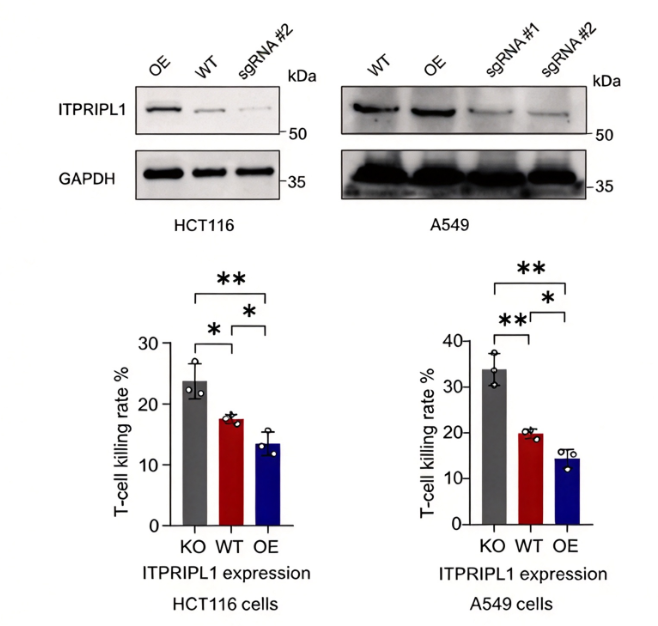
To explore the function of ITPRIPL1, the researchers stimulated peripheral blood mononuclear cells with extracellular domain ITPRIPL1-ECD and then performed single-cell sequencing, finding that ITPRIPL1 mainly inhibits CD8-positive T cells. In a co-culture system of tumor cells and T cells, overexpression of ITPRIPL1 inhibited the ability of T cells to kill tumor cells. After in vivo knockout of ITPRIPL1, T cell infiltration increased in the immune-privileged organ testis, while testicular abnormalities and sperm abnormalities appeared, whereas other organs remained normal. After knockout of ITPRIPL1, the proportion of T cells in peripheral blood mononuclear cells did not change significantly, but the exhaustion level decreased. These results collectively indicate that ITPRIPL1 participates in tumor immune evasion and maintenance of immune privilege by inhibiting T cell function.
IV. Molecular Mechanism of ITPRIPL1 Interacting with CD3e to Inhibit T Cell Activation.
Further studies showed that ITPRIPL1 can inhibit calcium flux after TCR activation. The researchers further found that ITPRIPL1 interacts with CD3e on the T cell surface, and verified their binding through co-immunoprecipitation, co-localization, and quantitative interaction analysis. The extracellular domain of ITPRIPL1 can inhibit T cell activation signals, while CD3e can reverse this inhibitory effect. In domain analysis, the researchers found that the RBD1 domain of ITPRIPL1 has the strongest interaction with CD3e, and the RBD1-Fc fusion protein can still interact with CD3e and inhibit T cell signaling, activation, and cytokine secretion.
Mechanistically, after T cell activation, CD3e can interact with proteins such as Nck, Lck, and Csk, while the RBD1 of ITPRIPL1 promotes the interaction between Nck and CD3e. Proximity ligation assays verified that ITPRIPL1 RBD1 promotes the interaction between Nck and CD3e. It has been reported in the literature that Nck inhibits the interaction between ZAP70 and CD3e by interacting with CD3e, thereby inhibiting downstream T cell signaling. The authors found that ITPRIPL1 RBD1 inhibits T cell signaling and calcium flux by promoting the interaction between Nck and CD3e and inhibiting ZAP70; after the CD3e K76T mutation or knockout of the CD3e PRS sequence, CD3e can no longer interact with Nck, and this inhibitory effect disappears accordingly. ITPRIPL1 RBD1 can also inhibit T cell activation mediated by antigen peptides of various affinities. At this point, the complete mechanism by which ITPRIPL1 inhibits T cells has been elucidated: after ITPRIPL1 interacts with CD3ε, it promotes the binding of Nck to CD3ε, inhibits ZAP70 recruitment, and thereby blocks downstream T cell signaling, ultimately inhibiting T cell function.
V. Antibody Drug Development Targeting ITPRIPL1 and Preclinical Validation.
Based on the above mechanism, the researchers screened and obtained the antibody clone 13B7. This antibody can inhibit the interaction between ITPRIPL1 and CD3ε, has good safety, and does not affect various organs; it can promote T cell signaling and cytokine secretion, promote T cell killing of target cells, and affect primary T cell subsets. The human ITPRIPL1 antibody can cross-react with dog and mouse ITPRIPL1. In animal models, the antibody can inhibit mouse tumor growth and inhibit human tumor growth in humanized mice, with effects superior to PD-L1 antibodies. Analysis of the tumor microenvironment showed that the antibody can mobilize T cells within the microenvironment. The antibody's efficacy depends on ADCC and T cells, and the IgG4 subtype cannot mediate ADCC. In dog spontaneous tumor models, the antibody can also effectively inhibit tumor growth. Clinical correlation analysis showed that, compared with normal tissues, tumor tissues highly express ITPRIPL1, and expression increases with tumor progression; CD8-positive T cell infiltration is negatively correlated with ITPRIPL1 levels; patient survival is negatively correlated with ITPRIPL1 levels. These data systematically validate the clinical translational potential of ITPRIPL1 as a tumor immunotherapy target.
VI. Conclusion.
In basic research and drug development related to ITPRIPL1, high-quality recombinant ITPRIPL1 protein is a core tool for dissecting its binding mechanism with CD3ε and evaluating the activity of targeting antibodies. In response to the needs of ITPRIPL1 functional research and immunotherapy drug screening, UniA provides ITPRIPL1/CD3L1 His Tag Protein, Human. This product is suitable for applications such as binding activity analysis of ITPRIPL1 and CD3ε, in vitro screening and evaluation of ITPRIPL1-blocking antibodies, research on ITPRIPL1-mediated T cell inhibitory signaling pathways, and exploration of tumor immune evasion mechanisms.
This article is reviewed and published by the technical expert team of UA
Disclaimer: This article partially utilizes artificial intelligence assistance in its creation. If any content involves copyright or intellectual property issues, please let us know and we promise to verify and remove it as soon as possible.
Purchase recombinant protein, choose 
UA protein focuses on providing various protein reagents, raw materials, and services required for drug research and development, cell therapy, gene therapy, and basic scientific research, including drug target proteins, immune checkpoint proteins, cytokines, tool enzymes, customized protein expression, and full-length transmembrane protein development. Nanjing Univ is committed to providing customers with high-quality products and professional services, and building a High-tech Biological Enterprise with International Competitiveness.
Target proteins | membrane proteins | cytokines | enzymes | viral antigens | protein customization
Nanjing UNIV Biotechnology Co., Ltd. Email:order@ua-bio.com Phone:+86-25-56221161

Product Information

Link:





©2021-2026 all rights reserved UNIV Biotechnology Co.,Ltd.
Privacy Policy
网站备案号 苏ICP备2025207586号-2 浙公网安备33010202004867号
 Business license (three certificates in one)
Tel:+86-25-56221161
E-mail:order@ua-bio.com
All products sold on this website shall not be used for clinical diagnosis or treatment of humans or animals, and shall only be used for non-medical purposes such as industrial or scientific research.


