




Recombinant M-CSF Protein: The Cornerstone of Macrophage Research from Basic Differentiation to Cutting-Edge Applications
Author: Senior Product Manager of UA Views:13 


This article focuses on the molecular characteristics and biological functions of macrophage colony-stimulating factor (M-CSF), systematically elaborating its key role as the core driver of macrophage differentiation in the in vitro induction of bone marrow-derived macrophages, analyzing the broad applications of M-CSF in frontier research fields such as hypoxic immunity, organ fibrosis, metabolic inflammation, biomaterial compatibility, and single-molecule imaging, and discussing the value of high-quality recombinant M-CSF protein in ensuring experimental reproducibility.
- Recent Advances
- Product Information
Recent Advances
M-CSF Recombinant Protein: The Cornerstone of Macrophage Research from Basic Differentiation to Cutting-Edge Applications
Brief Introduction: This article focuses on the molecular characteristics and biological functions of macrophage colony-stimulating factor (M-CSF), systematically elaborating its key role as a core driver of macrophage differentiation in the in vitro induction of bone marrow-derived macrophages, analyzing the broad applications of M-CSF in cutting-edge research fields such as hypoxic immunity, organ fibrosis, metabolic inflammation, biomaterial compatibility, and single-molecule imaging, and discussing the value of high-quality recombinant M-CSF protein in ensuring experimental reproducibility.
I. Molecular Characteristics of M-CSF and Its Function in Macrophage Differentiation.
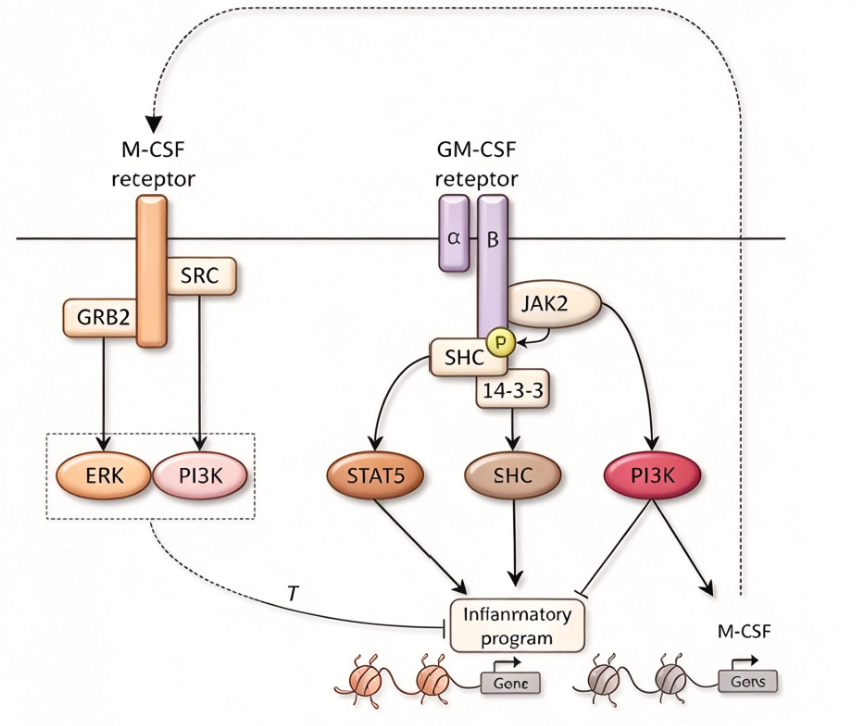
Macrophage colony-stimulating factor (M-CSF, also known as CSF-1) is an important hematopoietic growth factor and a core member of the colony-stimulating factor family. M-CSF binds to its receptor M-CSFR, activating downstream signaling pathways such as PI3K-AKT, RAS-MAPK, and JAK-STAT, thereby regulating the survival, proliferation, and differentiation of the monocyte-macrophage lineage. In in vitro research, M-CSF is a key reagent for inducing bone marrow-derived macrophage differentiation——primary cells isolated from mouse bone marrow can differentiate into high-purity bone marrow-derived macrophages within 7 to 10 days under continuous stimulation with M-CSF. Flow cytometry identification shows that the proportion of F4/80 and CD11b double-positive cells among M-CSF-induced bone marrow-derived macrophages can stably reach over 90%, providing a high-purity cell source for subsequent functional studies.
II. Application of M-CSF in Hypoxic Immunology Research.
A recent study published in Frontiers in Immunology systematically revealed for the first time the effects of acute hypoxia on primary macrophage proliferation, phagocytosis, transcriptome, and metabolic profile. The study found that acute hypoxia inhibits macrophage proliferation and phagocytic function while activating both pro-inflammatory and anti-inflammatory responses. Transcriptome analysis showed that hypoxia significantly enriched HIF signaling pathways, glycolysis, and the pentose phosphate pathway. Metabolomics confirmed that intermediates of the pentose phosphate pathway were substantially elevated under hypoxia, suggesting that this pathway is a key metabolic compensatory mechanism for macrophage adaptation to hypoxia. In this study, after isolating mouse bone marrow cells, 10 ng/mL recombinant mouse M-CSF was used for induction culture during the first 3 days, followed by supplementation with L-929 fibroblast supernatant for the next 4 days until differentiation and maturation at day 7, providing a high-purity cell source for subsequent RNA-seq and metabolomics analyses.
III. Application of M-CSF in Renal Fibrosis and Metabolic Steatohepatitis Research.
In the field of renal fibrosis research, a study published in iMetaMed found that the natural product isorhamnetin can competitively bind to the IL-6 receptor, block the JAK2/STAT3 pathway, inhibit renal tubular epithelial cell senescence and macrophage M2 polarization, thereby alleviating renal fibrosis. In this study, bone marrow-derived macrophages were aseptically isolated from the femurs of 2-month-old C57BL/6 mice and cultured in medium containing 20 ng/mL mouse M-CSF for 7 to 10 days to induce differentiation into macrophages. Functional validation showed that successfully differentiated bone marrow-derived macrophages were used for IL-6 stimulation experiments, and Western blot detection revealed that IL-6 significantly activated the JAK2/STAT3 pathway and upregulated CD206 expression, while isorhamnetin treatment effectively inhibited these changes.
In the field of metabolic steatohepatitis research, a study published in Chinese Medicine revealed that Alismatis rhizoma triterpenoids inhibit NLRP3-mediated macrophage pyroptosis through the KEAP1/NRF2 pathway, improving MCD diet-induced metabolic steatohepatitis. In this study, to induce differentiation into bone marrow-derived macrophages, 20 ng/mL M-CSF was added to the culture for 7 days. Key results showed that compound treatment significantly reduced ROS levels in LPS-stimulated bone marrow-derived macrophages while downregulating NLRP3, cleaved caspase-1, and N-GSDMD protein expression, confirming the central role of the KEAP1/NRF2 axis in regulating macrophage pyroptosis.
IV. Application of M-CSF in Biomaterial Compatibility and Single-Molecule Imaging Research.
In the field of biomaterials and immunology research, a study published in Progress in Orthodontics systematically compared for the first time the effects of micro/nanoplastics released from traditional thermoformed and 3D-printed orthodontic materials on macrophage differentiation. Primary bone marrow cells were collected by flushing the femurs of C57BL/6 mice and cultured in complete RPMI medium containing 20 ng/mL mouse M-CSF, with medium changes every 48 hours until co-culture experiments began at day 7. Flow cytometry analysis showed that after co-culture with microplastics from specific materials, the proportion of CD86 + iNOS + M1-like cells among bone marrow-derived macrophages was significantly increased, cell viability remained above 95%, and live-cell imaging visually demonstrated the process of microplastic particle phagocytosis.
In the field of cutting-edge imaging research, a study published in Nature Communications developed an automated analysis pipeline to achieve single-molecule kinetic resolution of glycosylated ligand-receptor interactions on the surface of primary immune cells. Bone marrow-derived macrophages were cultured in complete RPMI1640 medium containing 20 ng/mL M-CSF, and bone marrow-derived macrophages were used to study changes in mannose ligand binding kinetics under M0, M1, and M2 polarization states. Results showed that the total binding time of mannose ligands after M2 polarization was significantly higher than that of M0 and M1, suggesting that upregulated mannose receptor expression in M2 macrophages is accompanied by altered binding behavior.
V. Conclusion.
In macrophage-related basic research and drug development, high-quality recombinant M-CSF protein is key to ensuring the differentiation efficiency and experimental reproducibility of bone marrow-derived macrophages. To meet the needs of macrophage differentiation research and functional evaluation, Youai offers M-CSF Protein, Mouse. This product is suitable for applications including in vitro induced differentiation of mouse bone marrow-derived macrophages, macrophage polarization research, macrophage functional research in inflammatory disease and fibrosis models, and biomaterial compatibility evaluation.
As a core driver of macrophage differentiation, M-CSF, with its irreplaceable role in the in vitro induction of bone marrow-derived macrophages, has become a key tool in multiple research fields including basic immunology, metabolic diseases, tissue fibrosis, biomaterial compatibility, and single-molecule imaging. From hypoxic immune responses to renal fibrosis mechanisms, from metabolic steatohepatitis to orthodontic material compatibility, from macrophage polarization to single-molecule glycosylation kinetics, high-quality recombinant M-CSF protein continues to provide stable, efficient, and reproducible cell differentiation support for cutting-edge research. M-CSF Protein, Mouse provides reliable tool support for macrophage-related research and will continue to facilitate innovative exploration in the life sciences and translational medicine fields.
This article is reviewed and published by the technical expert team of UA
Disclaimer: This article partially utilizes artificial intelligence assistance in its creation. If any content involves copyright or intellectual property issues, please let us know and we promise to verify and remove it as soon as possible.
Purchase recombinant protein, choose 
UA protein focuses on providing various protein reagents, raw materials, and services required for drug research and development, cell therapy, gene therapy, and basic scientific research, including drug target proteins, immune checkpoint proteins, cytokines, tool enzymes, customized protein expression, and full-length transmembrane protein development. Nanjing Univ is committed to providing customers with high-quality products and professional services, and building a High-tech Biological Enterprise with International Competitiveness.
Target proteins | membrane proteins | cytokines | enzymes | viral antigens | protein customization
Nanjing UNIV Biotechnology Co., Ltd. Email:order@ua-bio.com Phone:+86-25-56221161

Product Information

Link:





©2021-2026 all rights reserved UNIV Biotechnology Co.,Ltd.
Privacy Policy
网站备案号 苏ICP备2025207586号-2 浙公网安备33010202004867号
 Business license (three certificates in one)
 Tel:+86-25-56221161
E-mail:order@ua-bio.com
All products sold on this website shall not be used for clinical diagnosis or treatment of humans or animals, and shall only be used for non-medical purposes such as industrial or scientific research.


