

Reporter Gene Detection System: A Core Technology Platform from Dual-Luciferase Design to Gene Regulation Research
Author: Senior Product Manager of UA Views:17 


This article systematically elucidates the synergistic mechanism of firefly luciferase and Renilla luciferase in dual-reporter gene design, centered on the technical principles and application framework of the dual-luciferase reporter gene assay system. It analyzes the application strategies of this system in miRNA target gene validation, promoter activity analysis, and signaling pathway research, while discussing key operational points in reporter gene vector construction and experimental procedures.
- Recent Advances
- Product Information
Recent Advances
Reporter Gene Detection System: A Core Technology Platform from Dual-Luciferase Design to Gene Regulation Research
Brief Description: This article systematically elaborates on the technical principles and application systems of the dual-luciferase reporter gene detection system, detailing the synergistic mechanism of firefly luciferase and Renilla luciferase in dual-reporter gene design. It analyzes the application strategies of this system in miRNA target validation, promoter activity analysis, and signaling pathway research, and discusses the key operational points in reporter gene vector construction and experimental procedures.
1. Design Principles of the Dual-Luciferase Reporter Gene Detection System
The dual-luciferase reporter gene detection system employs the simultaneous expression of firefly luciferase and Renilla luciferase in cells to form a precise internal reference standardization system. Firefly luciferase serves as the reporter gene to reflect changes in the expression of the target gene, while Renilla luciferase acts as the internal reference gene, providing a unified baseline for experiments. The core value of this design lies in reducing the impact of intrinsic variability factors on experimental accuracy, including the number of cultured cells, transfection efficiency, and lysis efficiency. The final results are expressed as the ratio of firefly luciferase activity to Renilla luciferase activity, effectively eliminating inter-well differences and ensuring comparability of data across different experimental batches and treatment groups. This system is widely used in gene regulation, non-coding RNA targeting interactions, and other research fields.
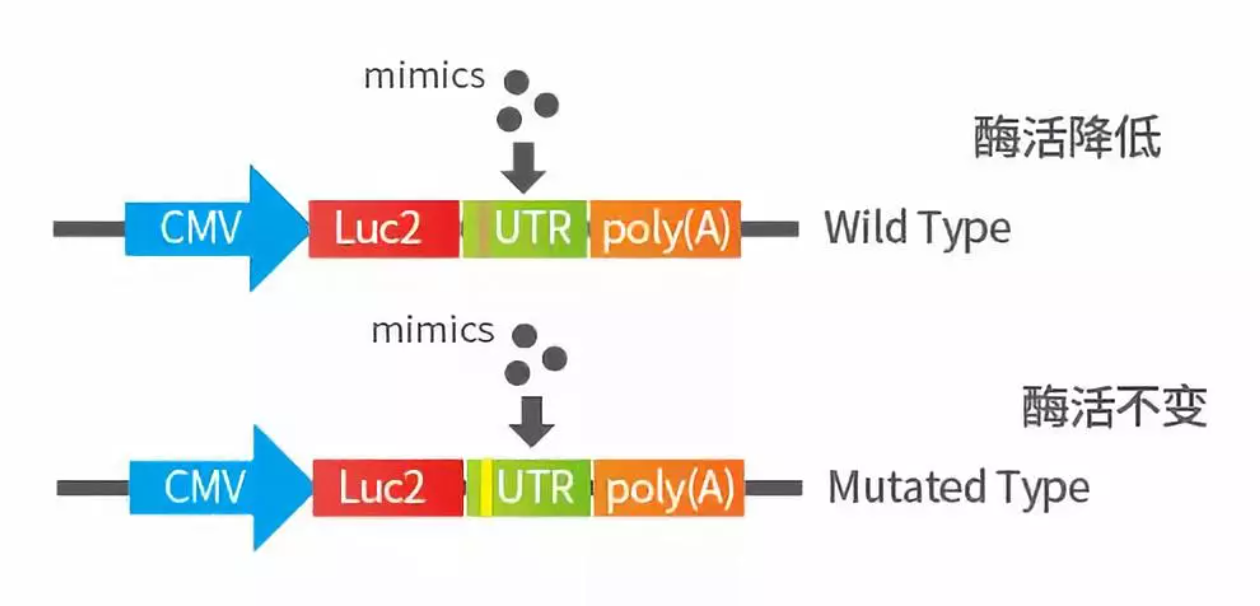
In vector design, the upstream promoter region of the firefly luciferase expression cassette can be inserted with different functional sequences, altering its reporter fluorescence through changes in transcription initiation conditions. The 3'UTR region of firefly luciferase can be replaced with the 3'UTR of the target gene. Overexpressing microRNA and detecting changes in luciferase activity can reflect whether there is a targeting interaction. This flexible vector design allows the dual-luciferase reporter system to adapt to various research needs.
2. Experimental Principles and Application Cases of miRNA Target Validation
miRNAs primarily act on the 3'UTR of target genes, with mechanisms including mRNA degradation or translation inhibition. In experimental design, the wild-type and binding site mutant sequences of the target gene's 3'UTR are respectively constructed into the 3' end of the reporter gene firefly luciferase in the vector. By comparing changes in reporter gene expression after miRNA overexpression, the interaction site between the miRNA and the target gene's 3'UTR can be determined. If luciferase activity decreases, it indicates a targeting interaction between the miRNA and the target gene; if activity remains unchanged, it suggests that the site is not the miRNA's target.
For example, in a study published in Nature Communications, researchers verified that the B4GALT3 gene has a binding site for miR-1247-3p. The predicted binding site sequence of B4GALT3 was cloned into the reporter gene vector, and a vector with mutated target sites was also constructed. These were co-transfected with miR-1247-3p mimics and negative controls. The results showed that the relative fluorescence value decreased in the wild-type group transfected with miR-1247-3p, while the mutant group's fluorescence value remained unchanged, indicating a targeting interaction. This experimental design strategy is also applicable to studies of miRNA interactions with lncRNAs and circRNAs.
3. Experimental Principles and Application Cases of Promoter Activity Validation
Transcription factors primarily act on the promoter regions of target genes. In experimental design, the promoter region sequence of the target gene replaces the promoter of the reporter gene firefly luciferase. By co-expressing the transcription factor and detecting changes in reporter gene expression, the binding sites of the transcription factor on the target gene promoter and its regulatory effects can be determined.
For example, in a study published in Nature Neuroscience, researchers verified that Sox9 has multiple binding sites in the Sox2 promoter region. By constructing different promoter fragments into the reporter gene vector and co-expressing Sox9, the results showed that shorter inserted fragments and reduced predicted binding sites were accompanied by decreased luciferase activity. This confirmed the direct regulatory role of Sox9 on the Sox2 promoter, demonstrating the powerful application value of the dual-luciferase reporter system in transcription factor regulation research.
4. Technical Route and Experimental Procedures of the Reporter Gene Detection System
The technical route of the dual-luciferase reporter gene detection includes the following key steps: designing the experimental plan based on the research objective, predicting binding sites using bioinformatics tools, constructing wild-type and mutant reporter gene vector systems, co-transfecting cells, and detecting enzyme activity. In predicting target gene binding sites, commonly used bioinformatics tools can assist researchers in identifying miRNA binding sites and transcription factor binding sites, improving the specificity and efficiency of experimental design.
In experimental operations, the constructed reporter plasmid and internal reference plasmid are first co-transfected into target cells. After transfection, the cells are cultured for an appropriate period to allow full expression of the reporter gene. According to the experimental design, the cells are then subjected to appropriate stimulation or treatment to activate or inhibit the activity of the target regulatory elements. After treatment, the cells are lysed, and luciferase substrates are added to sequentially detect the activity of firefly luciferase and Renilla luciferase. The final data analysis is based on the ratio of firefly luciferase activity to Renilla luciferase activity.
5. Main Application Directions of the Reporter Gene Detection System
The dual-luciferase reporter gene detection system has broad applications in gene expression regulation research. First, validating miRNA-mRNA targeting interactions—inserting the target mRNA's 3'UTR sequence into the reporter gene vector and co-transfecting the miRNA. If luciferase activity decreases, it suggests the target sequence. Second, validating miRNA-circRNA targeting interactions—inserting the circRNA sequence into the 3'UTR region of firefly luciferase in the reporter gene vector and detecting luciferase activity. Third, validating miRNA-lncRNA targeting interactions—inserting the lncRNA sequence into the 3'UTR region of firefly luciferase in the reporter gene vector and detecting luciferase activity.
Fourth, promoter activity analysis—segmenting the promoter region sequence and constructing each segment into the reporter gene vector to detect its promoter activity. Fifth, validating the interaction between specific transcription factors and promoters—inserting the promoter region into the reporter gene vector and co-transfecting the transcription factor in experimental cells to analyze whether overexpression of the transcription factor increases luciferase activity. Sixth, analyzing whether a signaling pathway is activated—constructing the downstream response element sequence of the signaling pathway into the reporter gene vector. Under different upstream signal conditions, luciferase activity represents the downstream response of the pathway.
6. Conclusion
In practical applications of the dual-luciferase reporter gene detection, high-quality detection reagents are key to ensuring data reliability and experimental reproducibility. To meet the needs of dual-luciferase reporter gene detection, UA provides the UA-Glo® Dual-Luciferase Assay System. This product has the following core features: supports sequential detection of firefly luciferase and Renilla luciferase, achieving internal reference standardization correction; optimized luminescence system provides high signal-to-noise ratio and stable signal output; homogeneous operation mode simplifies experimental procedures, compatible with 96-well and 384-well plate formats; suitable for miRNA target validation, promoter activity analysis, transcription factor regulation research, and signaling pathway analysis, among other application scenarios.
With its precise dual-reporter gene design and internal reference standardization strategy, the dual-luciferase reporter gene detection system has become an indispensable core technology platform in gene expression regulation research. From miRNA target validation to promoter activity analysis, from transcription factor regulation research to signaling pathway analysis, the dual-luciferase reporter gene detection system continues to play an irreplaceable supporting role. The UA-Glo® Dual-Luciferase Assay System provides a reliable tool for dual-luciferase reporter gene detection, promoting in-depth exploration and translational applications in the field of gene regulation research.
This article is reviewed and published by the technical expert team of UA
Disclaimer: This article partially utilizes artificial intelligence assistance in its creation. If any content involves copyright or intellectual property issues, please let us know and we promise to verify and remove it as soon as possible.
Purchase recombinant protein, choose 
UA protein focuses on providing various protein reagents, raw materials, and services required for drug research and development, cell therapy, gene therapy, and basic scientific research, including drug target proteins, immune checkpoint proteins, cytokines, tool enzymes, customized protein expression, and full-length transmembrane protein development. Nanjing Univ is committed to providing customers with high-quality products and professional services, and building a High-tech Biological Enterprise with International Competitiveness.
Target proteins | membrane proteins | cytokines | enzymes | viral antigens | protein customization
Nanjing UNIV Biotechnology Co., Ltd. Email:order@ua-bio.com Phone:+86-25-56221161

Product Information

Link:





©2021-2026 all rights reserved UNIV Biotechnology Co.,Ltd.
Privacy Policy 
网站备案号 苏ICP备2025207586号-2 浙公网安备33010202004867号
 Business license (three certificates in one)
 Tel:+86-25-56221161
E-mail:order@ua-bio.com
All products sold on this website shall not be used for clinical diagnosis or treatment of humans or animals, and shall only be used for non-medical purposes such as industrial or scientific research.