BRET Detection Substrate: A Core Tool from Energy Transfer to Live-Cell Protein Interaction Studies
Author: Senior Product Manager of UA Views:9 


This article systematically elaborates on the fundamental principles of Bioluminescence Resonance Energy Transfer (BRET) technology and its unique advantages compared to traditional Fluorescence Resonance Energy Transfer (FRET), analyzing the synergistic mechanisms of donors, acceptors, and substrates in BRET experiments. It explores the critical impact of substrate selection on detection sensitivity, signal stability, and experimental applicability.
- Recent Advances
- Product Information
Recent Advances
BRET Detection Substrates: Core Tools for Energy Transfer and Live-Cell Protein Interaction Studies
Summary: This article systematically elaborates on the fundamental principles of Bioluminescence Resonance Energy Transfer (BRET) technology and its unique advantages over traditional Fluorescence Resonance Energy Transfer (FRET), focusing on the technical characteristics and application systems of BRET detection substrates. It analyzes the synergistic mechanism of donors, acceptors, and substrates in BRET experiments and discusses the critical impact of substrate selection on detection sensitivity, signal stability, and experimental applicability.
1. Basic Principles and Core Features of BRET Technology
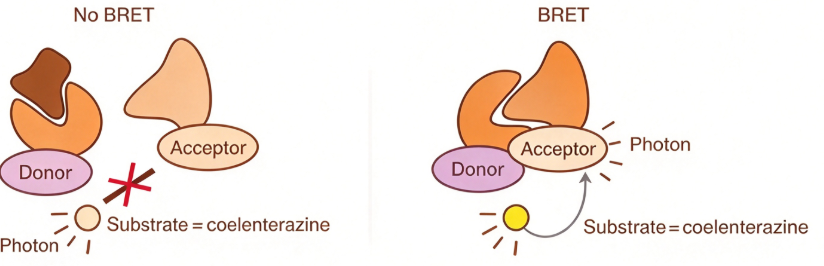
Bioluminescence Resonance Energy Transfer (BRET) is a non-radioactive molecular interaction detection technology that operates without an external excitation light source, based on the principle of resonance energy transfer. By replacing the donor fluorophore in FRET with luciferase, the bioluminescence from luciferase, in the presence of a substrate, excites the acceptor fluorophore through resonance energy transfer, thereby demonstrating interactions between target proteins. The core advantage of BRET technology lies in its elimination of external excitation light sources, fundamentally avoiding background interference from excitation light scattering and cellular autofluorescence, significantly improving the signal-to-noise ratio and sensitivity of detection.
In experimental design, proteins of interest are typically fused with bioluminescent donors or fluorescent acceptors. When the target proteins interact and bring the donor and acceptor within an effective distance (usually less than 10 nanometers), energy transfer occurs. By detecting changes in the acceptor emission signal relative to the donor emission signal, known as the BRET ratio, quantitative analysis of protein-protein interactions can be performed. Changes in the BRET ratio are positively correlated with the strength of protein interactions, with higher signals indicating stronger interactions.
2. Core Functions and Mechanisms of BRET Detection Substrates
BRET detection substrates play a pivotal role in initiating signals during the energy transfer process. In the BRET experimental system, the luciferase donor catalyzes the oxidation of the substrate in the presence of the substrate, generating a bioluminescent signal. This luminescent signal serves as the energy source, exciting the acceptor fluorophore through resonance energy transfer, causing it to emit fluorescence at a specific wavelength. Therefore, the chemical properties, membrane permeability, and oxidation efficiency of the substrate directly determine the intensity and duration of the bioluminescent signal, thereby influencing the sensitivity and reliability of the entire BRET detection.
The core requirements for BRET detection substrates include: excellent membrane permeability to ensure rapid cellular entry and sufficient interaction with intracellular luciferase; high oxidation efficiency to produce bioluminescent signals of sufficient intensity; superior chemical stability to maintain signal stability during the detection window; and low cytotoxicity to ensure normal physiological states of live cells during detection. The affinity and catalytic efficiency between the substrate and luciferase are key parameters determining BRET signal strength.
3. Basic BRET Experimental Procedures and Key Operational Points
Taking protein-protein interaction detection as an example, the basic BRET experimental procedure consists of four main steps: vector construction, cell transfection, plating and culturing, and BRET signal detection. During vector construction, target genes A and B are fused with luciferase donors and yellow fluorescent protein acceptors, respectively, to construct BRET donor and acceptor expression vectors. Fusion tags can be linked to the N-terminus or C-terminus of the protein, with flexible linker peptides introduced between the target protein and the tag to minimize effects on the protein's native conformation and function.
During cell transfection, the constructed fusion expression plasmids are transiently transfected into target cells, and the transfection ratio of donor to acceptor plasmids is optimized to achieve appropriate expression levels. In the plating and culturing stage, cells are re-seeded into 96-well or 384-well white clear-bottom culture plates 8 to 20 hours post-transfection and cultured for an additional 12 to 24 hours to ensure cell adherence and stable expression of fusion proteins.
During BRET signal detection, approximately 36 to 48 hours post-transfection, drug incubation is performed first, followed by the addition of luciferase substrate to initiate the bioluminescent reaction. A multifunctional fluorescence microplate reader is then used to detect luminescent signals at donor and acceptor wavelengths, and the ratio of acceptor to donor emission is calculated to obtain the BRET signal. The timing and concentration of substrate addition should be optimized based on experimental objectives to ensure optimal signal intensity and stability.
4. Application Scenarios of BRET Technology and Substrate Selection Strategies
BRET technology has broad application scenarios in life science research and drug development. In protein-protein interaction studies, it can be used for quantitative analysis of receptor dimerization, signal complex assembly, and the affinity of protein interaction interfaces. In GPCR research, BRET technology can detect receptor-G protein coupling, receptor internalization, and β-arrestin recruitment signaling events. In drug screening, it can assess the impact of candidate compounds on protein interactions, identifying active compounds from large compound libraries.
In substrate selection strategies, researchers must consider the type of luciferase, the characteristics of acceptor fluorescent proteins, and the specific requirements of the experimental system. Different luciferases have varying substrate selectivities, and the membrane permeability and oxidation kinetics of substrates also differ. For live-cell detection experiments, substrate membrane permeability and cytotoxicity are key considerations; for in vitro purified protein detection experiments, substrate oxidation efficiency and signal intensity are more critical. Additionally, the emission spectrum of the substrate must match the excitation spectrum of the acceptor fluorescent protein to ensure efficient energy transfer.
5. Conclusion
In practical applications of BRET detection, high-quality detection substrates are crucial for ensuring data reliability and experimental reproducibility. To meet the needs of BRET live-cell detection, UA-Glo® BRET Ligand618 is provided. This product offers the following core features: optimized membrane permeability ensures rapid cellular entry and sufficient interaction with intracellular luciferase; high oxidation efficiency produces intense bioluminescent signals, enhancing detection sensitivity; superior chemical stability maintains signal stability during the detection window; and low cytotoxicity ensures normal physiological states of live cells during detection. This product is suitable for live-cell BRET detection, protein-protein interaction analysis, GPCR signaling pathway research, and high-throughput drug screening.
As a core tool in bioluminescence resonance energy transfer technology, BRET detection substrates, with their pivotal role in initiating bioluminescent signals and driving energy transfer, provide reliable technical support for live-cell protein interaction studies. From the fundamental principles of BRET technology to the functional mechanisms of detection substrates, from standardized vector construction to signal detection procedures, from substrate selection strategies to experimental condition optimization, BRET detection substrates continue to play an irreplaceable supporting role. UA-Glo® BRET Ligand618 provides a reliable tool for BRET live-cell detection, driving in-depth exploration in protein interaction research and drug discovery.
This article is reviewed and published by the technical expert team of UA
Disclaimer: This article partially utilizes artificial intelligence assistance in its creation. If any content involves copyright or intellectual property issues, please let us know and we promise to verify and remove it as soon as possible.
Purchase recombinant protein, choose 
UA protein focuses on providing various protein reagents, raw materials, and services required for drug research and development, cell therapy, gene therapy, and basic scientific research, including drug target proteins, immune checkpoint proteins, cytokines, tool enzymes, customized protein expression, and full-length transmembrane protein development. Nanjing Univ is committed to providing customers with high-quality products and professional services, and building a High-tech Biological Enterprise with International Competitiveness.
Target proteins | membrane proteins | cytokines | enzymes | viral antigens | protein customization
Nanjing UNIV Biotechnology Co., Ltd. Email:order@ua-bio.com Phone:+86-25-56221161

Product Information

Link:





©2021-2026 all rights reserved UNIV Biotechnology Co.,Ltd.
Privacy Policy 
网站备案号 苏ICP备2025207586号-2 浙公网安备33010202004867号
 Business license (three certificates in one)
 Tel:+86-25-56221161
E-mail:order@ua-bio.com
All products sold on this website shall not be used for clinical diagnosis or treatment of humans or animals, and shall only be used for non-medical purposes such as industrial or scientific research.