Overview
This article systematically elaborates on the molecular mechanism of firefly luciferase-catalyzed substrate oxidation and luminescence, as well as its technical advantages as a reporter gene. It analyzes the core features of the Bright system, including high-brightness signal output, low background interference, and a wide dynamic range, and explores its broad applications in gene expression regulation research, signaling pathway analysis, and drug screening.
Bright Luciferase Assay System: A Core Technology Platform from High-Brightness Signals to High-Throughput Screening
Author: Senior Product Manager of UA Views:13 


This article systematically elaborates on the molecular mechanism of firefly luciferase-catalyzed substrate oxidation and luminescence, as well as its technical advantages as a reporter gene, focusing on the technical principles and application framework of the Bright luciferase assay system. It analyzes the core features of the Bright system, including high-brightness signal output, low background interference, and a wide dynamic range, and explores its extensive applications in gene expression regulation research, signaling pathway analysis, and drug screening.
- Recent Advances
- Product Information
Recent Advances
Bright Luciferase Assay System: A Core Technology Platform from High-Brightness Signals to High-Throughput Screening
I. Molecular Basis of the Bright Luciferase Assay System
The Bright Luciferase Assay System is a reporter system that detects firefly luciferase activity using luciferin as a substrate. Firefly luciferase consists of a single polypeptide chain. In the presence of magnesium ions, ATP, and oxygen, it catalyzes the oxidative decarboxylation of D-luciferin to generate oxyluciferin, releasing bioluminescence during this oxidation process, which can be quantitatively measured using a luminometer. This luminescent reaction exhibits extremely high quantum efficiency, and since mammalian cells lack endogenous luciferase, the background noise is minimal, resulting in an excellent signal-to-noise ratio.
The core design principle of the Bright system is to maximize signal intensity and signal-to-noise ratio. By optimizing substrate concentration, buffer formulation, and reaction kinetics, the Bright system can generate high-intensity luminescent signals in a short time, achieving extremely high detection sensitivity. The luciferase-catalyzed luminescent reaction does not require post-translational modifications; the protein produces reporter activity immediately after translation, ensuring instantaneous signal response. Additionally, the linear detection range spans 7 to 8 orders of magnitude, covering a broad spectrum from low to high expression levels, making it the most widely used reporter gene system in gene expression regulation research.
II. Technical Advantages and Signal Characteristics of the Bright System
The Bright Luciferase Assay System offers multiple technical advantages in life science research and drug development. In terms of high-brightness signals, the optimized reaction system produces extremely high photon yields, significantly improving detection sensitivity, making it suitable for low-expression gene regulation studies and trace sample detection. In terms of low background, mammalian cells lack endogenous luciferase, and the detection reagents themselves do not produce background luminescence, ensuring signal specificity.
The wide dynamic range of the Bright system spans 7 to 8 orders of magnitude, enabling researchers to simultaneously detect signals with significant differences in strength within the same experimental setup. In terms of operational convenience, the system adopts a homogeneous "add-mix-detect" workflow, eliminating the need for washing or separation steps, and is compatible with high-throughput formats such as 96-well and 384-well plates. In terms of signal stability, the optimized luminescent system ensures stable signals within the reading time window, facilitating batch processing. These combined advantages make the Bright system a core technology platform widely used in gene expression regulation research and drug screening.
III. Applications of the Bright System in Gene Expression Regulation Research
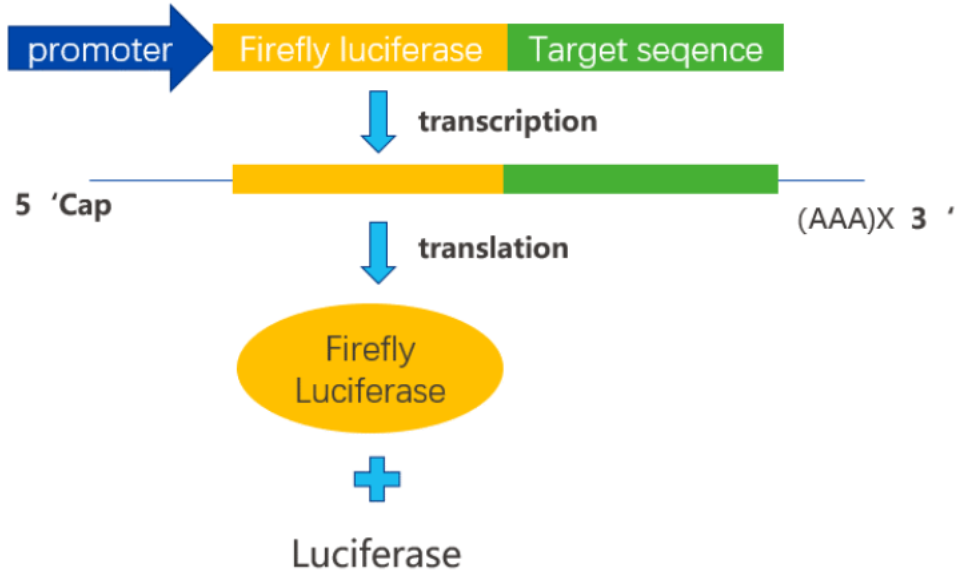
The Bright Luciferase Assay System has broad applications in gene expression regulation research. In promoter activity analysis, the promoter sequence of interest is cloned upstream of the luciferase-coding sequence, and changes in luciferase activity are measured to evaluate transcriptional activity. In signaling pathway studies, downstream response elements of the pathway are inserted into the reporter vector to monitor pathway activation in real time. In miRNA target validation, the 3'UTR sequence of the candidate target gene is inserted into the reporter vector, and changes in luciferase activity are detected after co-transfection with the miRNA.
In transcription factor regulation studies, transcription factor binding sites are tandemly cloned upstream of a minimal promoter to assess the regulatory effects of transcription factors on target genes. In dual-reporter gene systems, Renilla luciferase is typically used as an internal control, and the final results are expressed as the ratio of firefly luciferase activity to Renilla luciferase activity, effectively normalizing for transfection efficiency and cell number variations between wells. The high-brightness signals of the Bright system enable sensitive detection of regulatory effects by low-abundance transcription factors, expanding the scope of gene expression regulation research.
IV. Applications of the Bright System in Drug Screening and Cell Viability Assays
The Bright Luciferase Assay System holds significant value in drug discovery. In high-throughput drug screening, it can be used to evaluate the effects of candidate compounds on specific signaling pathways or gene expression, identifying active compounds from large compound libraries. In cell viability assays, ATP content is measured to indirectly reflect the number of viable cells—ATP is the direct energy source for cells, and it rapidly hydrolyzes upon cell death. Thus, measuring endogenous ATP levels reflects cell viability and counts. The high brightness and wide linear range of the Bright system make it particularly suitable for viability assays under low cell density conditions.
In reporter gene in vivo imaging, stable cell lines with chromosomally integrated luciferase genes can be established to monitor cell proliferation, migration, and differentiation in vivo. In protein-protein interaction studies, luciferase fragment complementation technology can detect interactions between proteins in living cells. Additionally, the system can be applied to miRNA functional validation, viral vector titer determination, and vaccine immunogenicity evaluation.
V. Key Operational Considerations for Bright Assay Experiments
In practical applications of the Bright Luciferase Assay System, the following key factors should be considered to ensure data reliability and reproducibility. In reagent equilibration, detection reagents and samples should be equilibrated to room temperature before use to avoid temperature-induced variations in reaction kinetics. In sample handling, adherent cells can be assayed directly in culture plates without digestion or transfer; for suspension cells, partial medium can be removed after centrifugation before detection. In signal reading, detection reagents should be thoroughly mixed after addition, and luminescence values should be read after complete cell lysis and signal stabilization.
In data processing, at least triplicate wells are recommended, and results should be normalized using an internal control reporter gene. In buffer compatibility, buffers containing EDTA or high salt concentrations should be avoided, as they may interfere with luciferase catalytic activity. In signal reading time, while the high-brightness signals of the Bright system enhance sensitivity, detection should still be completed within the recommended time window to ensure data accuracy.
VI. Conclusion
In practical applications of the Bright Luciferase Assay System, high-quality detection reagents are crucial for ensuring data reliability and experimental reproducibility. To meet the needs of luciferase reporter gene assays, UA-Glo® Bright Luciferase Assay System is provided. This product features an optimized high-brightness luminescence system with the following core characteristics: high-brightness signal output significantly enhances detection sensitivity, making it suitable for low-expression genes and trace samples; low background ensures excellent signal-to-noise ratio; a homogeneous "add-mix-detect" workflow eliminates the need for washing or separation steps and is compatible with 96-well and 384-well plates for high-throughput automation platforms; a wide dynamic range covering 7 to 8 orders of magnitude supports simultaneous detection of strong and weak signals. This kit is suitable for gene expression regulation research, signaling pathway analysis, miRNA target validation, cell viability assays, and high-throughput drug screening.
The Bright Luciferase Assay System, with its comprehensive advantages of high-brightness signal output, low background interference, wide dynamic range, and operational convenience, has become an indispensable core technology platform in gene expression regulation research and drug discovery. From the molecular mechanism of luciferase-catalyzed luminescence to the high-brightness signal design of the Bright system, and from promoter activity analysis to high-throughput drug screening, the Bright Luciferase Assay System continues to play an irreplaceable supporting role. The UA-Glo® Bright Luciferase Assay System provides a reliable tool for luciferase reporter gene assays, driving in-depth exploration and translational applications in related research fields.
This article is reviewed and published by the technical expert team of UA
Disclaimer: This article partially utilizes artificial intelligence assistance in its creation. If any content involves copyright or intellectual property issues, please let us know and we promise to verify and remove it as soon as possible.
Purchase recombinant protein, choose Nanjing UA-Bio
UA protein focuses on providing various protein reagents, raw materials, and services required for drug research and development, cell therapy, gene therapy, and basic scientific research, including drug target proteins, immune checkpoint proteins, cytokines, tool enzymes, customized protein expression, and full-length transmembrane protein development. Youai is committed to providing customers with high-quality products and professional services, and building a High-tech Biological Enterprise with International Competitiveness.
Target proteins | membrane proteins | cytokines | enzymes | viral antigens | protein customization
Nanjing UA Biotechnology Co., Ltd. Email:order@ua-bio.com Phone:+86-25-56221161

Product Information

Link:





©2021-2026 all rights reserved UA Biotechnology Co.,Ltd.
Privacy Policy 
网站备案号 浙ICP备2022019033号-2 浙公网安备33010202004867号
 Business license (three certificates in one)
 Tel:+86-25-56221161
E-mail:order@ua-bio.com
All products sold on this website shall not be used for clinical diagnosis or treatment of humans or animals, and shall only be used for non-medical purposes such as industrial or scientific research.