

Bioluminescent Luciferase Assay System: A Core Technology Platform from Reporter Genes to High-Throughput Screening
Author: Senior Product Manager of UA Views:15 


This article systematically elaborates on the technical principles and application systems of the bioluminescent luciferase assay system, detailing the molecular mechanism of luciferase-catalyzed substrate oxidation and luminescence, as well as its technical advantages as a reporter gene. It analyzes the synergistic application strategies of firefly luciferase and Renilla luciferase in dual-reporter gene systems and explores the widespread use of this assay system in gene expression regulation studies, signaling pathway analysis, and high-throughput drug screening.
- Recent Advances
- Product Information
Recent Advances
Bioluminescent Luciferase Assay System: A Core Technology Platform from Reporter Genes to High-Throughput Screening
Overview
This article systematically elaborates on the molecular mechanism of luciferase-catalyzed substrate oxidation and its technical advantages as a reporter gene. It analyzes the synergistic application strategies of firefly luciferase and Renilla luciferase in dual-reporter gene systems and explores the widespread applications of this assay system in gene expression regulation studies, signaling pathway analysis, and high-throughput drug screening.
This article systematically elaborates on the molecular mechanism of luciferase-catalyzed substrate oxidation and its technical advantages as a reporter gene. It analyzes the synergistic application strategies of firefly luciferase and Renilla luciferase in dual-reporter gene systems and explores the widespread applications of this assay system in gene expression regulation studies, signaling pathway analysis, and high-throughput drug screening.
1. Molecular Basis of the Bioluminescent Luciferase Assay System
The bioluminescent luciferase assay system is a reporter system that detects firefly luciferase activity using luciferin as a substrate. Luciferase catalyzes the oxidation of luciferin into oxyluciferin, emitting bioluminescence during the oxidation process, which can be measured using a luminometer. This luminescent reaction exhibits extremely high quantum efficiency, and since mammalian cells lack endogenous luciferase, the background signal is minimal, resulting in an excellent signal-to-noise ratio.
A key feature of the luciferase-catalyzed luminescent reaction is that it requires no post-translational modifications; the protein generates reporter activity immediately upon translation, ensuring real-time signal response. Additionally, the assay has a wide linear range spanning 7 to 8 orders of magnitude, covering low to high expression levels, making it the most widely used reporter gene system in gene expression regulation studies. Among all chemiluminescent reactions, the luciferase-catalyzed reaction has the highest quantum efficiency, with detection sensitivity reaching 10⁻¹⁹ moles, far exceeding the capabilities of traditional colorimetric assays.
2. Technical Advantages of the Luciferase Reporter Gene System
The bioluminescent luciferase assay system offers multiple technical advantages in life science research. In terms of high sensitivity, the luciferase-catalyzed luminescent reaction exhibits extremely high quantum efficiency, enabling detection of biomolecular interactions as low as femtomolar levels, making it suitable for studying low-expression gene regulation. In terms of low background, mammalian cells lack endogenous luciferase, and the assay reagents themselves produce no background luminescence, ensuring signal specificity. In terms of speed, the assay can be completed within minutes, with signal readout for individual samples taking only seconds, making it ideal for high-throughput operations.
In terms of operational convenience, the assay system employs a homogeneous "add-mix-measure" workflow, eliminating the need for washing or separation steps, and is compatible with high-throughput formats such as 96-well and 384-well plates. In terms of signal stability, "glow-type" assay reagents provide luminescent signals with half-lives lasting several hours, offering ample time for batch processing and high-throughput screening. These combined advantages make the luciferase reporter gene system the most widely used core technology platform for gene expression regulation studies and drug screening.
3. Design Strategies and Synergistic Applications of Dual-Reporter Gene Systems
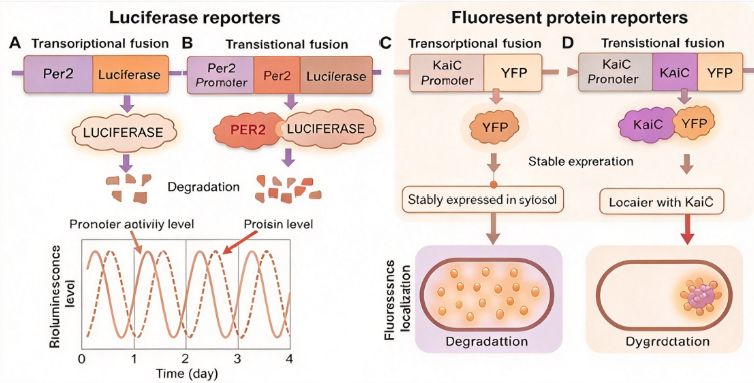
Luciferase can be fused with proteins to construct dual-reporter gene expression systems, such as Renilla luciferase with red fluorescent protein, firefly luciferase with green fluorescent protein, and firefly luciferase with Renilla luciferase dual-expression systems. These reporter genes are rapidly evolving and finding increasingly broad applications.
The core design logic of dual-reporter gene systems is as follows: firefly luciferase serves as the experimental reporter gene, with its activity reflecting the transcriptional activity of the target regulatory element; Renilla luciferase serves as the internal control reporter gene, driven by a constitutive promoter for consistent expression, used to normalize differences in transfection efficiency and cell numbers. The final results are expressed as the ratio of firefly luciferase activity to Renilla luciferase activity, effectively eliminating well-to-well variations and ensuring comparability across experimental batches and treatment groups. In dual-luciferase assays, the two luciferases use different substrates and emit different colors of light—firefly luciferase catalyzes luciferin oxidation to emit yellow-green light (wavelength ~550–580 nm), while Renilla luciferase catalyzes coelenterazine oxidation to emit blue light (wavelength ~480 nm). This optical difference allows sequential detection of both signals in the same well without interference.
4. Application Scenarios of the Bioluminescent Luciferase Assay System
The bioluminescent luciferase assay system has broad applications in life science research and drug development. In gene expression regulation studies, the promoter of interest is cloned upstream of the luciferase coding sequence, and changes in luciferase activity are measured to assess transcriptional activity. In signaling pathway studies, downstream response elements are inserted into reporter vectors to monitor pathway activation in real time. In miRNA target validation, candidate 3'UTR sequences are inserted into reporter vectors and co-transfected with miRNAs, followed by detection of changes in luciferase activity.
In drug screening, the assay system can be used to establish high-throughput screening platforms to evaluate the regulatory effects of candidate compounds on specific signaling pathways or gene expression. In cell viability assays, ATP content is measured to indirectly reflect the number of viable cells. ATP is the direct energy source for cells, and it rapidly hydrolyzes upon cell death, so measuring endogenous ATP levels can indicate cell activity and viable cell numbers. Additionally, the assay system can be used for reporter gene in vivo imaging, protein interaction studies, and cell tracing, among other applications.
5. Key Operational Considerations for Luciferase Assay Experiments
In practical applications of the bioluminescent luciferase assay, the following factors should be considered to ensure data reliability and reproducibility. For plasmid transfection, optimize the ratio of transfection reagent to DNA to ensure stable and reproducible transfection efficiency. For cell state, use cells in the logarithmic growth phase with good viability. For assay reagent selection, traditional "flash-type" reagents offer high signal intensity but rapid signal decay, requiring strict timing, whereas "glow-type" reagents, through optimized substrates and buffer systems, provide stable luminescent signals for several hours, offering ample time for batch processing and high-throughput screening.
For data processing, set up at least three replicates and normalize using the internal control reporter gene. Additionally, avoid buffers containing EDTA or high salt concentrations, as they may interfere with luciferase catalytic activity. For long-term culture experiments, monitor reporter gene expression stability to avoid expression decline due to retroviral vector construction methods.
6. Conclusion
In practical applications of the bioluminescent luciferase assay, high-quality assay reagents are critical for ensuring data reliability and experimental reproducibility. To meet the needs of luciferase reporter gene assays, UA offers the UA-Glo® Steady Luciferase Assay System. This product features an optimized "glow-type" luminescence system with the following core characteristics: luminescent signals with half-lives lasting several hours, supporting batch processing and flexible timing; high signal-to-noise ratio and low background enhance data reliability; a homogeneous "add-mix-measure" workflow compatible with 96-well and 384-well plates, eliminating separation or washing steps; suitability for high-throughput drug screening and quantitative analyses requiring high data reproducibility. The kit is ideal for gene expression regulation studies, signaling pathway analysis, miRNA target validation, and high-throughput drug screening.
The bioluminescent luciferase assay system, with its combined advantages of high sensitivity, wide linear range, low background, and operational convenience, has become an indispensable core technology platform for gene expression regulation studies and drug discovery. From the molecular mechanism of luciferase-catalyzed luminescence to the precise design of dual-reporter gene systems, from basic research on gene expression regulation to translational applications in high-throughput drug screening, the bioluminescent luciferase assay system continues to play an irreplaceable supporting role. The UA-Glo® Steady Luciferase Assay System provides a reliable tool for luciferase reporter gene assays, driving further exploration and translational applications in related research fields.
This article is reviewed and published by the technical expert team of UA
Disclaimer: This article partially utilizes artificial intelligence assistance in its creation. If any content involves copyright or intellectual property issues, please let us know and we promise to verify and remove it as soon as possible.
Purchase recombinant protein, choose Nanjing UA-Bio
UA protein focuses on providing various protein reagents, raw materials, and services required for drug research and development, cell therapy, gene therapy, and basic scientific research, including drug target proteins, immune checkpoint proteins, cytokines, tool enzymes, customized protein expression, and full-length transmembrane protein development. Youai is committed to providing customers with high-quality products and professional services, and building a High-tech Biological Enterprise with International Competitiveness.
Target proteins | membrane proteins | cytokines | enzymes | viral antigens | protein customization
Nanjing UA Biotechnology Co., Ltd. Email:order@ua-bio.com Phone:+86-25-56221161

Product Information

Link:





©2021-2026 all rights reserved UA Biotechnology Co.,Ltd.
Privacy Policy 
网站备案号 浙ICP备2022019033号-2 浙公网安备33010202004867号
 Business license (three certificates in one)
 Tel:+86-25-56221161
E-mail:order@ua-bio.com
All products sold on this website shall not be used for clinical diagnosis or treatment of humans or animals, and shall only be used for non-medical purposes such as industrial or scientific research.