

Acetylated Histone H4 Peptide: A Core Tool for Chromatin Modification Research and Epigenetic Regulation
Author: Senior Product Manager of UA Views:15 


This article systematically elucidates the molecular mechanisms of protein acetylation and its central role in chromatin conformation regulation and gene transcription activation, focusing on the molecular characteristics and biological functions of acetylated histone H4 peptides. It analyzes the multifaceted roles of histone H4 acetylation in cell differentiation, embryonic development, and cell cycle regulation, explores the technological evolution of research methods for acetylated proteins, and introduces the application value of acetylated histone H4 peptides in epigenetic studies.
- Recent Advances
- Product Information
Recent Advances
Acetylated Histone H4 Peptide: A Core Tool for Chromatin Modification Research and Epigenetic Regulation
Summary
This article systematically elaborates on the molecular characteristics and biological functions of acetylated histone H4 peptides, detailing the molecular mechanisms of protein acetylation and its central role in chromatin conformation regulation and gene transcription activation. It analyzes the multifaceted functions of histone H4 acetylation in cell differentiation, embryonic development, and cell cycle regulation, explores the technological evolution of acetylated protein research methods, and introduces the application value of acetylated histone H4 peptides in epigenetic research.
This article systematically elaborates on the molecular characteristics and biological functions of acetylated histone H4 peptides, detailing the molecular mechanisms of protein acetylation and its central role in chromatin conformation regulation and gene transcription activation. It analyzes the multifaceted functions of histone H4 acetylation in cell differentiation, embryonic development, and cell cycle regulation, explores the technological evolution of acetylated protein research methods, and introduces the application value of acetylated histone H4 peptides in epigenetic research.
I. Basic Concepts and Molecular Mechanisms of Protein Acetylation Modification
The most basic structural and functional unit of the human body is the cell, and cells primarily rely on proteins to perform complex tasks and sustain bodily functions. Just as different weapons are needed for battle, proteins require various "modifications" to execute different tasks. For example, when a protein is "grafted" with a group called an "acetyl group," it becomes an acetylated protein. Modified proteins can precisely regulate and control various intracellular pathways, executing the instructions issued by genes. The human body also has dozens or even hundreds of other "modifications," such as phosphorylation, ubiquitination, and methylation, with acetylation being one of the most extensively studied.
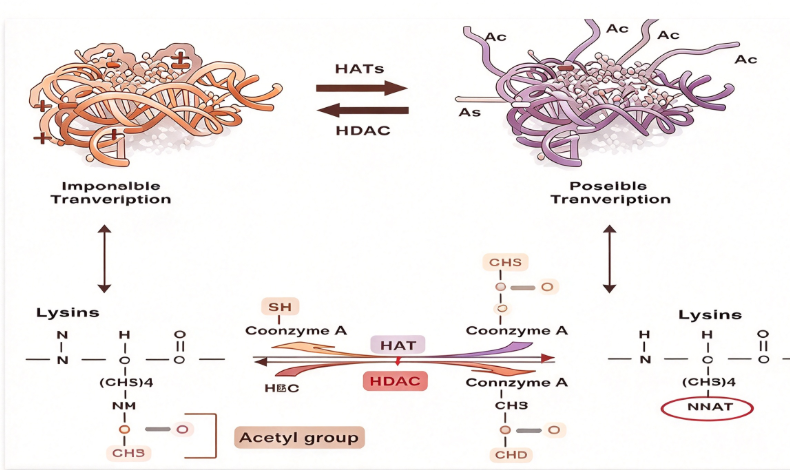
Acetylation is the process of adding an acetyl functional group to another organic compound and binding it. It is also an important form of post-translational protein modification in cells, primarily occurring on histone lysines and catalyzed by histone acetyltransferases. The reverse process, deacetylation, is catalyzed by histone deacetylases. This reversible modification process constitutes one of the core mechanisms of chromatin dynamic regulation.
II. Structural Features and Acetylation Sites of Histone H4
The N-terminus of core histones is rich in lysines, which are positively charged under physiological conditions. Core histones can be divided into five types, including core histones H2A, H2B, H3, and H4, as well as linker histone H1. Histone structures are highly conserved, especially H4. Core histones consist of a globular domain and a tail. The globular domain uses electrostatic interactions between arginine and the phosphodiester backbone to wrap DNA around the histone core, forming nucleosomes. The tail contains abundant arginine and lysine residues, serving as sites for post-translational modifications. H1 is diverse and exhibits species- and tissue-specificity. The lysines in histones can interact with negatively charged DNA or adjacent nucleosomes, leading to compact nucleosome conformations and highly folded chromatin.
In histone H4, lysine residues at positions 5, 8, 12, and 16 are the primary sites of acetylation modification. Acetylation weakens the interaction between histones and DNA, resulting in a looser chromatin conformation. This conformation facilitates the access of transcription regulatory factors, enabling them to bind and promote gene transcription, while deacetylation inhibits transcription. Thus, the acetylation state of histone H4 is a critical marker of chromatin activity.
III. Functions and Biological Significance of Acetylation Regulation
Acetylation reduces the positive charge of histones, weakening their binding to DNA and causing nucleosome disassembly. This allows transcription factors and RNA polymerase to bind to DNA smoothly, activating gene transcription. Acetylation can also lock the cell cycle by inhibiting cyclins, while histone deacetylation can silence gene expression.
Histone acetylation can also promote cell differentiation and inhibit embryonic development. For example, treating poorly differentiated tumor cells like HeLa with TSA can induce morphological differentiation, transforming them into cells resembling normal cells. Low concentrations of TSA can inhibit the formation of early gastrula-stage mesenchymal cells in starfish embryos, delaying gastrulation and preventing normal mesoderm formation in African clawed frog embryos. These studies demonstrate that histone acetylation plays a precise spatiotemporal regulatory role in developmental processes.
Histone acetylation exhibits diversity and dynamic changes. Specific gene loci undergo histone acetylation in unique ways, and the acetylation state of histones at particular chromatin sites is determined by the relative activities of histone acetyltransferases and deacetylases. Dysregulation of this dynamic balance is closely associated with the development of various malignancies and developmental abnormalities.
IV. Technological Evolution of Acetylated Protein Research Methods
Labeled substrate-based methods are classic strategies for studying acetylation modifications. Yu and colleagues reacted chlorinated acetyl-CoA with its substrate L12 under the action of the enzyme GNAT, resulting in the formation of chlorinated acetyl-L12. The chlorinated acetyl-L12 was then incubated with a His18-captured fluorescent peptide. After chlorine elimination, the purified labeled substrate could be visualized via fluorescence autoradiography.
Acetylation antibodies that specifically recognize acetylated lysine residues are another important method. For lysine acetylation modifications, Kim and colleagues used immunoaffinity purification to enrich lysine-acetylated peptides, identifying 195 lysine-acetylated proteins in the cytoplasm, nucleus, and mitochondria of HeLa cells. However, lysine acetylation antibodies can only specifically recognize proteins or peptides with modified lysine residues and cannot detect acetylation modifications on serine or threonine. Antibodies that specifically recognize serine or threonine acetylation modifications would greatly facilitate proteomic analysis of these modifications.
Identifying acetylation modification sites via mass spectrometry is the most precise method. Mass spectrometry compares the detected peptide mass with the predicted peptide mass. If the masses differ by 42 Da, it is inferred that an acetylation modification has occurred on an amino acid residue or the protein terminus. By analyzing the b or y ions generated from the N- or C-terminus of the identified peptide, the specific acetylation site can be determined.
V. Research Application Value of Acetylated Histone H4 Peptides
In histone acetylation research, acetylated histone H4 peptides are a core tool for deciphering acetylation recognition mechanisms and screening epigenetic regulatory factors. These peptides typically encompass the N-terminal 1–21 amino acid sequence of histone H4, with acetylation modifications introduced at lysine residues 5, 8, 12, and 16. By incorporating a biotin label at the C-terminus, the peptides can be conveniently immobilized and detected. Such peptides are widely used in the following research scenarios: as substrates for measuring the activity of histone acetyltransferases and deacetylases; as ligands for analyzing the binding activity of bromodomain proteins; for high-throughput screening of epigenetic inhibitors; and for elucidating the molecular mechanisms by which acetylation modifications influence chromatin structure.
To meet these research needs, Uni offers [Lys(Ac)5/8/12/16]-Histone H4 (1-21)-GGK(Biotin). This product covers the N-terminal 1–21 amino acid sequence of histone H4, with acetylation modifications at lysine residues 5, 8, 12, and 16, and biotin labeling via the C-terminal GGK(Biotin). This peptide is suitable for studying the recognition mechanisms of histone acetylation modifications, analyzing bromodomain protein binding, and screening epigenetic-targeted drugs.
VI. Conclusion
As a core tool for epigenetic regulation research, acetylated histone H4 peptides play a pivotal role in chromatin conformation regulation and gene transcription activation, providing essential experimental materials for deciphering the molecular mechanisms of acetylation and screening targeted drugs. From the basic concepts of protein acetylation to the fine resolution of histone H4 acetylation sites, from the biological functions of acetylation regulation to the continuous evolution of research methods, acetylated histone H4 peptides continue to serve an irreplaceable supporting role. [Lys(Ac)5/8/12/16]-Histone H4 (1-21)-GGK(Biotin) offers reliable support for histone acetylation research and will continue to drive in-depth exploration in the field of epigenetics.
This article is reviewed and published by the technical expert team of UA
Disclaimer: This article partially utilizes artificial intelligence assistance in its creation. If any content involves copyright or intellectual property issues, please let us know and we promise to verify and remove it as soon as possible.
Purchase recombinant protein, choose Nanjing UA-Bio
UA protein focuses on providing various protein reagents, raw materials, and services required for drug research and development, cell therapy, gene therapy, and basic scientific research, including drug target proteins, immune checkpoint proteins, cytokines, tool enzymes, customized protein expression, and full-length transmembrane protein development. Youai is committed to providing customers with high-quality products and professional services, and building a High-tech Biological Enterprise with International Competitiveness.
Target proteins | membrane proteins | cytokines | enzymes | viral antigens | protein customization
Nanjing UA Biotechnology Co., Ltd. Email:order@ua-bio.com Phone:+86-25-56221161

Product Information

Link:





©2021-2026 all rights reserved UA Biotechnology Co.,Ltd.
Privacy Policy 
网站备案号 浙ICP备2022019033号-2 浙公网安备33010202004867号
 Business license (three certificates in one)
 Tel:+86-25-56221161
E-mail:order@ua-bio.com
All products sold on this website shall not be used for clinical diagnosis or treatment of humans or animals, and shall only be used for non-medical purposes such as industrial or scientific research.