
Peptide sequencing: Protein sequence analysis technology from mass spectrometry to gene derivation
Author: Senior Product Manager of UA Views:11 


This article systematically elaborates on the operational processes and core characteristics of the two main technological approaches—mass spectrometry and DNA/RNA sequencing—in peptide sequencing, analyzing the technical essentials of key steps such as enzymatic digestion, ionization detection, and sequence interpretation. It explores the applicability of different sequencing strategies in proteomics research and introduces the application value of recombinant trypsin in peptide sequencing sample preparation.
- Recent Advances
- Product Information
Recent Advances
Peptide Sequencing: Protein Sequence Analysis Techniques from Mass Spectrometry to Gene Deduction
Overview
This article systematically elaborates on the technical principles and methodologies of peptide sequencing, focusing on the two main approaches—mass spectrometry and DNA/RNA sequencing. It analyzes the key technical aspects of enzymatic digestion, ionization detection, and sequence interpretation, discusses the applicability of different sequencing strategies in proteomics research, and introduces the value of recombinant trypsin in peptide sequencing sample preparation.
This article systematically elaborates on the technical principles and methodologies of peptide sequencing, focusing on the two main approaches—mass spectrometry and DNA/RNA sequencing. It analyzes the key technical aspects of enzymatic digestion, ionization detection, and sequence interpretation, discusses the applicability of different sequencing strategies in proteomics research, and introduces the value of recombinant trypsin in peptide sequencing sample preparation.
I. Technical Background and Core Significance of Peptide Sequencing
Peptide sequencing refers to the process of determining the amino acid sequence of a protein, which is fundamental for understanding protein structure and function, analyzing post-translational modifications, and developing targeted drugs. Protein sequence information is indispensable for disease mechanism research, biomarker discovery, and biopharmaceutical quality control. Due to the large molecular weight and complex structure of proteins, direct sequencing of intact proteins is extremely challenging. Therefore, a "divide and conquer" strategy is typically employed—proteins are fragmented into smaller peptides, which are then sequenced, and the complete protein sequence is deduced by overlapping these peptide sequences. The two most commonly used methods are mass spectrometry and DNA/RNA sequencing, each with distinct principles and applications.
II. Technical Workflow of Mass Spectrometry Sequencing
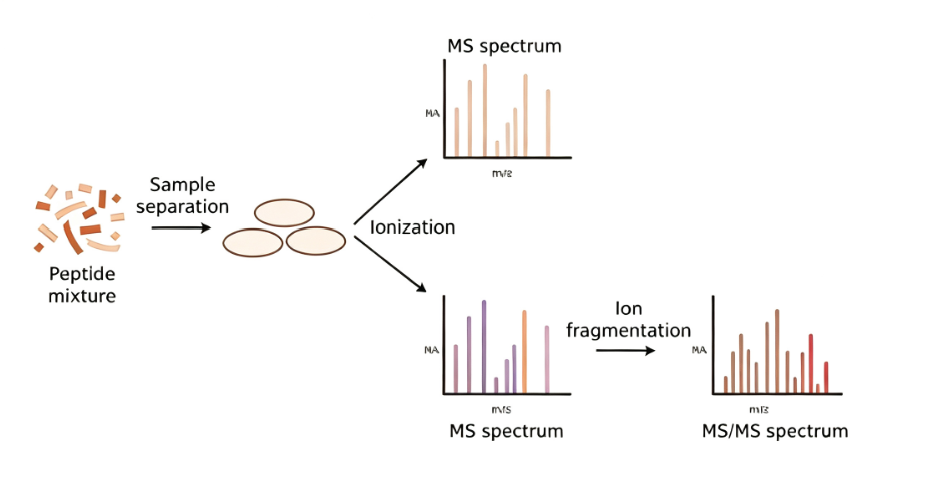
Mass spectrometry is the most widely used sequencing technique in proteomics research. Its core workflow consists of three key steps: sample preparation, mass spectrometry analysis, and data interpretation.
In the sample preparation stage, proteins are digested, typically using enzymes such as trypsin, which cleaves proteins into smaller peptides. Trypsin is the most commonly used protease in peptide sequencing due to its specificity for cleaving peptide bonds at the carboxyl termini of lysine and arginine residues, producing peptide fragments of suitable length and charge characteristics for mass spectrometry detection. The completeness and specificity of enzymatic digestion directly affect the coverage and accuracy of subsequent sequencing.
In the mass spectrometry analysis stage, peptides are analyzed using a mass spectrometer. First, peptides are ionized to form charged ions, commonly through electrospray ionization (ESI) or matrix-assisted laser desorption/ionization (MALDI). The charged ions are then separated and detected based on their mass-to-charge ratio (m/z). In tandem mass spectrometry (MS/MS), peptide ions undergo collision-induced dissociation (CID) to generate fragment ions. The mass differences between fragment ions reflect the mass differences between adjacent amino acid residues, providing the basis for sequence deduction.
In the data interpretation stage, the mass spectrometry data are used to determine the mass of each peptide, enabling the inference of the protein's amino acid sequence. Modern mass spectrometry data analysis typically employs database searching or de novo sequencing algorithms to match experimental spectra with theoretical spectra, achieving precise identification of protein sequences.
III. Technical Workflow of DNA/RNA Sequencing
DNA/RNA sequencing indirectly deduces the amino acid sequence of a protein at the genetic level. Its technical workflow includes four steps: transcription and reverse transcription, PCR amplification, sequencing, and translation.
In the transcription and reverse transcription stage, the protein-coding gene is transcribed into RNA, which is then reverse-transcribed into complementary DNA (cDNA). The key to this step lies in obtaining high-quality RNA templates and efficient reverse transcriptase activity.
In the PCR amplification stage, polymerase chain reaction (PCR) is used to amplify the cDNA, generating multiple copies. PCR amplification ensures sufficient template quantity for subsequent sequencing reactions and enables specific amplification of target gene regions through primer design. In the sequencing stage, DNA sequencing techniques are applied to the PCR-amplified products to determine the sequence of the original protein-coding gene. Modern high-throughput sequencing technologies enable massively parallel sequencing, significantly improving throughput and efficiency.
In the translation stage, the DNA sequence is translated into the corresponding amino acid sequence of the protein. Using the genetic codon table, nucleotide triplets (codons) are mapped to specific amino acid residues, allowing the deduction of the protein's primary structure. It is important to note that...
IV. Application Scenarios and Strategy Selection for Peptide Sequencing
Peptide sequencing technologies have broad applications in life science research and biopharmaceutical development. In proteomics research, mass spectrometry is used for large-scale identification of protein composition and abundance changes in biological samples. In biopharmaceutical quality control, peptide sequencing confirms the accuracy of recombinant protein drug sequences and the integrity of post-translational modifications. In antibody drug characterization, mass spectrometry is employed to analyze complementarity-determining region (CDR) sequences and glycosylation sites. In protein interaction studies, cross-linking mass spectrometry identifies interaction interfaces. For sequencing strategy selection, mass spectrometry is suitable for analyzing post-translational modifications, disulfide bond localization, and de novo sequencing of unknown proteins, while DNA/RNA sequencing is ideal for validating known gene sequences and large-scale gene expression analysis. These two methods complement each other and are often used together to obtain more comprehensive information.
V. Conclusion
In peptide sequencing sample preparation, high-quality proteases are critical for ensuring digestion efficiency and sequence coverage. To meet this research need, U-爱 offers Recombinant Trypsin. This product is prepared through a recombinant expression system, featuring high specific activity and excellent cleavage specificity. It is suitable for proteomics sample preparation, biopharmaceutical peptide mapping, and peptide sequencing applications, providing reliable enzymatic digestion support for peptide sequencing research.
As a core technology for deciphering protein amino acid sequences, peptide sequencing employs complementary strategies—mass spectrometry and DNA/RNA sequencing—at the protein and genetic levels, respectively. From enzymatic digestion in sample preparation to precise mass spectrometry data interpretation, from gene sequence amplification and sequencing to codon translation-based sequence deduction, the peptide sequencing technology system continues to provide critical technical support for protein science research and biopharmaceutical development. Recombinant Trypsin offers a reliable enzymatic digestion tool for peptide sequencing sample preparation, driving further exploration in proteomics and biopharmaceutical characterization.
```
This article is reviewed and published by the technical expert team of UA
Disclaimer: This article partially utilizes artificial intelligence assistance in its creation. If any content involves copyright or intellectual property issues, please let us know and we promise to verify and remove it as soon as possible.
Purchase recombinant protein, choose Nanjing UA-Bio
UA protein focuses on providing various protein reagents, raw materials, and services required for drug research and development, cell therapy, gene therapy, and basic scientific research, including drug target proteins, immune checkpoint proteins, cytokines, tool enzymes, customized protein expression, and full-length transmembrane protein development. Youai is committed to providing customers with high-quality products and professional services, and building a High-tech Biological Enterprise with International Competitiveness.
Target proteins | membrane proteins | cytokines | enzymes | viral antigens | protein customization
Nanjing UA Biotechnology Co., Ltd. Email:order@ua-bio.com Phone:+86-25-56221161

Product Information

Link:





©2021-2026 all rights reserved UA Biotechnology Co.,Ltd.
Privacy Policy 
网站备案号 浙ICP备2022019033号-2 浙公网安备33010202004867号
 Business license (three certificates in one)
 Tel:+86-25-56221161
E-mail:order@ua-bio.com
All products sold on this website shall not be used for clinical diagnosis or treatment of humans or animals, and shall only be used for non-medical purposes such as industrial or scientific research.