




IL-17F: A Key Effector of Th17 Immune Response and Novel Therapeutic Target for Inflammatory Diseases
Author: Senior Product Manager of UA Views:8 


This article focuses on the molecular characteristics and biological functions of interleukin-17F (IL-17F), systematically elaborating its pivotal role as a key member of the IL-17 family in inducing epithelial cells, endothelial cells, and fibroblasts to secrete pro-inflammatory factors. It also analyzes its pathological contributions to inflammatory diseases such as psoriasis, ankylosing spondylitis, periodontitis, and cardiovascular diseases.
- Recent Advances
- Product Information
Recent Advances
IL-17F: A Key Effector of Th17 Immune Responses and a Novel Target for Inflammatory Diseases
Overview
This article focuses on the molecular characteristics and biological functions of interleukin-17F (IL-17F), systematically elaborating its role as a key member of the IL-17 family in inducing epithelial cells, endothelial cells, and fibroblasts to secrete pro-inflammatory factors, and analyzing its pathological contributions in inflammatory diseases such as psoriasis, ankylosing spondylitis, periodontitis, and cardiovascular diseases.
This article focuses on the molecular characteristics and biological functions of interleukin-17F (IL-17F), systematically elaborating its role as a key member of the IL-17 family in inducing epithelial cells, endothelial cells, and fibroblasts to secrete pro-inflammatory factors, and analyzing its pathological contributions in inflammatory diseases such as psoriasis, ankylosing spondylitis, periodontitis, and cardiovascular diseases.
1. Molecular Composition of the IL-17 Family and the Role of IL-17F.
Interleukin-17 (IL-17) is a pro-inflammatory factor secreted by \(\mathrm{CD4 + T}\) cells, which can induce epithelial cells, endothelial cells, and fibroblasts to synthesize and secrete IL-6, IL-8, G-CSF, and PGE2, and promote the expression of ICAM-1. IL-17 is the primary effector of Th17 cells, and this family includes six ligand members (IL-17A to IL-17F) and five receptors (IL-17RA to IL-17RD and SEF). IL-17A and IL-17F are the most extensively studied members of the family, sharing approximately \(50\%\) amino acid sequence homology, and they exist as homodimers or heterodimers (IL-17A/IL-17F). IL-17F is primarily produced by activated Th17 cells but can also be secreted by innate lymphoid cells, γδ T cells, and NKT cells. IL-17F binds to the IL-17RA/IL-17RC receptor complex, activating NF-κB and MAPK signaling pathways and inducing the expression of downstream pro-inflammatory genes.
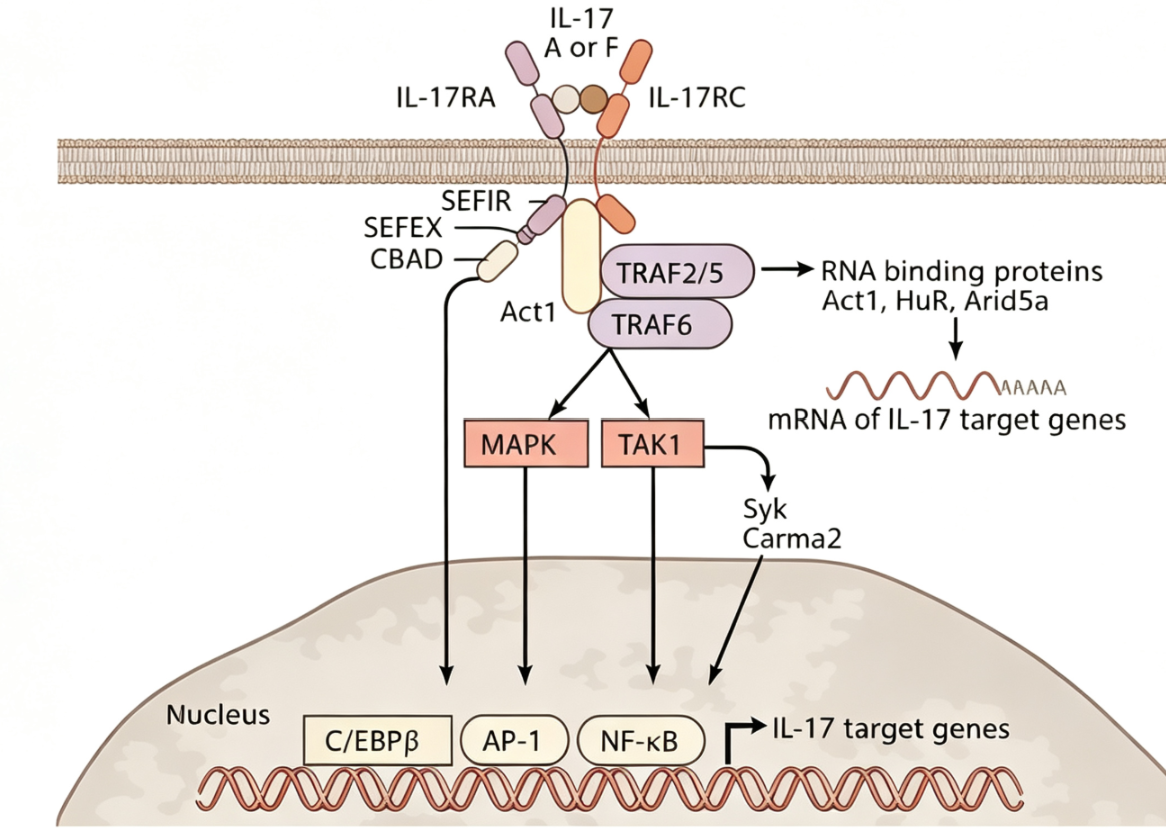
2. Pro-inflammatory Effects and Cellular Targets of IL-17F.
IL-17F acts on multiple cellular targets, leading to cell activation. Its effects on endothelial cells result in inflammation and pro-coagulant activity. When acting on epithelial cells and fibroblasts, IL-17F triggers the production of cytokines and enzymes. In monocytes and dendritic cells, IL-17F promotes inflammation by increasing the production of pro-inflammatory cytokines. IL-17F can enhance T-cell activation and stimulate epithelial cells, endothelial cells, and fibroblasts to produce various cytokines such as IL-6, IL-8, granulocyte-macrophage colony-stimulating factor, chemokines, and cell adhesion molecule 1, thereby driving inflammation. In the context of joint inflammation, IL-17F activates matrix destruction in cartilage and bone. IL-17F can form heterodimers with IL-17A, with biological activity intermediate between their respective homodimers.
3. Pathogenic Mechanisms of IL-17F in Psoriasis.
In psoriasis, the primary target cells of IL-17F include keratinocytes, endothelial cells, and innate immune cells. The systemic inflammatory response in psoriasis involves a positive feedback loop: IL-17F secreted by Th17 cells stimulates keratinocytes to produce inflammatory factors, altering the homeostasis of skin tissue-resident memory cells (\(\mathrm{CD8 + CD103 + TRM}\)) while further attracting activated lymphocyte subsets to maintain the inflammatory state in psoriatic plaques. Keratinocytes stimulated by IL-17F produce IL-17C, which can activate Th17 cells to secrete more IL-17F, further amplifying this immune pathway. IL-17F and IL-17A synergize in psoriatic lesions, jointly driving abnormal keratinocyte proliferation and inflammatory cascades.
4. Role of IL-17F in Ankylosing Spondylitis and Psoriatic Arthritis.
Chronic inflammation leading to structural damage is a key factor in the pathogenesis of ankylosing spondylitis (AS) and psoriatic arthritis (PsA). In AS and PsA patients, bone loss is associated with the activation of the IL-23/IL-17 axis, which stimulates osteoclast differentiation. Additionally, IL-17F regulates the activation and differentiation of osteoblasts. IL-23 can stimulate Th17 cells to secrete IL-17F and IL-22. IL-17F induces the expression of RANKL in osteoblasts and promotes osteoclast differentiation; it can also directly enhance osteoclastogenesis, leading to bone erosion. IL-17F and IL-22 promote the differentiation of mesenchymal stem cells into osteoblasts and hypertrophic chondrocytes, resulting in new bone formation. Eventually, calcified cartilage is gradually degraded and replaced by new bone, leading to spinal ankylosis. These mechanisms collectively form the molecular basis of structural damage in AS and PsA.
5. Pathological Contributions of IL-17F in Periodontitis and Cardiovascular Diseases.
In periodontitis, IL-17F upregulates granulocyte colony-stimulating factor and C-X-C motif chemokines in fibroblasts, coordinating the production and release of bone marrow neutrophils and their chemotactic recruitment to periodontal tissues. Furthermore, IL-17F inhibits endothelial cell production of Del-1, a glycoprotein that limits neutrophil infiltration by blocking the interaction between lymphocyte function-associated antigen-1 integrin on neutrophils and intercellular adhesion molecule-1 on endothelial cells. IL-17F can promote the destruction of connective tissue and underlying bone by stimulating the production of matrix metalloproteinases and RANKL in stromal cell types. Although IL-17F can also induce the production of epithelial-derived antimicrobial molecules, current evidence from human and animal studies suggests that the net effect of IL-17F signaling promotes disease progression.
In cardiovascular diseases, in vitro experiments indicate that IL-17F affects vascular constituent cells (endothelial cells, smooth muscle cells, fibroblasts, and adipocytes) and cardiomyocytes, thereby promoting the progression of cardiovascular inflammation. IL-17F induces vascular endothelial cells to secrete pro-inflammatory cytokines and chemokines; combined with IFN-γ, IL-17F promotes chronic apoptosis of vascular smooth muscle cells, accelerating atherosclerosis. In differentiated adipocytes, IL-17F increases the production of pro-inflammatory factors and promotes lipolysis, maintaining an inflammatory environment. Additionally, IL-17F can activate fibroblasts to participate in inflammation, increase collagen expression, reduce vascular compliance, and ultimately lead to hypertension. At the systemic level, plasma levels of IL-17F are elevated in patients with unstable angina or acute myocardial infarction, directly correlating with the degree of platelet aggregation.
6. Conclusion.
As a key effector of Th17 immune responses, IL-17F plays an indispensable role in the pathological processes of various inflammatory diseases, including psoriasis, ankylosing spondylitis, periodontitis, and cardiovascular diseases, through its core function of inducing epithelial cells, endothelial cells, and fibroblasts to secrete pro-inflammatory factors. Its elevated expression in multiple autoimmune diseases and close association with disease activity make it a highly promising therapeutic target in the field of inflammatory diseases. IL-17F Protein, Human provides critical tool support for in-depth analysis of IL-17F signaling networks and their functions in inflammatory diseases.
In IL-17F-related basic research and drug screening, high-quality human recombinant IL-17F protein is a core tool for receptor binding analysis, signaling pathway research, and exploration of inflammatory mechanisms. To meet this research demand, U-Pharm offers IL-17F Protein, Human, suitable for IL-17F/IL-17RA binding activity analysis, NF-κB signaling pathway mechanism exploration, and in vitro screening and evaluation of IL-17F-targeted antibody drugs.
This article is reviewed and published by the technical expert team of UA
Disclaimer: This article partially utilizes artificial intelligence assistance in its creation. If any content involves copyright or intellectual property issues, please let us know and we promise to verify and remove it as soon as possible.
Purchase recombinant protein, choose Nanjing UA-Bio
UA protein focuses on providing various protein reagents, raw materials, and services required for drug research and development, cell therapy, gene therapy, and basic scientific research, including drug target proteins, immune checkpoint proteins, cytokines, tool enzymes, customized protein expression, and full-length transmembrane protein development. Youai is committed to providing customers with high-quality products and professional services, and building a High-tech Biological Enterprise with International Competitiveness.
Target proteins | membrane proteins | cytokines | enzymes | viral antigens | protein customization
Nanjing UA Biotechnology Co., Ltd. Email:order@ua-bio.com Phone:+86-25-56221161

Product Information

Link:





©2021-2026 all rights reserved UA Biotechnology Co.,Ltd.
Privacy Policy 
网站备案号 浙ICP备2022019033号-2 浙公网安备33010202004867号
 Business license (three certificates in one)
 Tel:+86-25-56221161
E-mail:order@ua-bio.com
All products sold on this website shall not be used for clinical diagnosis or treatment of humans or animals, and shall only be used for non-medical purposes such as industrial or scientific research.
