




Syndecan-1/CD138: A Key Mediator of Macropinocytosis in Pancreatic Cancer and a Novel Therapeutic Target
Author: Senior Product Manager of UA Views:5 


This article systematically elucidates the molecular characteristics and functional mechanisms of Syndecan-1 (CD138) as a member of the heparan sulfate proteoglycan family. It focuses on how Syndecan-1 is regulated to the cell membrane surface via the MAPK-PSD4-ARF6 axis in KRAS mutation-driven pancreatic ductal adenocarcinoma, thereby mediating macropinocytosis to support tumor metabolic reprogramming.
- Recent Advances
- Product Information
Recent Advances
Syndecan-1/CD138: A Key Mediator of Macropinocytosis and Novel Therapeutic Target in Pancreatic Cancer
Summary
This article systematically elucidates the molecular characteristics and functional mechanisms of Syndecan-1 (CD138) as a member of the heparan sulfate proteoglycan family. It highlights its core role in KRAS-mutant-driven pancreatic ductal adenocarcinoma (PDAC), where it is regulated to the cell membrane surface via the MAPK-PSD4-ARF6 axis and subsequently mediates macropinocytosis to support tumor metabolic reprogramming.
This article systematically elucidates the molecular characteristics and functional mechanisms of Syndecan-1 (CD138) as a member of the heparan sulfate proteoglycan family. It highlights its core role in KRAS-mutant-driven pancreatic ductal adenocarcinoma (PDAC), where it is regulated to the cell membrane surface via the MAPK-PSD4-ARF6 axis and subsequently mediates macropinocytosis to support tumor metabolic reprogramming.
I. Therapeutic Challenges in Pancreatic Cancer and KRAS-Driven Surfaceome Remodeling
Pancreatic ductal adenocarcinoma (PDAC) is one of the most lethal solid tumors, with a five-year survival rate of less than 10%. Over 90% of PDAC cases harbor KRAS driver mutations, which represent the earliest molecular events in disease development. Despite preliminary progress in developing drugs targeting the KRAS signaling pathway, clinical efficacy remains limited. On the cancer cell surface, numerous molecular events associated with cancer progression are directly regulated by the KRAS pathway. However, the composition and function of the KRAS-regulated PDAC surface proteome have long remained unelucidated.
II. KRAS-Dependent Mechanism of Syndecan-1 Surface Localization
Using a doxycycline-inducible Kras mouse model combined with SILAC quantitative proteomics, researchers identified 221 differentially expressed plasma membrane proteins regulated by KRAS. Among these, SDC1 (Syndecan-1/CD138) exhibited the most significant upregulation in membrane expression upon KRAS activation. Syndecan-1 belongs to the heparan sulfate proteoglycan family and is a type I transmembrane glycoprotein whose extracellular domain carries heparan sulfate and chondroitin sulfate glycosaminoglycan chains.
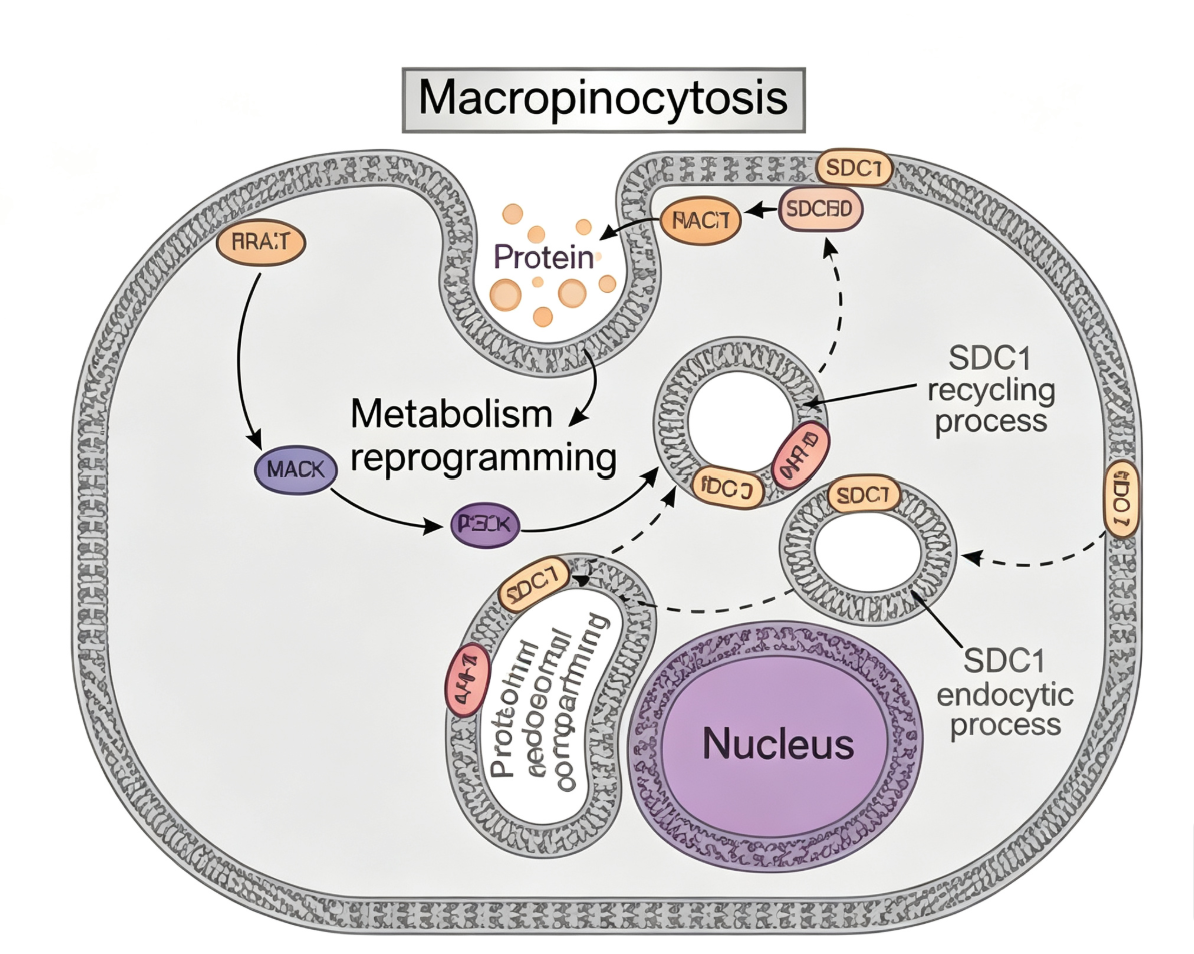
Mechanistic studies revealed that KRAS drives SDC1 membrane localization via the MAPK pathway. Specifically, KRAS signaling regulates PSD4 protein levels through the MAPK pathway. PSD4, as a guanine nucleotide exchange factor for ARF6, activates ARF6, promoting the transport and recycling of SDC1 from the intracellular pool to the plasma membrane, forming the KRAS-MAPK-PSD4-ARF6-SDC1 signaling axis. Upon KRAS signal withdrawal, PSD4 levels decrease in a time-dependent manner, followed by a reduction in SDC1 membrane expression.
III. Molecular Mechanism of Syndecan-1-Mediated Macropinocytosis
KRAS-mutant PDAC cells are highly dependent on macropinocytosis to uptake extracellular nutrients and sustain metabolic demands. Studies confirmed that SDC1, through its KRAS-dependent surface localization via the PSD4-ARF6 axis, plays a pivotal role in the initiation and maintenance of macropinocytosis. SDC1 knockout significantly inhibited macropinocytosis, manifesting as reduced macropinosome formation and decreased extracellular protein uptake. The small GTPase RAC1 is critical for membrane ruffling and macropinosome formation—SDC1 knockout cells exhibited markedly suppressed RAC1 activity, suggesting that SDC1 acts upstream of RAC1 to regulate macropinocytosis initiation.
IV. Preclinical Validation of Syndecan-1 as a Therapeutic Target
Loss-of-function experiments demonstrated that SDC1 knockout significantly impaired PDAC cell colony-forming ability, inhibited subcutaneous xenograft tumor growth, and markedly prolonged the survival of tumor-bearing mice. Across multiple PDAC models, in vivo functional loss screening consistently ranked SDC1 as the surface protein with the most pronounced impact on tumor survival. These findings establish the critical role of SDC1 in KRAS-driven PDAC and suggest its potential as a novel therapeutic target for pancreatic cancer.
V. Conclusion
As a key downstream effector of KRAS signaling, Syndecan-1 is regulated to the PDAC cell membrane surface via the MAPK-PSD4-ARF6 axis, where it plays an indispensable core role in the initiation and maintenance of macropinocytosis. Functional validation establishes SDC1's pivotal position in PDAC metabolic reprogramming and tumor maintenance, providing a solid theoretical foundation for its development as a novel therapeutic target. FITC-labeled Syndecan-1/CD138 recombinant protein offers a reliable detection tool to support related basic research and drug development.
In Syndecan-1-related tumor research and drug screening, high-quality fluorescently labeled recombinant proteins are essential tools for flow cytometry detection and target validation. To meet this research demand, UniLove provides FITC-Labeled Syndecan-1/CD138 His Tag Protein, Human, suitable for flow cytometry analysis of SDC1 surface expression levels in PDAC cell lines, binding activity evaluation of SDC1-targeting antibody drugs or ADC molecules, and detection of SDC1 membrane localization in macropinocytosis-related studies.
This article is reviewed and published by the technical expert team of UA
Disclaimer: This article partially utilizes artificial intelligence assistance in its creation. If any content involves copyright or intellectual property issues, please let us know and we promise to verify and remove it as soon as possible.
Purchase recombinant protein, choose Nanjing UA-Bio
UA protein focuses on providing various protein reagents, raw materials, and services required for drug research and development, cell therapy, gene therapy, and basic scientific research, including drug target proteins, immune checkpoint proteins, cytokines, tool enzymes, customized protein expression, and full-length transmembrane protein development. Youai is committed to providing customers with high-quality products and professional services, and building a High-tech Biological Enterprise with International Competitiveness.
Target proteins | membrane proteins | cytokines | enzymes | viral antigens | protein customization
Nanjing UA Biotechnology Co., Ltd. Email:order@ua-bio.com Phone:+86-25-56221161

Product Information

Link:





©2021-2026 all rights reserved UA Biotechnology Co.,Ltd.
Privacy Policy 
网站备案号 浙ICP备2022019033号-2 浙公网安备33010202004867号
 Business license (three certificates in one)
 Tel:+86-25-56221161
E-mail:order@ua-bio.com
All products sold on this website shall not be used for clinical diagnosis or treatment of humans or animals, and shall only be used for non-medical purposes such as industrial or scientific research.
