




IL-12: From Th1 Immune Response Regulation to a Central Factor in Tumor Immunotherapy
Author: Senior Product Manager of UA Views:5 


This article focuses on the molecular characteristics and biological functions of IL-12, systematically elaborating its pivotal role as a core member of the IL-12 family in promoting Th1 cell differentiation, inducing IFN-γ production, and enhancing the activity of cytotoxic T cells and NK cells. It also analyzes various delivery strategies and clinical translation progress in tumor immunotherapy.
- Recent Advances
- Product Information
Recent Advances
IL-12: From Th1 Immune Response Regulation to a Core Factor in Tumor Immunotherapy
Overview
This article systematically elaborates on the molecular characteristics and biological functions of IL-12 as a core member of the IL-12 family, highlighting its key role in promoting Th1 cell differentiation, inducing IFN-γ production, and enhancing the activity of cytotoxic T cells and NK cells. It also analyzes various delivery strategies and clinical translation progress in tumor immunotherapy.
This article systematically elaborates on the molecular characteristics and biological functions of IL-12 as a core member of the IL-12 family, highlighting its key role in promoting Th1 cell differentiation, inducing IFN-γ production, and enhancing the activity of cytotoxic T cells and NK cells. It also analyzes various delivery strategies and clinical translation progress in tumor immunotherapy.
I. Molecular Structure and Family Classification of IL-12
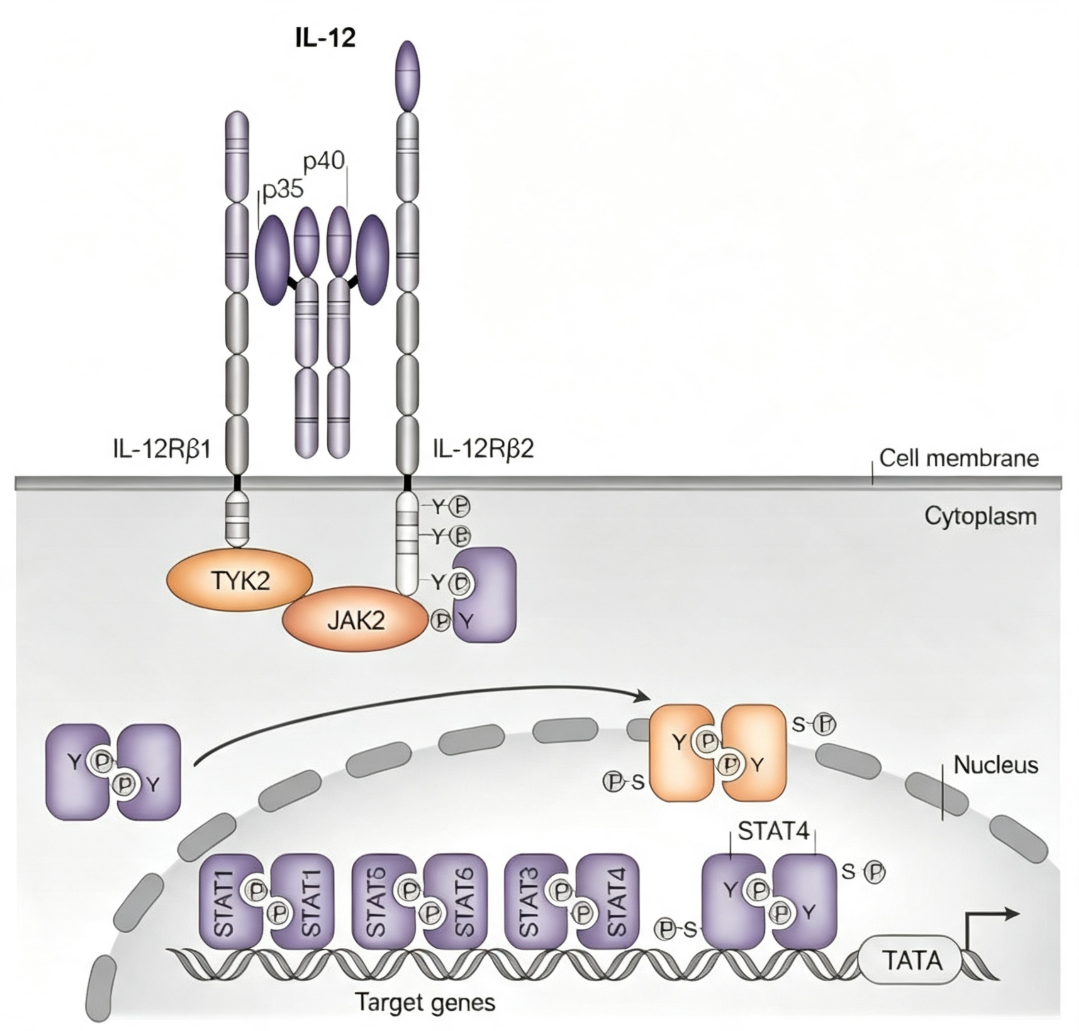
Interleukin-12 (IL-12) is a core member of the IL-12 cytokine family, which also includes IL-23, IL-27, IL-35, and IL-39. IL-12 is a heterodimeric glycoprotein composed of two subunits, p35 and p40, linked by disulfide bonds. The p35 subunit (IL-12A) consists of approximately 197 amino acid residues with a molecular weight of about 35 kDa, containing a signal peptide and four α-helix bundles. The p40 subunit (IL-12B) consists of about 306 amino acid residues with a molecular weight of about 40 kDa, structurally homologous to cytokine receptors. The IL-12 receptor is composed of two subunits, IL-12Rβ1 and IL-12Rβ2, where IL-12Rβ1 provides the binding site for the p40 subunit, and IL-12Rβ2 provides the binding site for the p35 subunit. IL-12 and IL-23 share the p40 subunit and the IL-12Rβ1 receptor subunit but exhibit significant differences in immune regulatory functions.
II. Signal Transduction Mechanism of IL-12
Upon binding to the IL-12 receptor complex on target cells, IL-12Rβ1 and IL-12Rβ2 phosphorylate and activate JAK2 and TYK2, respectively, leading to the aggregation and phosphorylation of STAT4. Phosphorylated STAT4 forms homodimers and translocates to the nucleus, binding to the interferon γ-activated sequence in the promoter regions of target genes to initiate transcription of downstream genes such as IFN-γ and TNF-α. STAT4 is the most critical transcription factor in the IL-12 signaling pathway, and its activation strength determines IL-12's ability to induce Th1 differentiation and IFN-γ production.
III. Immune Regulatory Functions of IL-12
IL-12 plays a multi-layered regulatory role in immune responses. At the T cell differentiation level, IL-12 is a key factor in inducing naive CD4⁺ T cells to differentiate into Th1 cells, upregulating T-bet expression, promoting Th1 differentiation, and inhibiting Th2 and Th17 differentiation. At the effector function level, IL-12 is one of the strongest stimulators for inducing IFN-γ production in T cells and NK cells, synergistically enhancing the cytotoxic activity of cytotoxic T lymphocytes (CTLs) and NK cells, and promoting the release of perforin and granzymes.
In anti-infective immunity, IL-12 plays a critical role in immune responses against intracellular pathogens (e.g., Mycobacterium tuberculosis, Toxoplasma gondii). Patients with IL-12 or STAT4 deficiencies are highly susceptible to intracellular bacterial and protozoan infections, underscoring the irreplaceable role of IL-12 in infection immunity.
IV. Advances in Tumor Immunotherapy with IL-12
The anti-tumor activity of IL-12 has been extensively validated in various preclinical models. However, systemic administration of recombinant IL-12 protein is limited by dose-dependent toxicity, including cytokine release syndrome and multi-organ toxicity, severely restricting its clinical application as a monotherapy.
To overcome the toxicity limitations of systemic IL-12 delivery, researchers have developed various localized delivery strategies. In gene therapy, viral vectors (e.g., adenovirus Ad-RTS-hIL-12) are used for intratumoral injection to achieve sustained local expression of IL-12 in the tumor microenvironment. Early clinical trials have evaluated dose escalation and efficacy in patients with recurrent/progressive glioblastoma. In plasmid DNA delivery, lipopolymer-encapsulated IL-12 plasmids such as GEN-1 have been explored in ovarian cancer. mRNA delivery technology, leveraging its non-integrative and transient expression advantages, such as MEDI1191 (an mRNA-LNP formulation encoding IL-12), combined with anti-PD-L1 monoclonal antibodies, has demonstrated safety and immunogenicity in patients with advanced solid tumors. Additionally, combined regimens encoding multiple immunomodulatory factors (e.g., scIL-12, IL-15sushi, IFNα, and GM-CSF) have entered clinical evaluation.
In CAR-T cell engineering, researchers have designed "armored" CAR-T cells that express IL-12, enabling CAR-T cells to spontaneously secrete IL-12 upon tumor recognition to remodel the tumor microenvironment and enhance anti-tumor activity. Various localized IL-12 delivery strategies based on viral vectors and cell carriers have entered clinical trials.
V. Conclusion
As a core member of the IL-12 cytokine family, IL-12 plays an irreplaceable role in anti-tumor and anti-infective immunity due to its unique functions in promoting Th1 differentiation, inducing IFN-γ production, and enhancing cytotoxic activity. Although systemic IL-12 administration faces safety challenges, the rapid development of novel localized delivery strategies, such as gene therapy, mRNA delivery, and cell engineering, continues to expand IL-12's application prospects in tumor immunotherapy. Human recombinant IL-12 protein, as a critical tool for basic research and early drug development, will continue to provide essential support for in-depth exploration of IL-12's immune regulatory network.
In IL-12-related basic research and drug screening, high-quality human recombinant IL-12 protein is a core tool for studying T cell differentiation, evaluating NK cell function, and analyzing signaling pathways. To meet this research demand, U-AI provides IL-12 Protein, Human, suitable for applications such as Th1 cell differentiation and STAT4 signaling pathway exploration, NK cell activity regulation studies, and IL-12/IL-12R binding activity analysis.
This article is reviewed and published by the technical expert team of UA
Disclaimer: This article partially utilizes artificial intelligence assistance in its creation. If any content involves copyright or intellectual property issues, please let us know and we promise to verify and remove it as soon as possible.
Purchase recombinant protein, choose Nanjing UA-Bio
UA protein focuses on providing various protein reagents, raw materials, and services required for drug research and development, cell therapy, gene therapy, and basic scientific research, including drug target proteins, immune checkpoint proteins, cytokines, tool enzymes, customized protein expression, and full-length transmembrane protein development. Youai is committed to providing customers with high-quality products and professional services, and building a High-tech Biological Enterprise with International Competitiveness.
Target proteins | membrane proteins | cytokines | enzymes | viral antigens | protein customization
Nanjing UA Biotechnology Co., Ltd. Email:order@ua-bio.com Phone:+86-25-56221161

Product Information

Link:





©2021-2026 all rights reserved UA Biotechnology Co.,Ltd.
Privacy Policy 
网站备案号 浙ICP备2022019033号-2 浙公网安备33010202004867号
 Business license (three certificates in one)
 Tel:+86-25-56221161
E-mail:order@ua-bio.com
All products sold on this website shall not be used for clinical diagnosis or treatment of humans or animals, and shall only be used for non-medical purposes such as industrial or scientific research.
