




The Technical Principles, Application Strategies, and Experimental Optimization of the Dual-Luciferase Reporter Gene System
Author: Senior Product Manager of UA Views:9 


This article focuses on the technical principles of the dual-luciferase reporter gene system, systematically elaborating on the differences in catalytic properties between firefly luciferase and Renilla luciferase, as well as their synergistic application in the dual-reporter gene system. It analyzes the core value of this technology in miRNA target validation, promoter activity analysis, and signaling pathway research.
- Recent Advances
- Product Information
Recent Advances
Technical Principles, Application Strategies, and Experimental Optimization of the Dual-Luciferase Reporter Gene System
Overview
This article focuses on the technical principles of the dual-luciferase reporter gene system, systematically explaining the differences in catalytic properties between firefly luciferase and Renilla luciferase and their synergistic application in the dual-reporter system. It analyzes the core value of this technology in miRNA target validation, promoter activity analysis, and signaling pathway research.
This article focuses on the technical principles of the dual-luciferase reporter gene system, systematically explaining the differences in catalytic properties between firefly luciferase and Renilla luciferase and their synergistic application in the dual-reporter system. It analyzes the core value of this technology in miRNA target validation, promoter activity analysis, and signaling pathway research.
1. Basic Principles of Luciferase Reporter Gene Technology
The luciferase reporter gene assay is a bioluminescence detection system that uses luciferin as a substrate to quantitatively analyze firefly luciferase activity. Its core principle is based on the biochemical reaction in which firefly luciferase catalyzes the oxidative decarboxylation of D-luciferin to produce oxyluciferin. During this process, chemical energy is converted into visible light in the form of bioluminescence. This luminescent reaction strictly depends on the presence of ATP, Mg²⁺, and oxygen, so the level of luciferase activity directly reflects the expression level of the reporter gene in living cells. By cloning the transcriptional regulatory elements of interest (such as promoters, enhancers, or 3'UTRs) upstream or downstream of the firefly luciferase coding sequence to construct a reporter gene plasmid, transfecting it into target cells, and applying specific treatments, changes in luciferase activity can be precisely measured to evaluate the transcriptional activity of the regulatory element under different conditions.
2. Design Logic and Internal Reference Standardization of the Dual-Luciferase Reporter System
Single-reporter gene experiments are often affected by variations in experimental conditions such as cell viability, transfection efficiency, cell lysis efficiency, and pipetting accuracy. To correct for systematic errors caused by these external factors, the dual-luciferase reporter system introduces a second luciferase—Renilla luciferase—as an internal reference control, forming the dual-luciferase reporter gene system. The differences between Renilla luciferase and firefly luciferase are mainly reflected in substrate specificity and catalytic properties: firefly luciferase uses D-luciferin as a substrate and catalyzes luminescence (yellow-green light, 550-570 nm) in the presence of ATP and Mg²⁺; Renilla luciferase uses coelenterazine as a substrate and catalyzes luminescence (blue light, 480 nm) with only oxygen required.
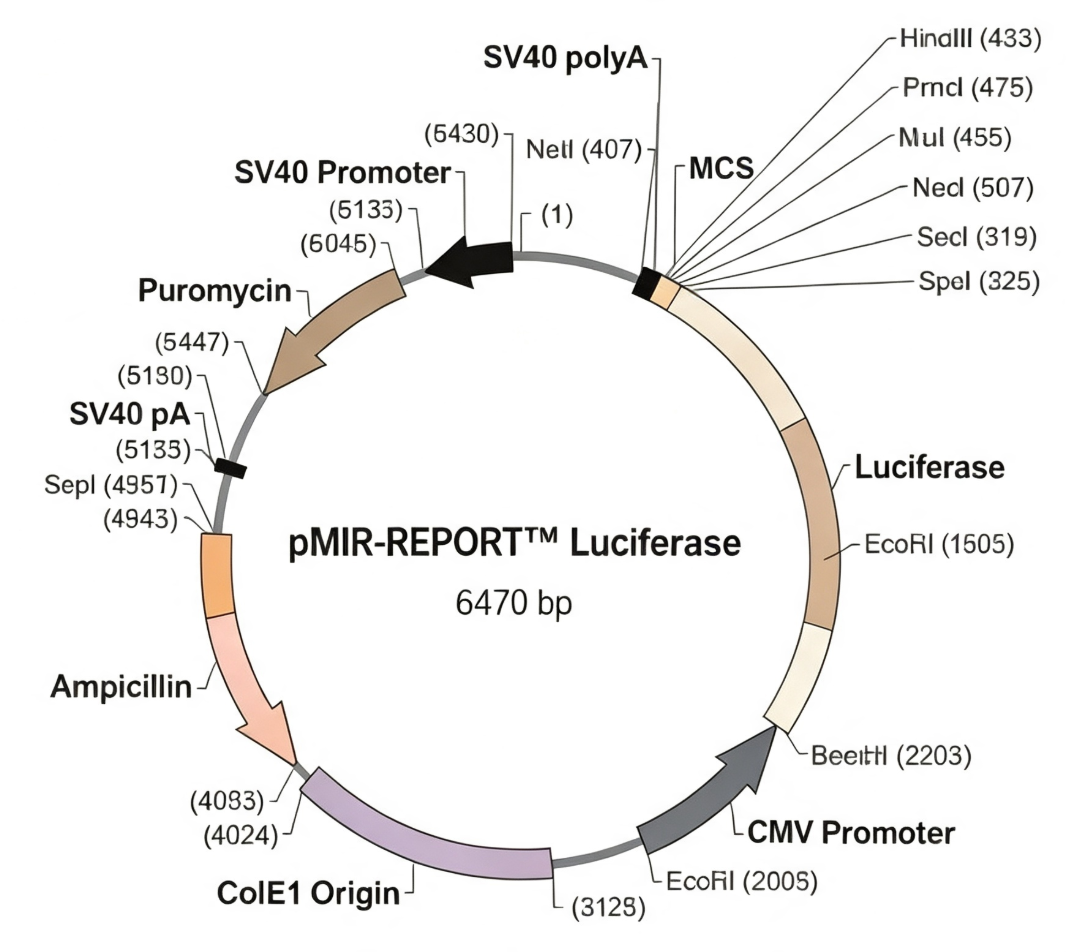
In experimental design, researchers co-transfect plasmids carrying the Renilla luciferase gene (such as pRL series vectors) with reporter gene plasmids into the same batch of cells. The constitutive promoter (e.g., CMV or TK promoter) drives the constant expression of Renilla luciferase, serving as an internal reference to measure transfection efficiency and cell number. The final detection results are presented as the ratio of "firefly luciferase activity value/Renilla luciferase activity value," effectively eliminating inter-well differences and making the data comparable across different experimental batches and treatment groups.
3. Core Application Areas of the Dual-Luciferase Reporter System
The dual-luciferase reporter system has broad application value in molecular biology research, primarily covering the following core areas.
In miRNA target gene validation, the 3'UTR sequence of the target mRNA is cloned into the 3'UTR region of the firefly luciferase reporter vector (e.g., pMIR-REPORT). After co-transfection with the miRNA expression vector, a significant decrease in luciferase activity indicates that the miRNA can recognize and inhibit the expression of the target gene through base pairing. This strategy can also be used to validate targeting interactions between miRNAs and lncRNAs.
In transcription factor and promoter regulation studies, transcription factor binding sites or full-length promoter sequences are inserted upstream of the luciferase reporter vector. By overexpressing transcription factors or drug treatments, the regulatory effects of transcription factors on promoter activity can be quantitatively assessed.
In signaling pathway activity analysis, downstream response elements (such as NF-κB response elements, cAMP response elements, hypoxia response elements, etc.) are inserted into the reporter vector. After transfection, stable cell lines are established, and changes in luciferase activity are used to monitor the activation and inhibition states of signaling pathways in real time.
Additionally, this technology can be applied to promoter structure analysis, functional evaluation of promoter single nucleotide polymorphisms (SNPs), and GPCR drug screening.
4. Key Experimental Procedures and Data Analysis
Taking the validation of Gene A as an miRNA target gene as an example, the experimental procedure typically includes the following steps: seed target cells in a 24-well plate, transfect miRNA mimics or inhibitors the next day, co-transfect the reporter gene plasmid (containing the target fragment) and internal reference plasmid on the third day, and perform dual-luciferase detection on the fourth day. In specific operations, each well is typically transfected with 300 ng of the reporter plasmid and 10 ng of the internal reference plasmid, using lipid transfection reagents in Opti-MEM medium. Fresh medium is replaced 6 hours after transfection, and cells are lysed with lysis buffer after 24 hours. The supernatant is centrifuged, and firefly luciferase substrate and Renilla luciferase substrate are added sequentially. The luminescence values are read using a microplate reader. For data processing, the ratio of firefly luciferase to Renilla luciferase is calculated for each well, normalized to the control group, and finally presented as relative luciferase activity in a bar chart.
5. Common Experimental Issues and Optimization Strategies
Since reporter gene detection results are highly sensitive to experimental conditions, researchers need to pay attention to the following key aspects. First, if the fluorescence value is too high, it can be resolved by reducing the plasmid transfection amount or diluting the supernatant after lysis, but the substrate concentration should not be reduced. Second, low fluorescence values are usually due to low transfection efficiency or substrate oxidation failure. Ensure plasmid DNA quality, use cells in the logarithmic growth phase, balance all reagents to room temperature before detection, and use the substrate immediately after dissolution. Third, large differences between replicates may be caused by pipetting errors, uneven lysis, or inconsistent cell growth states. It is recommended to set up three replicates per condition, centrifuge the supernatant after lysis to ensure uniformity, and calibrate pipettes regularly. Generally, differences within the same order of magnitude between replicates are acceptable.
6. Conclusion
The dual-luciferase reporter gene system, through the internal reference standardization design of firefly luciferase and Renilla luciferase, provides a precise, reliable, and widely applicable technical platform for gene expression regulation research. Proper experimental design, rigorous operational procedures, and reasonable optimization strategies will help researchers fully exploit the technical potential of this system to obtain biologically meaningful data conclusions. Based on this demand, UA-Glo® One-luc Luciferase Assay System is provided. This detection system has the following core features: optimized "glow-type" luminescence signals that can be maintained for several hours, providing a flexible time window for batch processing, especially suitable for high-throughput drug screening; high signal-to-noise ratio and low background enhance data reliability; a homogeneous "add-mix-detect" operation mode compatible with 96/384-well plates, requiring no separation or washing steps. This detection system is suitable for experimental scenarios such as miRNA target validation, promoter activity analysis, and signaling pathway screening.
This article is reviewed and published by the technical expert team of UA
Disclaimer: This article partially utilizes artificial intelligence assistance in its creation. If any content involves copyright or intellectual property issues, please let us know and we promise to verify and remove it as soon as possible.
Purchase recombinant protein, choose Nanjing UA-Bio
UA protein focuses on providing various protein reagents, raw materials, and services required for drug research and development, cell therapy, gene therapy, and basic scientific research, including drug target proteins, immune checkpoint proteins, cytokines, tool enzymes, customized protein expression, and full-length transmembrane protein development. Youai is committed to providing customers with high-quality products and professional services, and building a High-tech Biological Enterprise with International Competitiveness.
Target proteins | membrane proteins | cytokines | enzymes | viral antigens | protein customization
Nanjing UA Biotechnology Co., Ltd. Email:order@ua-bio.com Phone:+86-25-56221161

Product Information

Link:





©2021-2026 all rights reserved UA Biotechnology Co.,Ltd.
Privacy Policy 
网站备案号 浙ICP备2022019033号-2 浙公网安备33010202004867号
 Business license (three certificates in one)
 Tel:+86-25-56221161
E-mail:order@ua-bio.com
All products sold on this website shall not be used for clinical diagnosis or treatment of humans or animals, and shall only be used for non-medical purposes such as industrial or scientific research.
